 Kit Yates
Did you know
111111111 × 111111111 = 12345678987654321?
1/2
111111111 × 111111111 = 12345678987654321?
1/2
@PeteKirkham @geomannie @kityates TIL this number pattern from John Grant’s A Book of Numbers (1982).
I wonder if there is more (or less) to this than meets the eye, when compare with 11111 × 11111 = 123454321, etc?

@foldworks @PeteKirkham @geomannie @kityates It works in different bases:
(digits increasing from 1) * (base - 2) + (increasing digit from 1) = (digits decreasing from highest in base)
It's ... not well defined for base 2.

@storybead @PeteKirkham @geomannie @kityates
Using BASE and DECIMAL functions in LibreOffice for hexadecimal (before overflow). Took longer to do than I thought it would…
#mathematics #number #pattern #arithmetic #LibreOffice #LibreOfficeCalc
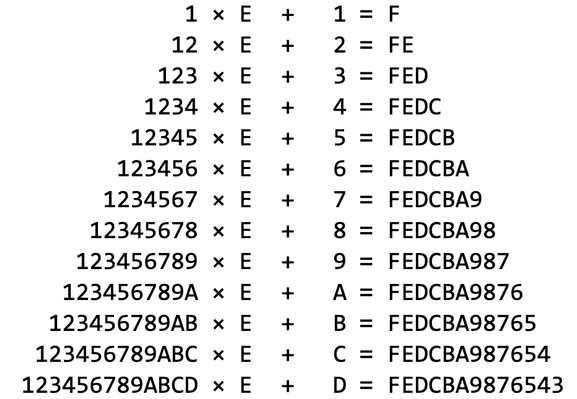
@foldworks @PeteKirkham @geomannie @kityates yep. I did the first few in octal, hex, and base 3. My partner, who really maths the math, came up with a better theorem and proof by induction of the general case.
base 2:
1 x 0 + 1 = 1
base 3:
1 x 1 + 1 = 2
12 x 1 + 2 = 21
I think it would be neat to try to visualize this in some 2 or 3 dimensional graphing space, but I don't know quite how to approach that.
@storybead @PeteKirkham @geomannie @kityates
I like the duodecimal version but didn't use X and E for 10 and 11 😀
Yeah, I wonder if there's some visualisation that could make clear what's going on

 Katja
Katja Bob Downie
 Pete Kirkham
 foldworks
 rowan {forest witch}