David G. Wells’ “The Penguin dictionary of curious and interesting…” books are excellent and have been great source of inspiration for me.

They are now are almost 30 years old.

What new entries would you put in these books—either because they’re new after publication, or could have (should have) been included at the time?

#mathematics #geometry #books #bookstodon #askfedi

Some suggestions for curious and interesting ‘Numbers’ based on personal knowledge (or ignorance). What would you add?

Sum of three palindromes (Javier Cilleruelo, Florian Luca and Lewis Baxter; try it at https://somethingorotherwhatever.com/sum-of-3-palindromes h/t @christianp)

Proof of Fermat's Last Theorem (Andrew Wiles)

Twin primes conjecture is still open, but there are infinitely many pairs of primes that differ by 246 (Yitang Zhang, James Maynard and Terence Tao @tao)

#mathematics #number #askfedi

The incredible palindromic hat-trick

Some suggestions for curious and interesting ‘Geometry’, more in my comfort zone but still plenty of ignorance 😊

What would you add?

Aperiodic monotile (Smith, Myers, Kaplan & Goodman-Strauss)

Noperthedron (Steininger & Yurkevich)

Progress in various packing problems (https://erich-friedman.github.io/packing/)

15 types of convex pentagonal tilings (Rao and others)

Solving cubics with origami (Beloch & Lill; see http://origametry.net/papers/amer.math.monthly.118.04.307-hull.pdf)

#mathematics #geometry #askfedi

Erich's Packing Center

Now for curious and interesting ‘Puzzles’.

What would you add?

Sudoku

Thinking / puzzle video games like Sokoban

Hmm, I like puzzles but my knowledge is a bit thin (and we no longer have a galvanising figure like Martin Gardner.)

#mathematics #puzzle #puzzles #askfedi

Now suggestions for curious and interesting ‘Mathematics’. This means strange facts, anecdotes, paradoxes, portraits of eccentric mathematicians, mathematical philosophy, quotes and mathematics education.

“The only way to learn mathematics is to do mathematics.” – Paul R. Halmos

“Mathematics is not about numbers, equations, computations, or algorithms: it is about understanding.” – William Paul Thurston

“The most exciting phrase to hear in science, the one that heralds new discoveries, is not ‘Eureka!’ but ‘That’s funny…’” — Isaac Asimov

“I used to think that maths teachers were all teaching the same subject, some doing it better than others. I now believe that there are *two effectively different subjects being taught under the same name, ‘mathematics’.*’

...‘relational understanding’ [means]… knowing both what to do and why. Instrumental understanding I would until recently not have regarded as understanding at all. It is what I have in the past described as ‘rules without reasons’, without realising that for many pupils *and their teachers* the possession of such a rule, and ability to use it, was what they meant by ‘understanding’.” Richard Skemp (https://atm.org.uk/write/MediaUploads/Journals/MT077/Relational_Understanding_and_Instrumental_Understanding_–_Richard_R._Skemp.pdf)

#mathematics #MathEd #MathsEd #iTeachMath #iTeachMaths #education #AskFedi #books #quote #quotes
@foldworks
"rules without reasons" - him not knowing the reasons doesn't mean there aren't any...

borrowing - is easy to prove why we have that rule

Invert and multiply - ditto

Change sides and sign - trivially easy to demonstrate the reason

He then makes a wrong assumption that teachers don't cover anything that isn't in the textbook - which is only an aid for the teacher - the SYLLABUS (not the textbook) says what is actually taught, and includes REASONING, so just a big strawman then 🙄

@SmartmanApps
It's worth read Skemp's articles as he describes the advantages of Instrumental Understanding as well as Relational Understanding.

Here's a link to the version published in The Arithmetic Teacher, 1978 https://teamone.msuurbanstem.org/wp-content/uploads/2014/07/Skemp-Relational-Instrumental-clean-copy-AT-1978.pdf

This work has been built on by others, including Jo Boaler.

#mathematics #ITeachMath #MathematicsEducation #MathEd #MathsEd

@foldworks
"Instrumental Understanding as well as Relational Understanding" - teachers already know the difference - it's part of a degree in teaching - and we call it ROTE learning vs. Constructivist learning. Again the issue is he made a wrong assumption, based on what was in textbooks, about teachers only ever using ROTE learning, instead of looking in a syllabus or actually asking them about it. We absolutely do teach the reasons for all the rules he claimed that we don't. It's a strawman.

@SmartmanApps
Skemp was writing about England in the 1970s.

However, even today, are all learners in all the world’s schools taught the reasons for all the rules, and use constructivist learning?

I’m not sure in fact that instrumental cf. relational understanding are direct analogies of rote cf. constructivist learning.

Perhaps a relevant analogy is atomised cf. connectionist learning, e.g. ‘Alternatives to atomisation’ by Colin Foster (2025), Mathematics Teaching 295 https://www.foster77.co.uk/Foster,%20Mathematics%20Teaching,%20Alternatives%20to%20atomisation.pdf and Teaching to Big Ideas https://www.youcubed.org/resource/teaching-to-big-ideas/

#mathematics #education #iTeachMath #MathematicsEducation #MathEd #MathsEd

@foldworks
"in the 1970s" - I know that. The reasons were being taught then. This isn't a change in modern education

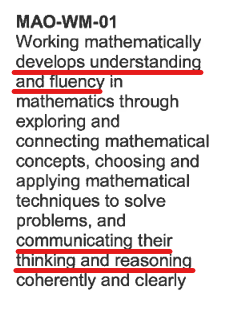
"are all learners in all the world’s schools taught the reasons for all the rules" - easy enough to look in the syllabus. Guaranteed you'll find the word "understanding" many times

"I’m not sure in fact that instrumental cf. relational understanding are direct analogies of rote cf. constructivist learning" - not teaching the reasons vs. teaching the reasons. Not complicated!