
@bioinformacion
#SMA20261 #MatemáticasAplicadas2025 #sciart ¿Sintiendo el pánico de las citas? 😱 ¡Acompáñame en esta historieta!
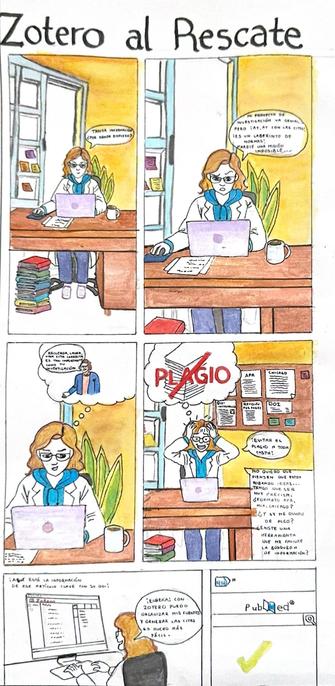
Se llama "Zotero al Rescate" y sigue a Laura en su lucha contra el "laberinto de normas" y el miedo al plagio. ¡Por suerte, Zotero y el DOI llegan al rescate!
@malu_vel @lma
#ElLaberintodelaRevisióndeLiteratura

¿Empezando una revisión de literatura en biociencias? ¡Es todo un reto! 🤯 A veces se siente como un laberinto de normas, tal como le pasó a Laura en nuestra historieta #ZoteroAlRescate. El objetivo del curso es justo eso: "buscar, recuperar, procesar, analizar y reusar literatura académica".
🔗https://docs.google.com/presentation/d/18hWijVYklLR76WyDM2fQYddNcSr7puRbA5kbufiR_vY

@malu_vel @lma

presentacion curso sma lmichan 20261

Seminario de Matemáticas Aplicadas a las Ciencias Físicas e Ingeniería: BIOinformación 2026-1 Layla Michán https://orcid.org/0000-0002-5798-662X 1 presentacion curso sma lmichan 20261

Google Docs

El primer pánico: ¿Cómo empiezo? ¿Qué leo primero? ¿Cómo evito el plagio? La presión es real. Antes de poder reportar (Unidad 5) , necesitas un plan sólido para tu revisión (Unidad 4).
🔗 https://docs.google.com/document/d/1xeykPYXNBeohvj96aosyRE-tnKbH7KjMJdQcRUfgV2M/edit?tab=t.0

@malu_vel @lma

bioinformacion para ciencias físicas e ingenieria 2026-1

Seminario de Matemáticas Aplicadas a las Ciencias Físicas e Ingeniería: Bioinformación UNIVERSIDAD NACIONAL AUTÓNOMA DE MÉXICO Denominación de la actividad académica: Bioinformación Clave: Semestre: Campo de conocimiento: Número de créditos: ...

Google Docs

Una buena revisión de literatura es un arte. No solo es una lista de resúmenes, es la base de tu investigación. Como dice Pautasso (2013), ¡hay reglas para hacerlo bien!🤓
- Pautasso, M. (2013). Ten simple rules for writing a literature review. PLOS Computational Biology, 9(7), e1003149. https://doi.org/10.1371/journal.pcbi.1003149

#RevisiónSistematica
@malu_vel @lma

Ten Simple Rules for Writing a Literature Review

Luego viene el "fantasma del plagio" 👻. La clave es el rigor. La "Unidad 5.4 Referencias y citas" no es un capricho, es la base de la ética científica. Hay que ser responsables con cómo usamos las fuentes.
🔗 https://docs.google.com/document/d/1xeykPYXNBeohvj96aosyRE-tnKbH7KjMJdQcRUfgV2M/edit?tab=t.0
@malu_vel @lma
bioinformacion para ciencias físicas e ingenieria 2026-1

Seminario de Matemáticas Aplicadas a las Ciencias Físicas e Ingeniería: Bioinformación UNIVERSIDAD NACIONAL AUTÓNOMA DE MÉXICO Denominación de la actividad académica: Bioinformación Clave: Semestre: Campo de conocimiento: Número de créditos: ...

Google Docs

Ser responsable con las referencias es una habilidad fundamental. Penders (2018) lo deja claro: ¡referenciar responsablemente es una regla de oro!

- Penders, B. (2018). Ten simple rules for responsible referencing. PLOS Computational Biology, 14(4), e1006036. https://doi.org/10.1371/journal.pcbi.1006036
@malu_vel @lma

Ten simple rules for responsible referencing

Por suerte, no estamos solos. Herramientas como Zotero, que usan "Metadatos", son nuestros aliados. Ayudan a "descongelar la biblioteca digital" y organizar el caos. ¡Justo como en nuestra historieta!

- Hull, D., Pettifer, S. R., & Kell, D. B. (2008). Defrosting the Digital Library: Bibliographic Tools for the Next Generation Web. PLOS Computational Biology, 4(10), e1000204. https://doi.org/10.1371/journal.pcbi.1000204

#Zotero #Bioinformática #FinDelHilo

@malu_vel @lma

Defrosting the Digital Library: Bibliographic Tools for the Next Generation Web

Many scientists now manage the bulk of their bibliographic information electronically, thereby organizing their publications and citation material from digital libraries. However, a library has been described as “thought in cold storage,” and unfortunately many digital libraries can be cold, impersonal, isolated, and inaccessible places. In this Review, we discuss the current chilly state of digital libraries for the computational biologist, including PubMed, IEEE Xplore, the ACM digital library, ISI Web of Knowledge, Scopus, Citeseer, arXiv, DBLP, and Google Scholar. We illustrate the current process of using these libraries with a typical workflow, and highlight problems with managing data and metadata using URIs. We then examine a range of new applications such as Zotero, Mendeley, Mekentosj Papers, MyNCBI, CiteULike, Connotea, and HubMed that exploit the Web to make these digital libraries more personal, sociable, integrated, and accessible places. We conclude with how these applications may begin to help achieve a digital defrost, and discuss some of the issues that will help or hinder this in terms of making libraries on the Web warmer places in the future, becoming resources that are considerably more useful to both humans and machines.