Last night I a wonderful #documentary about the #EditDroid - a non-linear video editor pre-dating the AVID/1 system in 1984. R&D was funded by George Lucas under his company, The Droid Works. Few folks are aware this even existed. I remember trying to research it maybe 20 years ago to no success. Since then many folks have uncovered various artifacts.

The documentary is on YouTube and is worth a watch if you like these types of historical, #retrocomputing deep dives.

https://www.youtube.com/watch?v=t887NRtAw9o

EditDroid Rise and fall 1080p

YouTube

The system used an array of #Laserdiscs to store raw film footage. The players were linked to a control box that was controlled by a SUN Microsystems computer that allowed you to recall footage, make an edit decision list, it kept track of film frame numbers, and had many advanced features that allowed a classical film editor to use the system.

It interfaced with a jog shuttle knob to control the video.

Some footage of the #EditDroid at the NAB conference:

https://www.youtube.com/watch?v=27hVFq2RB1w&themeRefresh=1

Editdroid NAB 2

YouTube

A few years ago a lucky #LaserDisc hunter bought a laserdisc that was used as a demonstration of the #EditDroid system that contained 30 minutes of unedited Return of the Jedi footage.

The footage has since been uploaded to YouTube as well and is a great example of modern lost media. There exists today film, media, and audio that may exist on LaserDisc or VHS but has never been remastered or re-released otherwise. Some folks go around hunting those down as a hobby.

https://www.theverge.com/2013/10/27/5035596/lost-return-of-the-jedi-footage-discovered-on-699-laserdisc

Lost ‘Return of the Jedi’ footage discovered on $699 LaserDisc

The Verge

The #EditDroid worked! It was used on a number of productions and was eventually displaced by the Avid/1 NLE system that had the new, superior approach of digitized video on hard drives vs. laserdiscs. Avid bought the EditDroid system from Droid Works and integrated many of its patents and technologies into their system.

I love this kind of retro computing history. It was a system way ahead of its time, like the Pixar Image Computer, had a short life, and relatively few details exist today.

Someone uploaded a high-resolution copy of the original #EditDroid brochure:

http://typewritten.org/Articles/DroidWorks/ed-485.pdf

A Frequently Asked Questions document on The Droid Works letterhead:

http://typewritten.org/Articles/DroidWorks/qa-485.pdf

As well as a SoundDroid non-linear sound editing brochure, which apparently was developed first before they included video in the design.

http://typewritten.org/Articles/DroidWorks/sd-485.pdf

Very interesting history! I recommend folks go deep dive into this. I’ve literally been researching this topic for over 20 years.

What I love about this bit of history is that it means the first non-linear video editing system was done on a #Sun-1 computer running #SunOS.

#SunMicrosystems #retrocomputing #EditDroid #Unix #BSD

@occult Likely so, although it mentions 68010 so Sun-2 CPU and the Sun 2 systems were out in 1984.
@hairyvisionary I stand corrected! The sources I found state it was a Sun-1 but I trust your timeline.
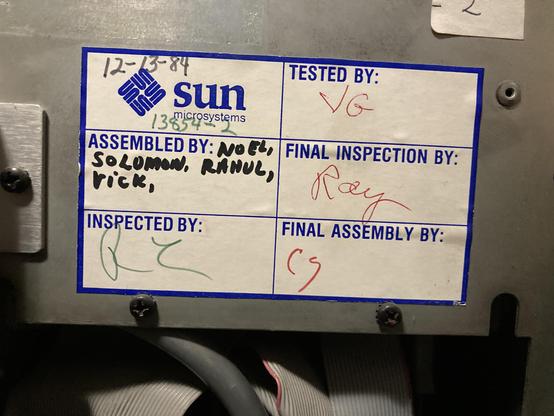
@occult Could have been late 1984, pic is from a Sun 2/120, still Multibus

@hairyvisionary Sadly, in the documentary they discuss how there are no preserved EditDroid systems, and they were most likely junked.

Would be an epic museum installation.

@occult Keeping the Sun running would likely be the easy part!