@MikeDunnAuthor

The anti-capitalist argument ought to be to draw a distinction between consent to delegate and consent to alienate. The latter is invalid as David Ellerman argues. The usual leftist argument that capitalist employment is coercive just isn’t persuasive.

@jlou

Isn't persuasive mostly because we've been so heavily propagandized all our lives.

True, everyone has the right to refuse employment if they don't like the conditions, just like everyone has equal right to sleep under the bridge (or not, depending on local laws).

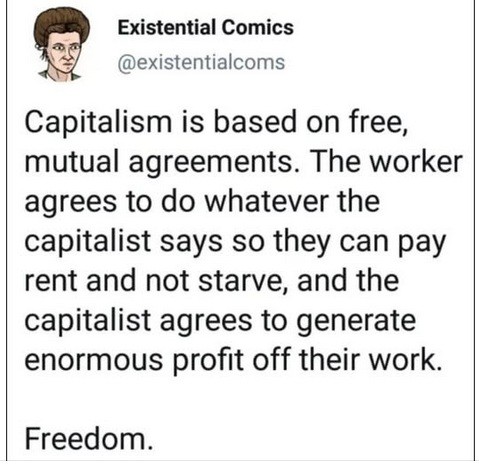
But because the consequence of refusing that job and all others that don't meet our basic needs is homelessness and starvation, we are compelled to accept jobs that don't meet our basic needs. That is coercive.

@MikeDunnAuthor

Refusing to purchase groceries can also lead to starvation, but surely contracts to purchase groceries are acceptable. The critique has to pick out something that differentiates the employer-employee contract from other contracts. The consent vs. coercion distinction applies to most contracts and isn’t unique to employment.

Source: https://youtu.be/UQxvAjFSlCw

David Ellerman: Abolish Human Rentals | [wage slavery]

YouTube

@jlou I do not unconditionally approve of contracts to purchase groceries, especially if all the groceries are provided by one producer such that you can only starve if you don't buy from it.

Consent goes as far as the outside option goes. If the outside option is death, consent is meaningless.

@MikeDunnAuthor

@magitweeter @MikeDunnAuthor

I agree, but that is a criticism of monopolies not of capitalism per se. Many pro-capitalist thinkers are anti-monopolist. The anti-monopolist argument, by itself, doesn’t philosophically justify abolishing capitalism. The alternative to any particular employment contract isn’t death because there are multiple employers.

To rule out capitalism decisively, the argument must be that employment itself inherently violates workers’ inalienable human rights

@jlou I am skeptical by default of arguments that rely on human rights, because it takes a state to enforce rights. To make an argument against employment from human rights is to argue that the state should ban employment. And that's an absurdity. States are value-extraction machines, and it will never be in their interest to ban the institutions that enable value extraction.

@MikeDunnAuthor

@magitweeter @MikeDunnAuthor

Human rights don’t need a state. Human rights are a moral concept. How they ought to be protected is another question altogether.

Construing the employment contract’s abolition as a ban is misunderstanding the situation. The state’s legal system is the one that creates the employment contract. There are no factual transfers of possession that correspond to the legal transfers of property in an employment contract. Abolishing the employment contract is liberating.

@jlou Rights look good on paper, but the argument is not complete without the matter of enforcement. I don't oppose capitalism out of an abstract commitment to human rights. I oppose capitalism because it makes people's lives worse.

Employment contracts are no more, no less state-enforced than any other kind of contract. I don't get that part.

@magitweeter

Making peoples’ lives worse = violating peoples’ rights and/or reducing their freedom

The state enforces the employers’ ownership of the firm’s whole product despite the whole product being in the workers’ de facto possession and control rather than labor being in the employer’s de facto possession. This is a mismatch between contractual and factual transfers. Here, the state enforces a contract as if it had been fulfilled despite it being unfulfillable even in principle.

@jlou That's a silly idea. The US constitution recognizes a right to bear arms. It is the existence of the right, not its violation, that makes people's lives worse, through unfettered gun violence.

@magitweeter

Gun violence violates people’s right to life. What constitutes making people’s lives worse depends on the moral framework.

@jlou Yes, which is why basing opposition to capitalism on human rights is a silly idea. Someone's rights are always being trampled one way or the other.

@magitweeter

I don’t see how people’s moral rights are necessarily being trampled always.

You’re conflating the state’s system of rights with moral rights. The two concepts are different.

@jlou “Moral rights” are the very thing the existence of which i'm questioning when i say rights have to be enforced by the state.

@magitweeter

The state can violate people’s rights and it does so quite frequently. Anti-state arguments often appeal to rights arguments based on lack of consent to the social contract to delegitimize the state.

Well, I just don’t see why you believe that rights have to be enforced by the state. If I protect someone from violence, surely, I’ve protected their rights, but I’m not the state. Moral rights can fail to be enforced, and still be valid.

@jlou The concept of consent is not based on rights, to the best of my understanding. To argue from consent is not to argue from rights.
@magitweeter This is incorrect. Of course, consent is based on rights. Consent is about alienable rights. By consenting you give another party the right to do something you’ve got the alienable right to do.
@jlou Consent is about power. It is to forgo opposition to what you could oppose. A violation of consent occurs when you're denied the power to meaningfully oppose. Rights are not involved in it.

@magitweeter

what you could oppose = you have a right to overrule

Consent is a consideration from rights-based deontological ethics. The Stanford encyclopedia of philosophy defines rights as:

“Rights are entitlements (not) to perform certain actions, or (not) to be in certain states; or entitlements that others (not) perform certain actions or (not) be in certain states.”

https://plato.stanford.edu/entries/rights/

#deontology #deontoloigical #ethics #philosophy

Rights (Stanford Encyclopedia of Philosophy)

@jlou Sure, you can frame it like that, but all you're doing is defining rights in terms of consent. There's no particular reason why rights should be the primitive notion and consent the derived notion, instead of the opposite.

@magitweeter

What would it mean for consent to be primitive here?
Rights aren’t a primitive notion. They’re always derived from moral principles. Also, there are rights that are non-transferable even with consent, so consent doesn’t capture all rights.

In metaethics, there are 3 types of ethical theories: rights-based/deontological, consequentialist and virtue ethics. Consent is from the rights-based/deontological tradition. There is no consent-focused ethical theory that isn’t rights-based.

@jlou “Consent is primitive” in this context means that the notion of a right is defined in terms of consent. For example, “one has a right to X if one's absence of consent for not-X compels others not to deprive one of X” is a definition of rights in terms of consent.

(It is an objectionable definition, but i'm just giving an example)

One could then define consent in terms of further primitive notions, or take consent itself as a primitive.

@magitweeter

Yeah I don’t see how this isn’t a rights-based system as it has a conception of rights. Rights aren’t primitive. The primitive notion is moral principles. Rights are established with a moral argument from these moral principles.

Rights can be violated though. The existence of a right doesn’t necessarily compel anything from immoral or amoral actors. This suggestion doesn’t seem to handle inalienable rights, which are rights that can’t be given up or transferred even with consent.

@magitweeter Perhaps, it would help to consider ethical systems that don’t directly care about consent like consequentialist systems to better grasp what rights-based ethical systems are through contrast with the alternative. A consequentialist seeks to maximize some measure of moral goodness or value across all agents and potentially moral patients. One example is hedonic utilitarianism, which seeks to maximize happiness and reduce suffering.
@jlou That the notion of a right is definable within the system doesn't make it “rights-based”. It is consent-based because consent is the primary focus. One could forget about “rights” and the system would lead to the same material conclusions. You can frame it as a matter of “rights”, but that makes no essential difference.

@magitweeter

Yeah it does. Non-rights-based ethical systems like consequentialism have no concept of rights whatsoever.

The ethical system I advocate derives the rights it argues for from moral principles. You could just as easily call it responsibility-based because it centers personal responsibility. It would lead to the same conclusion regardless of whether you emphasize rights or responsibility principles.

@jlou I think you're confused. Consequentialism is not only compatible with a theory of rights, it can even be based on rights. In consequentialism, too, rights can be defined downstream of consequences (“it's better for people to have these rights”) or vice versa (“the better outcome is the one where rights are less violated”).

@magitweeter

Those are legal or institutional rights not moral ones, which is what I meant. These arguments claim having a certain set of institutional/legal rights enforced leads to better consequences such as increased happiness. With rights-based, I mean deontological ethics. I used this because it seemed more intuitive. Consent is a deontological paradigm. Committed consequentialists override consent if it leads to better consequences.

Neither of us seems to believe rights are primitive.

@jlou “Rights-based” is a misleading way to describe deontology. Deontology is often duty-based: rights can be defined downstream from duties, as what others have the duty not to infringe. What appears as a “right” is a matter of framing, not necessarily the core ethical concept. Structurally, rights and duties are dual to each other.
@jlou More to the point: if i adopt a moral framework without inalienable rights, that's a loss to your argument, not mine. My argument against capitalism follows from consent, not inalienable rights.

@magitweeter

A deontological theory without inalienable rights would have a hard time criticizing self-sale contracts, non-democratic governance and coverture marriage contracts. It would be hard to critique capitalism because you’d have no objection to workers selling their voting rights in firms and any organization to the highest bidder.

Workers consent to the employment contract with their particular employer. Labor monopsony is solvable with unionization like capitalist Nordic countries.

@jlou Under the gold standard for consent, it is specific, informed and reversible. Self-sale and coverture require one to unconditionally give away all rights forever: not specific, informed or reversible. They cannot be validly consented to.

Even supposing the argument against the sale of voting rights failed, it is only concentration of power that creates the mutual incentives for such a sale. Economic egalitarianism = the sale ceases to be mutually beneficial even if morally permissible.

@magitweeter

In a self-sale contract, you relinquish your labor rights for your working lifetime but retain your right to life, etc. Irreversibility isn’t unique to self-sale contracts. For instance, transferring material property is also irreversible, as the purchaser can transform it or refuse to sell it back. This argument doesn’t rule out self-sale in all cases. After a self-sale, the person can still buy themselves back. Inalienable rights actually rule out these abhorrent contracts.

@magitweeter

There are still incentives to engage in voting rights transfers, even in egalitarian circumstances, as a risk reduction through diversification strategy or because the seller doesn’t get much value out of their individual voting rights. Even if you start out egalitarian, without inalienability, rights will eventually concentrate and accumulate resulting in an inegalitarian situation. The only way to truly prevent an inegalitarian situation is non-transferability of rights.

@jlou Of course there would still be incentives, but not mutually beneficial ones. Under egalitarianism, no seller would be willing to sell at any price point that any buyer were willing to pay. This is all assuming no circumstances invalidating consent (fraud, coercion, obfuscation, overreach).

@magitweeter

Of course there would be mutually beneficial incentives. I buy your voting rights and you get paid. Seems mutually beneficial to me.

Do you have any evidence to support the claim that no buyer would be able to afford any sellers price? That’s a pretty strong claim.

@jlou Social aversion to concentration of power.

When you start buying votes, that draws skeptical looks. Other people's voting rights have a social cost that no one's willing to pay.

If you don't have inbuilt social mechanisms against the concentration of power, if political power is just another commodity that can be bought and sold without raising eyebrows, you don't have an economically egalitarian society.

@magitweeter

Why would there be a social aversion if there is nothing morally wrong with selling voting rights?

“If you don't have inbuilt social mechanisms against the concentration of power, if political power is just another commodity that can be bought and sold without raising eyebrows, you don't have an economically egalitarian society.”

Exactly, inalienable rights are essential to economic egalitarianism.

@jlou Why wouldn't there be a social aversion even if there is nothing morally wrong with selling voting rights? Breaches of etiquette are morally fine yet socially skeevy. Social norms are not the same thing as morality.

@magitweeter

I’ll concede that violations of social etiquette constitute social aversion. However, there are problems that make this limited in its effectiveness at preserving egalitarianism.

1. Social etiquette violations don’t merit as strong of a response as moral rights’ violation.
2. Social etiquettes are difficult to preserve in the presence of strong economic incentives for breaking them.
3. What is economically incentivized transforms culture.

@jlou Reversibility is part of the gold standard but not an absolute requirement. Consent for surgery, say, is obviously not reversible, but it compensates by being thoroughly specific and informed.

«After a self-sale, the person can still buy themselves back» This misunderstands reversibility. Withdrawal of consent is enough to impose on the counterpart a duty of restitution. Merely the opportunity to “buy yourself back” does not entail reversibility.

@magitweeter

Yeah, withdrawing consent from the self-sale would be a breach of contract and would be allowed with liability for breaching.

Without a theory of inalienable self-determination, I don’t see how selling labor by the lifetime is different from selling property. Labor is specific. Inalienability of labor is what demonstrates the moral invalidity of this contract. If you discard that, there doesn’t seem to be a strong objection from a deontological perspective.

@jlou “allowed with liability for breaching” = not reversible.

“Labor” is not specific enough. Get hired for a specific set of tasks for a specific term, and then it starts getting specific enough. What is the expected output, what are the risks, how are they managed? That's closer to specific and informed.

“Anything i want you to do for the rest of your life” can't be validly consented to.

@magitweeter

Today’s marriage contracts have similarly complex termination procedures. You can lose half of your assets potentially in a divorce, yet marriage is consensual. I don’t think your argument works in all conceivable cases against self-sale.

The inalienable rights case against self-sale explains what’s special about it and employment that makes them wrong. Inalienable rights were also used in the feminist movement to argue against unjust marriage contracts like coverture marriage

@jlou Marriage has a termination procedure. Self-sale as you're describing it has only breach-of-contract impositions. They are not equally reversible.

The more you try to paint self-sale as “reversible”, the more it resembles just a very general long-term labor contract, the less “abhorrent” it appears and the less you have a case for inalienable rights.

@magitweeter

Breach of contract is a termination procedure.

A contract where the master gets 100% of the positive and negative fruits of your labor for life is abhorrent.

I haven’t even made the case for inalienable rights yet in this discussion.

You’ve conceded that wage labor contracts aren’t objectionable on consent grounds, which is the point I’m making. Consent vs. coercion is not the right way to critique the employment contract and capitalism.

@jlou That's because the problem with capitalism isn't the employment contract, it's the concentration of power that drives consent invalid.

@jlou «Workers consent to the employment contract» It's not valid consent because it is not freely given (the outside option is catastrophic).

«Labor monopsony is solvable with unionization like capitalist Nordic countries» I would hardly call that a solution. The Nordic model both depends on vast material inputs from the global south and is vulnerable to regulatory capture.

@magitweeter

The outside option isn’t starving. It’s working for another employer other than the one giving you the deal.

This just doesn’t seem to necessarily have anti-capitalist implications. Regulatory capture is a problem that can happen in any system. Even in a perfectly democratic system, there is the possibility of a 51% attack. I’m pointing out that the imbalance between labor and capital in the Nordic countries is less not their particular standard of living.

@jlou Then it's not meaningful consent because (by concentration of power) all employers offer essentially the same conditions. A versus A is not a meaningful choice.

Regulatory capture is not a thing under consent because you can't just force people to do what you want, nor fool them into agreeing to do what you want. The only way to capture institutional power is to breach consent and invite retaliation.

@magitweeter

Going back to the grocery analogy, your dollar can only buy so many groceries. Does that mean grocery purchases are non-consensual?

As long as there are no inalienable rights, regulatory capture is inevitable. Interest groups can and inevitably will buy out people’s voting rights and exercise them in their own interests.

@jlou In the general sense, of course not. There is meaningful choice in what groceries you get, or even whether you get groceries at all instead of paying for a meal.

In another sense, under capitalism, it isn't for most people, because they have no meaningful alternative to paying for food. Commons-based alternatives such as community food gardens mitigate this to an extent, but those can only go so far until you're no longer doing capitalism.

@magitweeter

Not all jobs are the same just like groceries. My point is that employment and grocery store purchases are on a similar footing when it comes to consent. In some cases, labor contracts are even collectively bargained.

Not having an alternative to paying for groceries is not a serious argument. Obviously, everyone would prefer to get things without paying. It isn’t a violation of consent to have to pay. That just makes things mutually beneficial.

@jlou Growing it, hunting it, foraging for it, herding it, trading for it. All alternatives to paying for food from a wage that may be preferable to it but not “obviously” so. All of them unavailable to the vast majority of members of a capitalist society.

@magitweeter Hunting is morally wrong.

Trading for it is already possible under capitalism.

Growing food can be made more accessible while preserving capitalism through Georgist capitalism with UBI.

I’ve always thought that a capitalist ideologue could totally buy the lack of consent argument from mainstream socialist thought and resolve it by supporting a UBI. What would be the coercion-based argument against capitalism with a UBI?

@jlou Trading is possible, but beyond the access of much of the population who don't have the tools to craft their own wares.

How is the UBI paid for?