TOPIC> The Moon

2025 July 20

Lunar Nearside
* Image Credit: NASA / GSFC / Arizona State Univ. / Lunar Reconnaissance Orbiter
https://www.nasa.gov/
https://www.gsfc.nasa.gov/
https://lroc.sese.asu.edu/index.html

Explanation:
About 1,300 images from the Lunar Reconnaissance Orbiter spacecraft's wide angle camera were used to compose this spectacular view of a familiar face - the lunar nearside. But why is there a lunar nearside? The Moon rotates on its axis and orbits the Earth at the same rate, about once every 28 days. Tidally locked in this configuration, the synchronous rotation always keeps one side, the nearside, facing Earth. As a result, featured in remarkable detail in the full resolution mosaic, the smooth, dark, lunar maria (actually lava-flooded impact basins), and rugged highlands, are well-known to earthbound skygazers. To find your favorite mare or large crater, just follow this link or slide your cursor over the picture. The LRO images used to construct the mosaic were recorded over a two week period in December 2010.
https://lroc.im-ldi.com/visit/exhibits/1/gallery/17

https://apod.nasa.gov/apod/ap250720.html

#space #moon #astrophotography #photography #science #astronomy #nature #NASA #ESA #education

2025 June 28

Lunar Farside
* Image Credit: NASA / GSFC / Arizona State Univ. / Lunar Reconnaissance Orbiter
https://www.nasa.gov/
https://www.gsfc.nasa.gov/
https://lroc.sese.asu.edu/index.html

Explanation:
Tidally locked in synchronous rotation, the Moon always presents its familiar nearside to denizens of planet Earth. From lunar orbit, the Moon's farside can become familiar, though. In fact this sharp picture, a mosaic from the Lunar Reconnaissance Orbiter's wide angle camera, is centered on the lunar farside. Part of a global mosaic of over 15,000 images acquired between November 2009 and February 2011, the highest resolution version shows features at a scale of 100 meters per pixel. Surprisingly, the rough and battered surface of the farside looks very different from the nearside covered with smooth dark lunar maria. A likely explanation is that the farside crust is thicker, making it harder for molten material from the interior to flow to the surface and form dark, smooth maria.

https://apod.nasa.gov/apod/ap250628.html

#space #moon #astrophotography #photography #science #astronomy #nature #NASA #ESA #education

Tidal locking

results in the Moon rotating about its axis in about the same time it takes to orbit the Earth. Except for libration effects, this results in it keeping the same face turned towards the Earth, as seen in the figure on the upper left. (The Moon is shown in polar view, and is not drawn to scale.)

+ Upper left:
> If the Moon didn't spin at all, then it would alternately show its near and far sides to the Earth while moving around our planet in orbit.

+ Upper right:
> If rotational frequency is larger than orbital frequency, a small torque counteracting the rotation arises, eventually locking the frequencies (situation depicted in green)

+ Down left:
> A simulation shows the variability in the portion of the Moon visible from Earth due to libration over the course of an orbit. Lighting phases from the Sun are not included.

+ Down right:
> Animation of the Moon as it cycles through its phases. The apparent wobbling of the Moon is known as libration

From Wikipedia, the free encyclopedia

CREDITS
Contributors to Wikimedia projects
* Stigmatella aurantiaca
* Jim McKeeth
* Tom Ruen
* Poopooman-ger

#space #moon #astrophotography #photography #science #astronomy #nature #NASA #ESA #education

Orbit the Moon! - LROC WAC Global Mosaic and DTM

The Lunar Reconnaissance Orbiter Camera (LROC) WAC is a push-frame camera that captures seven color bands (321, 360, 415, 566, 604, 643, and 689 nm) with a 57-km swath (105-km swath in monochrome mode) from a 50 km orbit. One of the primary objectives of LROC is to provide a global 100 m/pixel monochrome (643 nm) base map with incidence angles between 55°-70° at the equator, lighting that is favorable for morphological interpretations. Each month, the WAC provides nearly complete coverage of the Moon under unique lighting. As an added bonus, the orbit-to-orbit image overlap provides stereo coverage. Reducing all these stereo images into a global topographic map is a big job, and is being led by LROC Team Members from the German Aerospace Center (Deutsches Zentrum für Luft- und Raumfahrt; DLR). Several preliminary WAC topographic products have appeared in LROC featured images (Orientale basin, Sinus Iridum). For a sneak preview of the WAC global DEM with the WAC global mosaic, view a rotating composite Moon (Full Res).

The global mosaic comprised of over 15,000 WAC images acquired between November 2009 and February 2011. The non-polar images were map projected onto the GLD100 shape model (WAC derived 100 m/pixel DTM), while polar images were map projected on the LOLA shape model. In addition, the LOLA derived crossover corrected ephemeris, and improved camera pointing, provide accurate positioning (100 m) of each WAC image.

CREDIT
LROC
WAC
DLR

https://lroc.im-ldi.com/images/298

#space #moon #astrophotography #photography #science #astronomy #nature #NASA #ESA #education

@staff

"I'm sorry for you Mastodon users due to insufficiently configured software on your server side you unfortunately only see a third of the displayed images. I can expressly recommend the platform defcon.social to scientifically and creatively interested and committed users of the Fediverse."

Moon Phases

In our entire solar system, the only object that shines with its own light is the Sun. That light always beams onto Earth and Moon from the direction of the Sun, illuminating half of our planet in its orbit and reflecting off the surface of the Moon to create moonlight. Sometimes the entire face of the Moon glows brightly. Other times we see only a thin crescent of light. Sometimes the Moon seems to disappear. These shifts are called moon phases.

The eight lunar phases are, in order: new moon, waxing crescent, first quarter, waxing gibbous, full moon, waning gibbous, third quarter, and waning crescent. The cycle repeats about once a month (every 29.5 days).

Like Earth, the Moon has a day side and a night side, which change as the Moon rotates. The Sun always illuminates half of the Moon while the other half remains dark, but how much we are able to see of that illuminated half changes as the Moon travels through its orbit.

Images:
1.
Position of the Moon and the Sun during each of the Moon’s phases

2. - 9.
All Moon Phases
Let’s take a look at the individual phases, and how the movements of the Moon and Sun appear to us as we watch from the Northern Hemisphere on Earth.

10.
Overview From Space
The Moon orbits Earth from a viewpoint above the North Pole in this animation. The blue gridlines show how the same side of the Moon always faces Earth. The size of the Earth and Moon are enlarged 20 times.

CREDITS:
* NASA's Scientific Visualization Studio
* NASA/JPL-Caltech

@support

https://science.nasa.gov/moon/moon-phases/

#space #moon #astrophotography #photography #science #astronomy #nature #NASA #ESA #education #fediverse #mastodon #defconsocial

"Hello my dear moon addicts, I hope you enjoy this year's moon phases as much as I do. The best thing to do is to put on headphones, adopt a comfortable posture and a chilled drink would also be the order of the day, enjoy!"

This wonderful visualization shows the Moon's phase and libration at hourly intervals throughout 2025, as viewed from the Northern Hemisphere. Each frame represents one hour. In addition, this visualization shows the Moon's orbit position, sub-Earth and subsolar points, and distance from the Earth at true scale. Craters near the terminator are labeled, as are Apollo landing sites, maria, and other albedo features in sunlight.
https://svs.gsfc.nasa.gov/5415


* Video credit:
NASA’s Goddard Space Flight Center
* Data visualization by: Ernie Wright (USRA)
* Producer & Editor: James Tralie
* Music Provided by Universal Production Music: "Shine a Light," "Space and Time," and "Spiralling Stars" by Timothy James Cornick

#space #moon #astrophotography #photography #science #astronomy #nature #NASA #ESA #education

The main Moon phases

Diagram of the main lunar phases. With the Sun assumed to be far off to the right, the inner circle shows the positions of the Moon as seen from above Earth’s North Pole that correspond to the phases of the Moon that we see from Earth as shown on the outer circle.

When the Moon is in other different positions in its orbit around Earth, it will appear as a crescent and other partial shapes. As the Moon shifts from new Moon to full Moon — as it moves to where we can see more of the part brightened by the Sun — we say the Moon is waxing. During the other half of the time, when the Moon is passing from full Moon to new Moon, we say the Moon is waning.

There can also be “supermoons”. Because the Moon’s orbit is slightly oblong instead of a perfect circle, there are times when the Moon is closer to Earth than usual and appears larger in the sky. When that also coincides with full Moon or new Moon, it’s called a supermoon. A supermoon will look slightly larger than normal, but the change is not big enough to be obvious to the naked eye.

CREDIT
NASA

https://www.planetary.org/space-images/the-main-moon-phases

#space #moon #astrophotography #photography #science #astronomy #nature #NASA #ESA #education

Lunar eclipse
A lunar eclipse is an astronomical event that occurs when the Moon moves into the Earth's shadow, causing the Moon to be darkened. Such an alignment occurs during an eclipse season, approximately every six months, during the full moon phase, when the Moon's orbital plane is closest to the plane of the Earth's orbit.

This can occur only when the Sun, Earth, and Moon are exactly or very closely aligned (in syzygy) with Earth between the other two, which can happen only on the night of a full moon when the Moon is near either lunar node. The type and length of a lunar eclipse depend on the Moon's proximity to the lunar node.

When the Moon is totally eclipsed by the Earth (a "deep eclipse"), it takes on a reddish color that is caused by the planet when it completely blocks direct sunlight from reaching the Moon's surface, as the only light that is reflected from the lunar surface is what has been refracted by the Earth's atmosphere. This light appears reddish due to the Rayleigh scattering of blue light, the same reason sunrises and sunsets are more orange than during the day.

Unlike a solar eclipse, which can only be viewed from a relatively small area of the world, a lunar eclipse may be viewed from anywhere on the night side of Earth. A total lunar eclipse can last up to nearly two hours (while a total solar eclipse lasts only a few minutes at any given place) because the Moon's shadow is smaller. Also unlike solar eclipses, lunar eclipses are safe to view without any eye protection or special precautions.

TEXT
From Wikipedia, the free encyclopedia

VIDEO
Lunar Eclipse Essentials

Explainer Video about Lunar Eclipses
Updated April 22, 2022
Credit
* Scientific Visualization Studio/NASA
* Goddard Space Flight Center.
* Lead Producer: Chris Smith.
* Lead Visualizer: Ernie Wright.
* Producer: David Ladd.
* Technical Support: Aaron Lepsch.

#space #moon #astrophotography #photography #science #astronomy #nature #NASA #ESA #education

2025 August 30

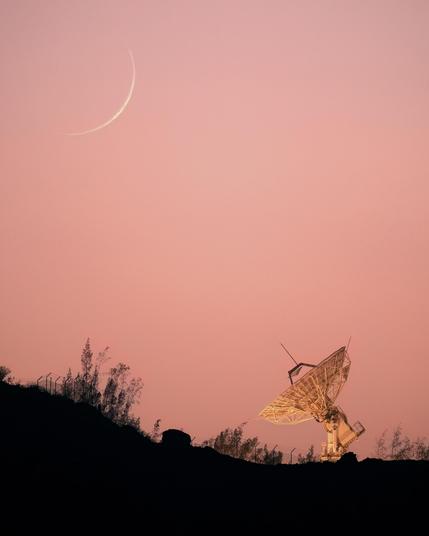
A Two Percent Moon
* Image Credit & Copyright: Marina Prol
https://www.marinaprol.com/

Explanation:
A young crescent moon can be hard to see. That's because when the Moon shows it's crescent phase (young or old) it can never be far from the Sun in planet Earth's sky. And even though the sky is still bright, a slender sunlit lunar crescent is cleary visible in this early evening skyscape. The telephoto snapshot was captured on August 24, with the Moon very near the western horizon at sunset. Seen in a narrow crescent phase about 1.5 days old, the visible sunlit portion is a mere two percent of the surface of the Moon's familiar nearside. At the Canary Islands Space Centre, a steerable radio dish for communication with spacecraft is titled in the direction of the two percent Moon. The sunset sky's pastel pinkish coloring is partly due to fine sand and dust from the Sahara Desert blown by the prevailing winds.
https://svs.gsfc.nasa.gov/5415/
https://science.nasa.gov/skywatching/
https://apod.nasa.gov/apod/ap080411.html

https://apod.nasa.gov/apod/ap250830.html

#space #moon #astrophotography #photography #science #astronomy #nature #NASA #ESA #education

Visualization of total lunar eclipse viewed from the moon.
(converted to GIF with ffmpeg)

With the lunar horizon in the foreground, the Earth passes in front of the Sun, revealing the red ring of sunrises and sunsets along the limb of the Earth. The Earth and Sun are in Virgo for observers on the Moon. The bright star above them is beta Virginis.

On September 28, 2015 Universal Time (the evening of the 27th for the Americas), the Moon enters the Earth’s shadow, creating a total lunar eclipse. When viewed from the Moon, as in this animation, the Earth hides the Sun. A red ring, the sum of all Earth’s sunrises and sunsets, lines the Earth’s limb and casts a ruddy light on the lunar landscape. With the darkness of the eclipse, the stars come out.

The city lights of North and South America and of western Europe and Africa are visible on the night side of the Earth. The part of the Earth visible in this animation is the part where the lunar eclipse can be seen.

Credits:
NASA's Scientific Visualization Studio
* Visualizer: Ernie Wright (USRA)
* Producers: David Ladd (USRA)
Michelle Handleman (USRA)
* Scientists: John Keller (NASA/GSFC)
Noah Petro (NASA/GSFC)

https://svs.gsfc.nasa.gov/4341

FYI: https://defcon.social/@grobi/114893280006806716

#space #moon #astrophotography #photography #science #astronomy #nature #NASA #ESA #education

2025 September 11

The Umbra of Earth
* Image Credit & Copyright: Wang Letian (Eyes at Night)
http://www.luckwlt.com/About%20Me.html
http://www.luckwlt.com/

Explanation:
The dark, inner shadow of planet Earth is called the umbra. Shaped like a cone extending into space, it has a circular cross section most easily seen during a lunar eclipse. And on the night of September 7/8 the Full Moon passed near the center of Earth's umbral cone, entertaining eclipse watchers around much of our fair planet, including parts of Antarctica, Australia, Asia, Europe, and Africa. Recorded from Zhangjiakou City, China, this timelapse composite image uses successive pictures from the total lunar eclipse, progressing left to right, to reveal the curved cross-section of the umbral shadow sliding across the Moon. Sunlight scattered by the atmosphere into Earth's umbra causes the lunar surface to appear reddened during totality. But close to the umbra's edge, the limb of the eclipsed Moon shows a distinct blue hue. The blue eclipsed moonlight originates as rays of sunlight pass through layers high in the upper stratosphere, colored by ozone that scatters red light and transmits blue. In the total phase of this leisurely lunar eclipse, the Moon was completely within the Earth's umbra for about 83 minutes.
https://science.nasa.gov/moon/eclipses/
https://en.wikipedia.org/wiki/Lunar_eclipse#Total_lunar_eclipse
https://earthsky.org/astronomy-essentials/total-lunar-eclipse-september-7-2025/

https://apod.nasa.gov/apod/ap250911.html

#space #moon #astrophotography #photography #science #astronomy #nature #NASA #education

2007 September 1

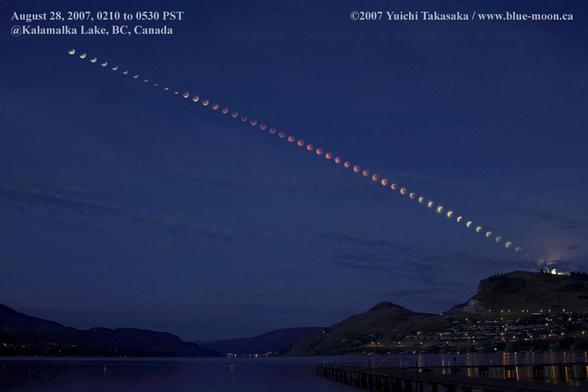
Kalamalka Lake Eclipse
* Credit & Copyright: Yuichi Takasaka
http://www.blue-moon.ca/

Explanation:
Recorded on August 28th, this serene total lunar eclipse sequence looks southwest down Kalamalka Lake toward the lights of Coldstream, British Columbia. An exposure every 4 minutes captured the Moon's position and eclipse phase, until the Moon set behind the town lights and a hill on the horizon. In fact, the sequence effectively measures the duration of the total phase of the eclipse. Around 270 BC, the Greek astronomer Aristarchus also measured the duration of lunar eclipses - though probably without the benefit of digital clocks and cameras. Still, using geometry, he devised a simple and impressively accurate way to calculate the Moon's distance, in terms of the radius of planet Earth, from the eclipse duration.

http://www.phy6.org/stargaze/Shipprc2.htm
https://www.mreclipse.com/Special/LEprimer.html

https://apod.nasa.gov/apod/ap070901.html

#space #moon #astrophotography #photography #science #astronomy #nature #NASA #education

2019 January 25

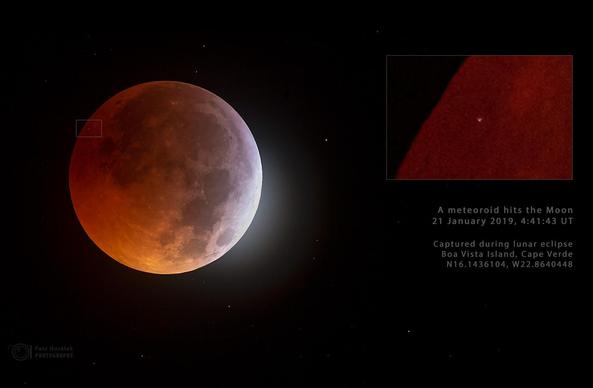
Moon Struck
* Image Credit & Copyright: Petr Horálek
https://www.petrhoralek.com/?page_id=20

Explanation:
Craters produced by ancient impacts on the airless Moon have long been a familiar sight. But only since the 1990s have observers began to regularly record and study optical flashes on the lunar surface, likely explosions resulting from impacting meteoroids. Of course, the flashes are difficult to see against a bright, sunlit lunar surface. But during the January 21 total eclipse many imagers serendipitously captured a meteoroid impact flash against the dim red Moon. Found while examining images taken shortly before the total eclipse phase began, the flash is indicated in the inset above, near the Moon's darkened western limb. Estimates based on the flash duration recorded by the Moon Impact Detection and Analysis System (MIDAS) telescopes in southern Spain indicate the impactor's mass was about 10 kilograms and created a crater between seven and ten meters in diameter.
https://www.petrhoralek.com/?p=4458
https://www.scientificamerican.com/article/in-a-first-earthlings-spot-a-meteor-strike-the-eclipse-darkenhttps://spaceweather.com/archive.php?view=1&day=23&month=01&year=2019ed-moon/
https://spaceweathergallery.com/eclipse_gallery.html
https://apod.nasa.gov/apod/ap011208.html

https://apod.nasa.gov/apod/ap190125.html

#space #moon #astrophotography #photography #science #astronomy #nature #NASA #education

May 17, 2013

Bright Explosion on the Moon - NASA Science
by Alicia Cermak

For the past 8 years, NASA astronomers have been monitoring the Moon for signs of explosions caused by meteoroids hitting the lunar surface. "Lunar meteor showers" have turned out to be more common than anyone expected, with hundreds of detectable impacts occurring every year.

They've just seen the biggest explosion in the history of the program.

"On March 17, 2013, an object about the size of a small boulder hit the lunar surface in Mare Imbrium," says Bill Cooke of NASA's Meteoroid Environment Office. "It exploded in a flash nearly 10 times as bright as anything we've ever seen before."

Anyone looking at the Moon at the moment of impact could have seen the explosion--no telescope required. For about one second, the impact site was glowing like a 4th magnitude star.

Ron Suggs, an analyst at the Marshall Space Flight Center, was the first to notice the impact in a digital video recorded by one of the monitoring program's 14-inch telescopes. "It jumped right out at me, it was so bright," he recalls.

The 40 kg meteoroid measuring 0.3 to 0.4 meters wide hit the Moon traveling 56,000 mph. The resulting explosion1 packed as much punch as 5 tons of TNT.

These false-color frames extracted from the original black and white video show the explosion in progress. At its peak, the flash was as bright as a 4th magnitude star.

Cooke believes the lunar impact might have been part of a much larger event.

"On the night of March 17, NASA and University of Western Ontario all-sky cameras picked up an unusual number of deep-penetrating meteors right here on Earth," he says. "These fireballs were traveling along nearly identical orbits between Earth and the asteroid belt."
[...]

Read more: https://science.nasa.gov/science-research/planetary-science/16may_lunarimpact/

Credits:

Author: Dr. Tony Phillips | Production editor: Dr. Tony Phillips | Credit: Science@NASA

#space #moon #astrophotography #photography #science #astronomy #nature #NASA #education

2025 September 12

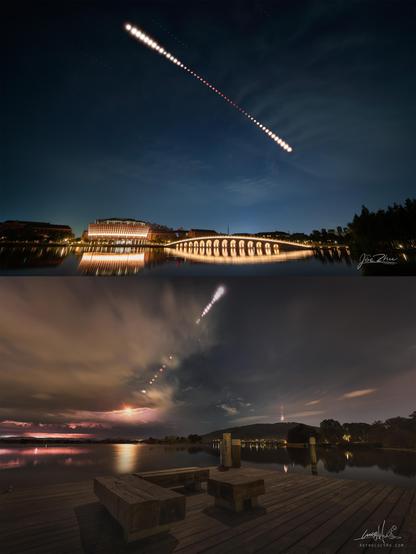
Lunar Eclipse in Two Hemispheres
* Image Credit & Copyright: North - Zhouyue Zhu, South - Lucy Yunxi Hu
https://www.fantasticjoe.com/#/
https://www.astrolucyhu.com/about-lucy

Explanation:
September's total lunar eclipse is tracked across night skies from both the northern and southern hemispheres of planet Earth in these two dramatic timelapse series. In the northern hemisphere sequence (top panel) the Moon’s trail arcs from the upper left to the lower right. It passes below bright planet Saturn, seen under mostly clear skies from the international campus of Zhejiang University in China at about 30 degrees north latitude. In contrast, the southern hemisphere view from Lake Griffin, Canberra, Australia at 35 degrees south latitude, records the Moon’s trail from the upper right to the lower left. Multiple lightning flashes from thunderstorms near the horizon appear reflected in the lake. Both sequences were photographed with 16mm wide-angle lenses and both cover the entire eclipse, with the darkened red Moon totally immersed in Earth's umbral shadow near center. But the different orientations of the Moon’s path across the sky reveal the perspective shifts caused by the views from northern vs. southern latitudes.

https://www.astrolucyhu.com/about-lucy

#space #moon #astrophotography #photography #science #astronomy #nature #NASA #education

The Moon’s Rotation

An enduring myth about the Moon is that it doesn't rotate. While it's true that the Moon keeps the same face to us, this only happens because the Moon rotates at the same rate as its orbital motion, a special case of tidal locking called synchronous rotation. The animation shows both the orbit and the rotation of the Moon. The yellow circle with the arrow and radial line have been added to make the rotation more apparent. The arrow indicates the direction of rotation. The radial line points to the center of the visible disk of the Moon at 0°N 0°E.

Credit:
NASA's Scientific Visualization Studio
Visualizer:
Ernie Wright (USRA)

Technical support
Laurence Schuler (ADNET Systems, Inc.)
Ian Jones (ADNET Systems, Inc.)

#space #moon #astrophotography #photography #science #astronomy #nature #NASA #education

2025 October 4

The Rotating Moon
* Video Credit: NASA, Lunar Reconnaissance Orbiter, Arizona State U.
https://www.nasa.gov/
https://science.nasa.gov/mission/lro/
https://www.lroc.asu.edu/about/team

Explanation:
No one on Earth sees the Moon rotate like this. That's because the Moon is tidally locked in synchronous rotation, showing only one side to denizens of our fair planet. Still, given modern digital technology, combined with many detailed images returned by the Lunar Reconnaissance Orbiter (LRO), a high resolution virtual Moon rotation movie can be composed. In fact, the featured time-lapse video starts with a view of the familiar lunar nearside and quickly finds the Mare Orientale, a large crater with a dark center that is difficult to see from the Earth, rotating into view just below the equator. In a complete lunar rotation condensed into 24 seconds, the video clearly shows that the Earth-facing nearside of the Moon contains an abundance of dark lunar maria, while the lunar farside is dominated by bright lunar highlands. Of course you can just join other moon-watchers under hopefully clear skies tonight. Check out the sunlit portion of the lunar nearside on International Observe the Moon Night.
https://en.wikipedia.org/wiki/List_of_plains_on_the_Moon
https://en.wikipedia.org/wiki/Geology_of_the_Moon#Highlands

https://moon.nasa.gov/observe-the-moon-night/
https://lroc.im-ldi.com/about

https://apod.nasa.gov/apod/fap/ap251004.html

#space #moon #astrophotography #photography #science #astronomy #nature #NASA #education

@grobi Every time I see this animation I'm astounded at how the surface looks translucent and multilayered. Maybe it's just shifting shadows.