 Yoïn van Spijk
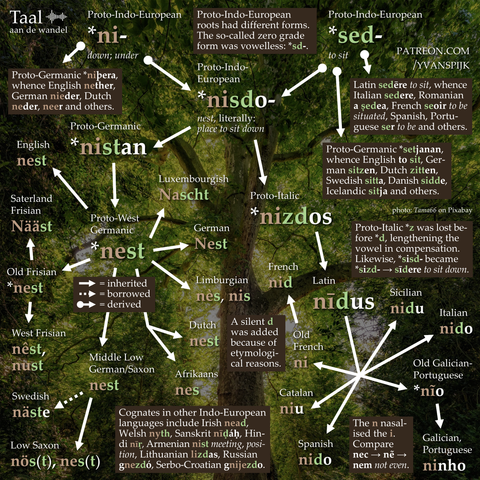
Historically, the word ‘nest’ consists of two parts.
The part ‘ne-‘ is related to ‘nether’, while ‘-st’ is related to the verb ‘to sit’. The distant Proto-Indo-European ancestor of ‘nest’ meant “place to sit down”.
That proto-word also produced Spanish ‘nido’, Portuguese ‘ninho’ and their Romance relatives, as well as Welsh ‘nyth’, Hindi ‘nīṛ’, and Serbo-Croatian ‘gnijezdo’.
Click my new graphic to learn more:
 Krazov
 Der Zarte Kulturträger