
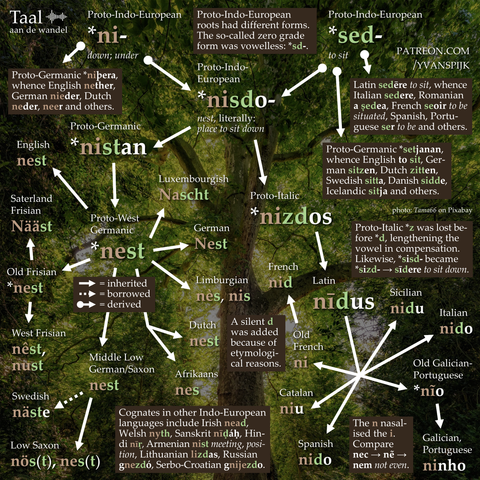
Historically, the word ‘nest’ consists of two parts.

The part ‘ne-‘ is related to ‘nether’, while ‘-st’ is related to the verb ‘to sit’. The distant Proto-Indo-European ancestor of ‘nest’ meant “place to sit down”.

That proto-word also produced Spanish ‘nido’, Portuguese ‘ninho’ and their Romance relatives, as well as Welsh ‘nyth’, Hindi ‘nīṛ’, and Serbo-Croatian ‘gnijezdo’.

Click my new graphic to learn more:
@yvanspijk "Gniazdo" in Polish. Huh.
@Krazov @yvanspijk Yeah, it is not only Serbo-Croatian, but common word for all Slavic (and Baltic in some degree) languages.
It is ‘hniazdo’ for Belarusian and ‘hnizdo’ for Ukrainian and Czech, ‘gnezdo’ for Slovenian and so on. ‘Lizdas’ in Lithuanian and ‘ligzda’ in Latvian, for comparison.
@yvanspijk In Swedish there's been a semantic shift where näste has an almost exclusively ominous association (eg huggormsnäste! = vipers nest, but fågelbo = birds nest) and in general is also perceived as an old-fashioned word.
@DavidH Ah, fascinating! What's the general word nowadays?
@yvanspijk -bo in most cases. Although when it comes to animals nests there are some words that are specific to the species. Like -kula for wolves or -lya for foxes
@DavidH Very interesting! Thanks!