 Jessamyn
Book 50: Kluge. Marcus and I went to college together and were in the same program, so it's fun to see some of the things we learned in college show up in this exploration of the foibles of the human brain and human cognition. Marcus uses sensible real world examples as well as citations from real science to explain some of the weird things our brain does and offers some ideas about why it might be that way. He wraps up with some suggestions for ways to think your way out of some common problems
Book 51: We Solve Murders. If you liked the Thursday Murder Club books, you will probably like this. It's a new set of characters but a similar theme--people who are not really in the murder-solving biz get thrust into a situation and have to rise to the occasion. Looks like it will become its own series. Wider age range of characters. Same sort of humor. I enjoyed it and you have to love Osman who thanks booksellers and librarians FIRST in his acknowledgements section.
Book 52: The Library Mule of Cordoba. A graphic novel, translated from French, about the destruction of a library in Spain in the year 976 when "radical clergy" swept in during a power vacuum. Some books are secreted away by a ragtag group: one enslaved black woman, one enslaved eunuch, a random thief and an ornery mule. This book is about their travails and has both a cautionary warning about the destruction of books but also an essay about the actual political situation of that era at the end.
Book 53: Stars in their Eyes. I don't love how the cover shows the main Big Deal Event in this book but otherwise it was a delight. Maisie is a queer nerdy girl with one leg after a cancer diagnosis. She deals with some chronic pain and general crap at school. Ollie is a non-binary nerd who likes to draw and is volunteering (with their dad) at the comic con that Maisie goes to with her (also nerdy) mom. A lot of people will feel seen in this very sweet story about what you can see on the cover.
Book 54: The Utterly Uninteresting and Unadventurous Tales of Fred, the Vampire Accountant. A fun book suggested by a friend. If you like the title you will probably also like the book. These are a few sequential short stories with the same set of characters that take you through Fred's first little while as a vampire, getting used to the whole thing, meeting people (and parahumans) and making friends. It's funny and does not take itself too seriously.
Book 55: The Third Rule of Time Travel. I will read any book about time travel. This one is good but also a little all over the place. There's a lot of "Let me explain the SCIENCE to you" parts which were less interesting to me than the human drama, but that part was a bit trauma-filled. The basic conceit: you can only sort of time travel, consciousness only, and only for about 90 seconds, and only into the past. Or... are the supposedly immutable roles in this universe more malleable than that?
Book 56: Ruined by Design. Monteiro helps people become better, ethical designers who do good work and get paid. This is the "shitty pulp edition" which was FINE for my purposes. I appreciate Monteiro's principled stance on things and how he spells it out with humor and just the right amount of rage. General thesis: designers should be more involved not just in the "how" of designing things but the "why" and should push back when the answer to "why" is something bullshitty and unethical.
Book 57: Short-Circuited in Charlotte. This is the 2nd in a series of Vermont-based mysteries. I didn't love the first one but I figured I'd see if they improved. This one was similarly just okay (and I had to ILL it from Florida!). There's a maker fair type thing in Charlotte and then a murder happens, and then another. Stella, the textile consultant turned erstwhile investigator, tries to figure out what happened along with her forest ranger husband Nick. Totally OK book but not a great one.
Book 58: The Unmaking of June Farrow. This is the second book I've read this year with the same general theme: generations of women living in a rural farm setting having something vaguely magical about them which makes the locals distrust them, also the main character is a woman with an absent mom and a lot of questions. This one is more of a time-loop type of story and so has some of the potentially confusing aspects of time loopery but I really liked watching how the story was revealed.
Book 59: The Island of the Colorblind. Somehow there was an Oliver Sacks book that I missed. This one is about him going to a series of tropical islands to look at 1. a group of people who all have a similar achromatopsia, and 2. bunch of people who have a Parkinsonian-like disease of unknown etiology, and 3. cycads. This is an older book that he's updated with a series of lengthy and interesting end notes. More questions than answers, but I liked being in the tropics with him for a bit.
Book 60: Only This Beautiful Moment. Oh my heart. A lovely, complex book about a gay US teen with Iranian parents. His mom died when he was young, his dad is closed off but ok, not supportive when he came out, but didn't kick him out of the house either. A trip back to Iran to see his dying grandpa opens a LOT of doors of introspection as well as revelations. The story is told in 3 story lines (son, dad, grandpa) as they are each figuring out their own lives against an Iranian political backdrop
Book 61: Interstellar Megachef. A scifi story about a woman who ran away to Primus from Earth in a future time where civilized people settled other planets and Earth remained as it is, barbarous and petty. Saraswati fled her terrible royalty family to make a go of it as a chef (which she was already doing on Earth ). She meets Ko, a woman making VR sims. They do not hit it off at first, then they do. Great stuff about food and foodways and what it means to be from a place. Bad cover, good book.
Book 62: The Benevolent Society of Ill-Mannered Ladies. A regency mystery with two unmarried sisters, fraternal twins, who try to help people in need by doing things which are entirely unsuitable for women in their era. Gus is a brazen problem solver whose height makes it easier to be a commanding presence. Julia is good at all the social graces and deep knowledge of peerage. I enjoyed the setting and both of these characters and, once again, terrible cover and really good book.
Book 63: The Accidental Network. I was given this book to blurb. It's written, w/ help, by the guy who built the first mass-produced cable modem and helped usher in the broadband era. It takes place in the 128 beltway near where I grew up and it was fun getting to remember the tech world of that era (one my dad was closely involved in). Yassini-Fard is a gracious man, giving credit where it's due, throughout this narrative. The retelling is uneven in parts but network nerds should still love it.
Book 64: A Dying Fall. Another in this series of forensic mysteries, this one talks about the excavation of a possible King Arthur and some white supremacists in the northern part of the country. Ruth's baby is toddling (and feels precocious for 18 months, but what do I know) and there was less "Big thriller part at the end" for which I was grateful and more druid stuff. If you like this series generally, this is a good book in the series.
Book 65: Class, A Graphic Guide. This isn't a graphic novel exactly but an illustrated guide to a topic that is well-assisted by some good imagery. This book gets into a lot of scholarship on the subject of class, UK-based but applicable basically anywhere. Told from a social-justice-forward perspective which I personally enjoyed, it outlined the major thinkers on the subject and where they agree and disagree on how to look at this complex topic. Want to think more deeply about class? Read this.
Book 66: Please Be My Star. A young woman moves to a new place and gets involved with the local theater kids while a deeply negative voice inside her head says she's a creepy loser who will never have friends. She becomes the director of a one-act play which winds up starring her total crush and a few more people who mostly she becomes friendly with. There is some low-key conflict and then the resolution you are expecting (it's ON THE COVER). Good story, def. for a younger audience than me.
DNF: Little Weirds. I thought this was going to be a comedian memoir of some kind and I've always liked Slate and her lateral way of looking at things. However this book is written in a lateral sort of prose-poem-ish style that I could not get into at all and noped out by chapter three.
Book 67: Birds and the Trick of Time. There are books of poetry that I read where I think "I like these poems but I probably wouldn't like this person" and this was one of those. Some excellent short poems about birds and rural living and growing up with an abusive dad and traveling on a shoestring and using the word "augur" far too many times, but I've been enjoying getting back into poetry and I'm glad I read this.
Book 68: A Grave in the Woods. I have liked these books in the past, a little bit of French history, a little bit of delicious food descriptions, a nice cozy community where people get along, a mystery somewhere along the lines, moral law enforcement. This one is not great and maybe that's a me thing, but there seemed to be walls of "tell me don't show me" about French history, not much of a mystery, a big dramatic flood which was a nice story of civic engagement but otherwise felt bolted on.
Book 69: Assassins Anonymous. Kind of like what it says on the cover. A guy who used to be an assassin enters recovery and finds it difficult because there are still some people who are trying to kill him. There's some violence, some 12 stepping, some light romance interests, a cat, and a lot of figuring how how you can actually make amends in this life if you did some pretty difficult stuff. I found it compelling and funnier than I was expecting.
Book 70: The Medusa Protocol. This is the sequel to Assassins Anonymous. One of our recovered assassins has been remanded to a dark prison for reasons unknown and the remaining ones have to decide what to do and see if there are any non-lethal ways to get their colleague out. A little too much fight blocking for me in this one (I return a high kick to the right side of his head making him fall down and to the left...) but it's a small nit to pick, another fun book about dark topic.
Book 71: The Outcast Dead. Another in this series of a forensic anthropologist often called in to work on a dig that happens to mirror some real life crime situation. She's a frazzled working mom. Her daughter's dad is married to someone else. There's a whole cast of characters who live and grow through these stories. This one is about motherhood and the tension between doing your job, having childminders (babysitters), and balancing what's in your heart with what's right in front of you.
Book 72: Big House Little House, Back House, Barn. A book about connected farm buildings of New England, though focusing primarily on Maine. I grew up in exactly this sort of place, one that my folks bought from the original farming family. Never thought much about it. Apparently the way it was arranged was like that for a number of interesting reasons, very few of which were "Because it's cold in the winter." and having to do with New England history. An absolute delight to read and learn from.
Book 73: The Library at the Edge of the World. A nice small town novel about a peninsula in Ireland which is slowly losing the population in its smaller villages and the Council is thinking of ways to centralize which the villagers mostly don't want. The librarian, a woman who came from London after a messy failed marriage and lives with her hard-to-please mother is the central character, driving a mobile library and meeting all the locals and trying to figure out what to do.
Book 74: Trans History From Ancient Times to the Present Day. A good "talking heads" style graphic novel about the history of trans people and trans identity based on actual "what we know" history (which is often, sadly, not much b/c of colonizers and active suppression). Not all the history is great, of course, but the authors emphasize the positive and also try to get more than just the usual voices, actively reaching out to many kinds of transfolk to create this wide compendium of histories.
Book 75: Woodworking. Emily St. James has written one hell of a first novel. A teacher in rural SD has decided, mostly, to do something about the fact that she is trans. The only other trans person she knows is a 17 year old girl who had to threaten the school district to be able to go to school--they form an unlikely alliance. She goes to support groups. She gets in her own head a LOT. She wavers. She has moments of bravery. She meets others like and not like herself. A masterful novel.
Book 76: The Science of Last Things. I somehow misread the blurb and cover and thought this would be a very different sort of book. It was essays about the author's life in the context of "the bigger picture" for lack of a better phrase. She discusses religion, her father's death, her cancer, prozac, the birth of her children. Many classic texts were cited and quoted from at length. It was very much not my thing, too "literary" by half, using words like chthonic when many simpler ones would do.
Book 77: The Expert of Subtle Revisions. This was another time travel/loop novel where I'm not entirely sure what happened but I enjoyed it. It's also got a Wikipedia aspect, done well so I'm a fan. This connects two time periods: 2016 Bay Area and 1930s Vienna (including the political upheval) with a few side visits to other times and places. I liked getting to experience both through this novel which is about math and power and who actually gets to write history. Strong female characters.
Book 78: Summer at the Garden Cafe. This is a gentle sequel to The Library at the Edge of the World. This one more about the characters we met in the last book & even LESS about the bookmobile. We see more people finding ways to make lives for themselves in the rural Irish town as well as a bit of history about the Irish Civil War which feels a bit bolted on. Once you know what sort of book this is (like the last, it's a happy ending book) it does remove what might otherwise be a bit of suspense
Book 79: Eartha. This is one of those tricky graphic novels which has a story that would be good for teens but has a few images that might encourage tut-tutting (my library does not have an "adult" section for GNs). It's a fascinating story about people who live on an island where dreams appear, but they start coming less often and Eartha, an all-around well-liked person, has to go to the city to figure it out. A lot going on here, masterfully illustrated and a nice warm tied-up ending.
Book 80: Night Magic. The author lives in Boone NC and laments that blue light and other artificial lighting is limiting our access to the things that come out only at night. Each chapter looks at a new thing (bats, glowworms, fireflies, fungi, owls) through this lens. I found the natural world discussions interesting and the use of a lot of "we" language (We can't pull ourselves away from our screens) to not resonate with me. If her opinions are also yours you'll love this. Otherwise, maybe not
Book 81: The Bezzle. I liked the original Marty Hench novel, this one didn't do it for me as much. Cory clearly knows a lot about ways that rich people can fuck over basically everyone else, as well as how terrible the US prison-industrial complex is. However, the plot gets a bit lost in his explanations of these things (things I mostly already knew). It was good to see Marty, and Catalina Island, but there was only one woman with any lines in this book and that wasn't quite enough for me
Book 82: Days at the Morisaki Bookshop. This was another of those "cat books." I loved the last one and did not care for this one as much. There was so much unspoken tension where I was like "JUST TELL THEM THAT THING" that it was a stressful read even though it's a gentle story of a (maybe depressed) woman in Japan who is not sure what to do with her life and spending time at a family-owned bookstore helps sort it all out.
Book 83: The Martian Contingency. I read the last book a while ago, so I'm not sure what parts of my feeling sort of "eh" about it were not remembering details from previous books and which were that, as an anxious person with Shit To Do, it wasn't fun reading about a Lady Astronaut who is anxious and has Shit To Do. It's about the 2nd expedition to Mars, with a permanent habitat on the planet and an orbiting space station above. A lot of "Why won't these people TALK to each other?" from me.
Book 84: Spent. I'm not always into anxious protagonists but I make a huge exception for this excellent book. Bechdel writes a graphic novel which is both about a fictionalized her but also has most of the cast of Dykes to Watch Out For, set against the backdrop of These Wretched Times both national and local. I saw a cameo of my congresswoman! I saw goats and seed art. The story is about Bechdel grappling with her fame, relationships, and trying to relate to the next generation of queer folk
Book 85: Vet at the Ends of the Earth. This is about a veterinarian from the UK who moves to the Falklands for work and then goes to more and more remote islands doing vet work. It's humorous and interesting and comes with a fair bit of history about the various locales (though not a lot of critique of their colonial legacy). I enjoyed the vignette-style recounting of meeting the world's oldest tortoise, troubleshooting a weird lamb disease, and searching for a lost dog in the island canyons.
Book 86: The Folded Sky. I like Elizabeth Bear's writing and I liked the past two books in this series but this one did not work for me. Another very anxious protagonist. Nearly constant assaults by space pirates who are two-dimensional unknowable opponents. A lot of that Momma Bear "Now that you've threatened my children I am REALLY MAD" posturing. There's a lot of interesting interspecies interactions and those parts are fascinating but was not enough for me.
Book 87: The Autistic's Guide to Self-Discovery. Sol runs a community for neurospicy folk and this is a very practical book on what it can be like to have autism diagnosed (or self-dignosed) later in life. He talks about his own experiences and shares a few stories from people he's worked with, suitably anonymized. While I don't entirely fit the criteria here, I'm also not what you'd call allistic so I read this with interest and think many people in the same boat could get a lot from it.
Book 88: The Mistletoe Matchmaker. This is another book in the Finfarran Peninsula series. I've liked the other two. This one had more of a "We're making a movie where all the actors can't be on set at the same time" vibe with a lot of plot lines happening at the same time but without a lot of overlap. And not much happens. And it's Christmas and there's a fete brewing. So not my fave of the series but it was enjoyable and a welcome balm from the angsty fiction I'd been reading.
Book 89: Alif the Unseen. Alif is the online name of an Arab-Indian hacker young man. After a breakup, he gets in way over his head trying to make a tool to make himself invisible to his ex (was she really his ex?) and has to involve some shady underworld/paranomal folk to help him get it sorted. He's being chased by someone powerful in the Dubai/UAE government who is also a highly capable hacker and spends some time in this world and... another. Lively and from a perspective I rarely see.
Book 90: The Lighthouse Keeper. This is a short book for children that I got as part of Library Thing's Early Reviewer program. It's translated from the Spanish and has a bunch of rhyming verses. The drawings are, as seen on this cover, pretty great. The verses are pretty simple but there is a short narrative about the job this man has and also he's got some sort of a thing going on with the moon. Highly enjoyable.
Book 91: Threadbare. This was more of a series of essays with some pictures that went with them (i.e. huge speech bubbles, not much storytelling in the images) than a graphic novel. It outlines, with footnotes, how the global fashion trade exploits women and transgender folk, obscures the lines between sex work and trafficking in order to maintain the status quo, and gives us shoddier goods at a much higher human cost. I wasn't on board entirely with all premises but was happy to learn more.
Book 92: Seeking. There is a longer story about why I ILLed a book of poetry from the 1930s all based on a postcard I found at a thrift store. I was pleased to get this book. I found Crabb's poetry to be pleasantly evocative, mainly about nature themes. The one about the library was, sadly, a paean to silence which was what you might expect for the time. Longer story about why I was looking for this book written up on my blog.
Book 93: The House. An elegant graphic novel with a lot of "show don't tell" going on in it. Three grown children of a man who has died come back to the house to clean it out and see what they might want to do with it. Each person reverts to type a bit, they're all very different, and the current time is juxtaposed with glimpses from their childhood or of their father doing various things. Sweet without being maudlin or telling you how to feel about any particular thing.
Book 94: Netherford Hall. I do not know how some books wind up on my TBR list. This was a Regency supernatural quasi-romance (maybe entirely romance, I am not familiar with the genre) which, if it sounds appealing, seems to be a good example of that genre. Not really my thing since there's a bit too much of that fantasy "Whose magic will outmagic the other?" but that is a me problem. The characters, nearly all women, are interesting and have depth and there's so much lovely description.
Book 95: Love You A Latke. I knew this one was a romance going into it. I liked the general themes of small town Vermont (though much of it takes place in NYC) trying to do something new for December and settling on a Hanukkah Festival run by the woman who operates the town's coffee shop. She has a frequent customer who she finds annoying but who helps her see the best in things. Schmaltzy, funny, sweet and predictable, it was nonetheless fun to be surrounded by Jewish/Vermont themes for a bit.
Book 96: Dreadful. What if you woke up in a ruined laboratory which was sort of on fire and you had no idea who you were? This is about a Dark Wizard who got his memories stolen after he captured a princess but before he could do whatever dastardly thing he had planned for her. There's a longer story about other Dark Wizards and the townspeople and a few goblins who act a little bit as comic relief. This book isn't laugh-a-minute funny but it is a humorous look at this situation and I liked it.
Book 97: A Short Bright Flash. A history of the Fresnel lens and lighthouses generally. Picked this up when I was idly browsing library shelves and it was much more interesting than I expected. French engineers! Civil War lighthouse attacks! World War II German lighthouse occupiers! Did you know that many Fresnel lenses floated in vats of mercury and this is believed to be why lighthouse keepers have a reputation for being drunk and/or crazy? Read this book, learn more.
Book 98: Shroud. Tchaikovsky writes a lot of books and I like most of them. This one is a bit of a first contact story which has a LOT of discussion (both show and tell) of alien intelligence and a dystopian future in which people have left earth and only exist in corporate-run resource-exploitation schemes mowing down whatever is in their path. It's got a lot of spookiness to it and also left me with a lot of questions since it ended somewhat abruptly. Ripe for a sequel.
DNF: The Age of Video Games. This graphic novel about the history of video games should have been right up my alley. But it was too meta for me--the illustrator and writer are also characters in the book--and, for a history, it jumped around all over the place. I knew a lot of the raw facts from other books. I read through the first few chapters and was just not interested in keeping up with it.
Book 99: Homebody. This is a nice, simple non-fiction graphic novel by trans non-binary graphic novelist Theo Parish talking about their lifelong journey towards figuring out how to be at home in their body. It's matter of fact, very well-illustrated, talks mainly about who was supportive (and not who wasn't) and drills down a little into some topics like deadnaming and gender identity vs. sexual preference. Ultimately it's a story of achievement and acceptance.

Book 100: Wash Day Diaries. Four young Black women, all friends, all living slightly different lives, care for each other and their hair in this series of vignettes about life in the Bronx. There's a lot going on and each woman has a different backstory and set of issues they are grappling with. It's lovely to see this collection of day-in-the-life that acknowledges that friendships can both be complicated but also deeply nurturing.
Book 101: The Impossible Fortune. Fans of the Thursday Murder Club will likely enjoy this one. It's got all our favorites (& a few new ones) who are all doing their things as they try to figure out why someone was trying to kill Joyce's son-in-law's best man. That guy disappears, his colleague gets killed, there's a lot of bitcoin in play and a few side quests and some tasty baked goods. Osman always thanks librarians in the acknowledgments, I will read these books as long as they are published.
Book 102: Automatic Noodle. This book is great just like everyone says. A group of sentient robots of various forms and previous purposes come into awareness in a shut down restaurant in the middle of San Francisco (itself inside of a seceded California). They do not have many rights, but they do have a few ideas and some plucky can-do attitudes. We get to learn more about each of them and watch them manage starting their own business in a culture that has a small but strong anti-robot bias.
Book 103: Enshittification. If you've read Cory's stuff here or elsewhere, you will know the skeleton of this book. This is a full treatment, including all the ancillary parts that go into how it happened and a big chunk of stuff at the end about what could possibly be done. I'm not quite the target audience for this book because I may know the topic too well, but it was good to have a refresher and learn more neologisms like enshitternet &c. Accessible to more than just the usual suspects.
Book 104: The Heist of Hollow London. I really enjoyed Robson's other book that I read and looked forward to this one. It's a complicated future where some people are nats (natural) and others are made (i.e. cloned) and the people who are made can be bought and sold like property. Arlo and his friend Drienne go from being brand ambassadors to being purchased to participate in a heist which winds up being not at all what it seems. A lot of little side stories give this novel some good depth.
Book 105: Six Centuries of Type & Printing. I am interested in the history of printing and this short and beautifully made short book was a nice little introduction to the various machines which transfer ink to paper to enable us to read it. It got a little in the weeds for me occasionally (complex descriptions of how a printing system worked which were hard for me to visualize) and there's a LOT of vocabulary. Overall, glad I read it and Glenn was definitely the guy to write this.
Book 106: Blades of Furry. I will read most graphic novels which come in to my library, most of which are YA. Which is how I wound up reading this queer, furry, paranormal ice skating story. It was really well done. The story moves along, you don't need to know/care about skating. The characters are believable, the tension isn't overdone. My only complaint was that I somehow overlooked at this was just "volume one" and I read 500 pages of it just to have it be "to be continued..."
Book 107: Hunter's Heart Ridge. This book didn't cohere quite as nicely as the one which preceded it. It was a very complex story about men who go to a hunting lodge, one of their party gets killed. There's a "we're all stuck here" snowstorm. Another member gets killed. The power goes out. That sort of thing, with a side story involving people who I knew and liked from the last book but which barely overlapped with this plot. I like mysteries which take place in VT but this one was just okay.
Book 108: Go Home, Ricky. I'm not sure how I found this book, perhaps the cover? It's about a young wrestler on a low-end circuit who gets injured and has to figure out what his life is about, washed up from the one thing he loved in his late 20s. He doesn't know who his dad is. He copes poorly with relationships. He gets along well with his mom. Each chapter is one little vignette about his life. There is very little plot. Kwak is a good writer, but I was hoping for more story, less character.
 Trisha Lynn 🇵🇭 🇺🇸 🇨🇦
@jessamyn Complex Deliverance in the Snow? A more thoughtful Hateful Eight?
 Adam Greenfield
@jessamyn Ha! I have trouble understanding furry content as anything but the worst, blithest and most unapologetic sort of cultural appropriation, and I am certain it will be universally understood that way in years to come. It’s funny to look in real time at something the future will regard with the same horror we have for cultural artifacts from last century.
@adamgreenfield Can you say more about that? I'm sure I'm missing something obvious but what is being appropriated? Indigenous traditions or something else? (I am not super well read on this and have no real strong opinions on furry culture as my life doesn't overlap with it much but my opinion has always been "mostly harmless")
 HTTP 1.1/418 Teapot
@jessamyn It sounds like fun. It does kinda sound like "queer, furry, paranormal ice skating story" as a genre was the result of a game of mad-libs.
@jessamyn Cool! Going to have to point a few printer-nerd folks at this.
 rednikki
 the elder sea
@jessamyn
Sitting in my comfy chair, getting ready to continue reading this. I saw Cory on tour and got a signed copy, and laughed a lot when he and Randall Munroe conversed about it.
Sitting in my comfy chair, getting ready to continue reading this. I saw Cory on tour and got a signed copy, and laughed a lot when he and Randall Munroe conversed about it.
@eldersea My favorite thing about Cory is that I think he mostly understands his position in the world, and what he's trying to do tactically. I saw him speak at an ALA (American Library Association) conference about privacy stuff and he said "Look, I don't expect you to walk out of here agreeing with me or thinking like I think, but I'd like to nudge you more towards my side of the argument" I've used that in talks ever since.
@jessamyn
He's very good at that. I took a normie to see him and they quickly grasped what he was after and how the nightmare that is now can be improved by moving towards his stance. I appreciate how he takes very tech things and makes them plain and relatable.
He's very good at that. I took a normie to see him and they quickly grasped what he was after and how the nightmare that is now can be improved by moving towards his stance. I appreciate how he takes very tech things and makes them plain and relatable.
 Aaron O
 Doctor M. Popular
@jessamyn I loved this book so much. Highly suggest it for folks who are looking for nice cozy fiction. Lots of extra Easter Eggs for us San Franciscans to enjoy.
 toddbuddy
 Ashe Dryden 🙆🏼♀️🐈🐈⬛
@jessamyn I really liked this one! Felt almost robot cozy.
 Berkubernetus
@jessamyn totally. It was so fun. I could read other books in this universe.
 masukomi
@masukomi from the blurbs it can sometimes sound like it might be dystopian but its very much not. There's one tough bit that discusses stuff during wartime (contextually super appropriate) but the rest of it is full of hope and fun ideas.
 Dan
Dan Annalee Newitz 🍜
@jessamyn yay I'm glad you liked it!!!
 Jay
Jay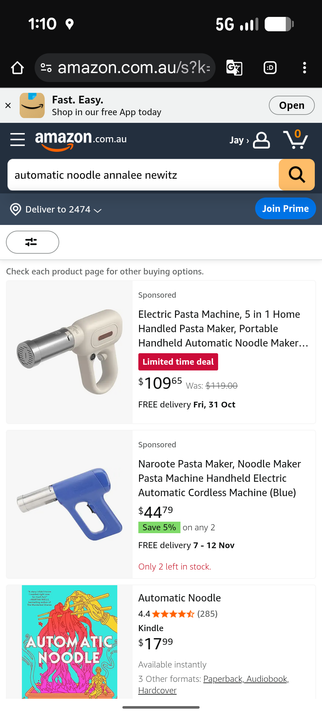
 Brian Buck 🇺🇦
@jessamyn Hold is over at my local library! I just now got this book loaded on my Kobo reader. Can’t wait to read it.
 Casey Peel
@jessamyn I'm reading this one now! Thanks for the rec!
 John Fleck
@jessamyn I put my name on the list at my library and I'm number 98 in the hold queue! A new record! (Long hold queues delight me. Suggests I'm joining a shared experience.)
 Weird Socks
@jessamyn
Definitely going to read this.
Definitely going to read this.
 jz.tusk
 Cainmark Does Not Comply 🚲
I read that a few weeks ago. Really enjoyed it.
 Chris Pepper
@jessamyn I sent this to my daughter, who grew up Jewish in NYC and graduated from Middlebury a year ago. Just ordered for Hannukah. Thanks! I hope you are well.
 David Fi&er
@jessamyn Nice to know I'm not the only person who's bad at keeping track of the provenance of items on the TBR pile
 Chris R
 Samuel Smith
@jessamyn it's rare to find books with covers of that texture nowadays.
Good job on the sluething. LLMs will hallucinate, as we all know, so finding pre-AI _prints_ gives confidence in more accurate information.
Libraries are awesome.
 Trevor Burrows
@jessamyn Thanks for writing up this experience -- was quite fun to read!
@NearerAndFarther IT GOT LONGER. I went back to the thrift store where I got the original postcard and in that same "basket of random postcards" place, I found a mess of other postcards both to and from her. Apparently her whole family were lively correspondents. It was really interesting to get to know her.