 Natasha
  🇪🇺
🇪🇺They are starting to get it ...
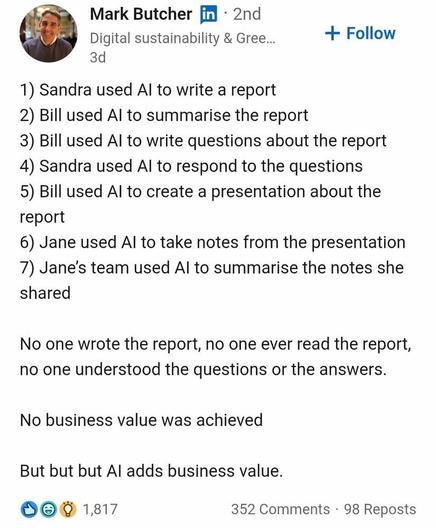
@Natasha_Jay But did the report ever actually need to be written? 'Cause if it wasn't, then AI is the symptom, not the root, of the problem.
Because nobody was reading, understanding, evaluating, or acting on the report to begin with. They just had to try harder to pretend to.
Oh heck; that's not a new problem!
In the late 1980s, our team was pressured to implement some "vitally important functionality" report that some person was spending FULL TIME producing. We were being forced to, so we went to every person who received the report, to determine their real business needs.
NOT A SINGLE PERSON EVER USED THE REPORT!
Not at all. Not once. Not ever.
It was 100% filed, ignored, and then later discarded.
100% USELESS WASTE.
@Natasha_Jay @JeffGrigg Doesn't surprise me. A few years ago, I read a book titled Bullshit Jobs by an anthropologist who found, during a freak survey, that anywhere from thirty to forty percent of all people held jobs they honestly believed contributed nothing to society. A lot of these are professional-managerial positions that produce exactly those kinds of reports, and exist mostly to make upper management feel important.
I've had family members tell me they felt like they spent more time filling out paperwork about their work than actually working, that they felt useless when promoted to management because the team already knew what they were doing, and a friend of mine who went on to read the book claimed it explained so much of what went on at his tech workplace.
The book, "Bullshit Jobs: A Theory"
by David Graeber
https://www.amazon.com/Bullshit-Jobs-Theory-David-Graeber-ebook/dp/B075RWG7YM/
@Natasha_Jay @JeffGrigg That's the one!
Sounds like you might've read it already.
Sorry; I have not read the "Bullshit Jobs" book. Seems too depressing. 😢
@Natasha_Jay @JeffGrigg @billseitz I'm not sure I even see a response in those highlights. He basically handwaves away Graeber's entire argument. In no way does he demonstrate how the sorts of jobs Graeber describes are not bullshit, how public/private partnerships end up creating more positions and bureaucracy instead of less (a major point of evidence—if it's more efficient, why all the red tape?), or provides a convincing alternative explanation for why so many people (a metric ton of people responded to his survey) think their jobs are useless, or explain how rising productivity has actually compelled us to work just as much, if not more, than we used to but for less.
Meanwhile, here's a practical example in Graeber's support: when I was doing political activism for single-payer healthcare a few years back, an opponent of the bill my org supported wrote an article complaining that a Medicare-for-All style program would be *too* efficient. That would eliminate a ton of bureaucratic positions, obviously, but also reduce demand for imaging equipment and such that would be rendered unnecessary by reduced specialist demand. We had to maintain the current system, according to the writers, so that those people could keep there jobs.
If people would be just as healthy, if not healthier, under a single-payer system, but the economy would shed jobs due to its efficiency, those jobs are bullshit jobs. The extra time and energy spent on selling medical imaging equipment would be in bullshit jobs because that level of demand can only be maintained by keeping people sicker than they ought to be. The workers making those products, as well as delivering that extra specialist care, would serve as "duct-tapers," according to Graeber's typology. Meanwhile, if increasing access reduces the number of bureaucrats, then those positions were, in fact, pure bullshit jobs, because obviously their task wasn't to provide healthcare, but to *prevent* people from obtaining it. How can a job be more ridiculous than that?
If the author wanted to mount a serious critique, he would've done well to address the question of whether or not Graeber's estimates, in the realm to 30-40%, were too aggressive. But doing so would require engaging with his argument seriously, and bringing the empirical rigor they claim Graeber lacked. Sadly, the author was neither committed enough to science to compel nor enough to comedy to amuse.
 ranmatoranma
 Jeff Grigg
 Bill Seitz