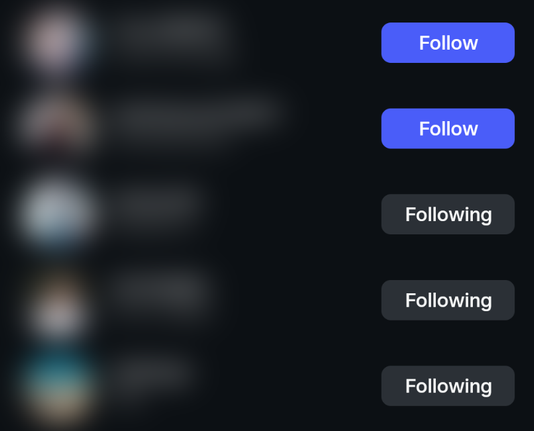
#a11y folks, what's your take on this UI pattern that's quite common on social platforms:

A button with a verb label (e.g. "Follow") that, after the button was pressed, changes to an adjective describing the status (e.g. "Following"), rather than being explicit about the action it'll perform when pressed again (e.g. "Unfollow").

Do you find this problematic in practice?
@diondiondion @aardrian do you have a view on this?

@ambrwlsn
Buttons should describe the action and the surrounding context should make the impact of that action clear.

I’ve always felt that social media pattern intentionally obfuscates how easily a user can unfollow someone, because unfollowing harms the business model.

But that’s not a uniquely accessibility-related issue, even if it can impact disabled users more. It’s a dark pattern that affects everyone.

@diondiondion

@aardrian @ambrwlsn Thanks for pitching in. I'm not sure if the "intentionally obfuscating" angle passes Hanlon's Razor ("don't ascribe to malice what can be ascribed to stupidity"), I feel like it's too common a pattern used in too diverse sorts of contexts for that (see another example below from Spotify).

Yet there's little to no writing about it, I find that interesting.

@aardrian @ambrwlsn Seemingly no one bats an eye at a "heart" icon marked up as a toggle button turning from a white outline to being filled red when it's pressed. But add a changing text label that re-inforces the visual, and you're in UI no-mans-land.