Digging into the drive in my NAS that faulted, I'm reminded that magnetic hard drives are preposterously magical technology.

Case in point, using Seagate's tools I can get the drive to tell me how much it's adjusted the fly height of each of its 18 heads over the drive's lifetime, to compensate for wear and stuff. The drive provides these numbers in _thousandths of an angstrom_, or 0.1 _picometers_.

For reference, one helium atom is about 49 picometers in diameter. The drive is adjusting each head individually, in increments of a fraction of a helium atom, to keep them at the right height. I can't find numbers of modern drives, but what I can find for circa ten years ago is that the overall fly height had been reduced to under a nanometer, so the drive head is hovering on a gas bearing that's maybe 10-20 helium atoms thick, and adjusting its position even more minutely than that

This is _extremely_ silly. You can buy a box that contains not just one, but several copies of a mechanism capable of sub-picometer altitude control, and store shitposts on it! That's wild.

Anyway my sad drive apparently looks like it had a head impact, not a full crash but I guess clipped a tiny peak on the platter and splattered a couple thousand sectors. Yow. But I'm told this isn't too uncommon, and isn't the end of the world? Which is, again, just ludicrous to think of. The drive head that appears to have bonked something has adjusted its altitude by almost 0.5 picometers in its 2.5 years in service. Is that a lot? I have no idea!

Aside from having to resilver the array and the reallocated sector count taking a big spike, the drive is now fine and both SMART and vendor data say it could eat this many sectors again 8-9 times before hitting the warranty RMA threshold. Which is very silly. But I guess I should keep an eye on it.

@danderson Personally I'd retire the drive under the assumption that particulate generated from the impact will likely contaminate it and make future damage more likely.

I aggressively replace drives at the first sign of trouble. Any increase in failed sector count is enough for me to no longer trust it.

@azonenberg @danderson I'm sure it's fine. What's the worst that can happen?

Actually, I think you would both like the MBI report on the Titan submersible implosion: https://media.defense.gov/2025/Aug/05/2003773004/-1/-1/0/SUBMERSIBLE%20TITAN%20MBI%20REPORT%20(04AUG2025).PDF

@willglynn @danderson already read it cover to cover.

No surprises having already read the preliminary and the NTSB material analysis report (which is itself a very good read).

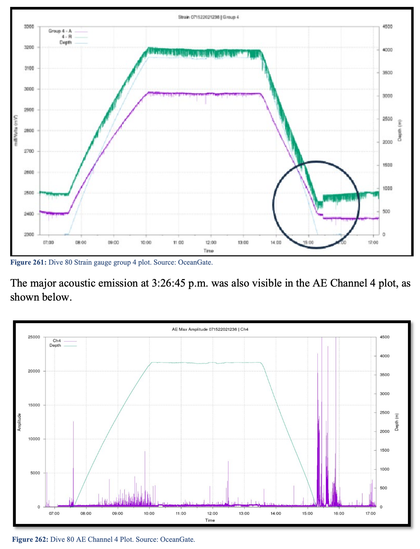
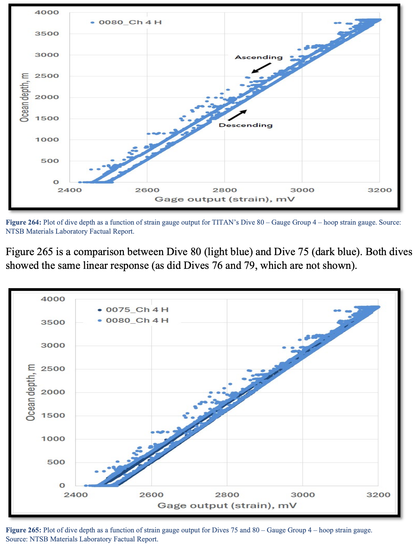
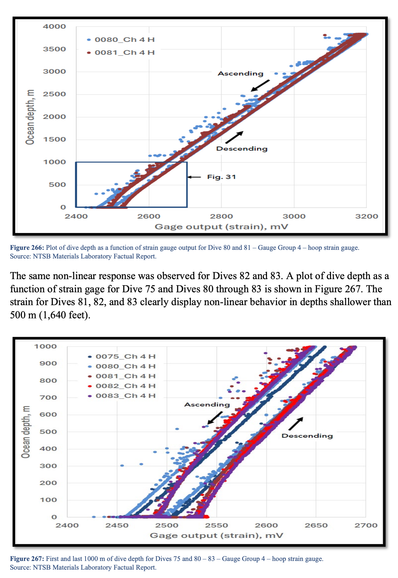
The part I find most interesting is that the RTM system *worked*. It detected a catastrophic delamination of the hull well in advance of the actual implosion. They just ignored the data.

Does it work reliably enough to make (well constructed and properly engineered) carbon fiber pressure hulls safe for limited cycle applications? Open question and after this incident it's not likely anyone will put the work into finding out.

But in this particular case, it did in fact give significant advance warning. The warnings being ignored is a company culture problem not a technological problem.

@azonenberg @danderson 💯

The simplest explanation I have is that OceanGate couldn't afford to design, build, and operate a safe carbon fiber submersible, but they could (just barely) afford to design, build and operate *a* carbon fiber submersible.

Combine that with OceanGate being a corporate veneer for Rush's personal endeavor, and you end up with Rush being willing to gamble himself and his passengers on the safety of the sub. If it works, great, he carries on. If it fails… well, he doesn't see a path forward after that anyway.

@willglynn @danderson Yeah but "company cut corners to save money and people died as a result" is not surprising at all.

The thing working at least a little, surviving to its full target depth a couple of times, *and* RTM detecting the impending failure with enough lead time the hull could have been safely retired after the dive with nobody dying?

That's surprising.

@azonenberg @danderson Agreed! That anything worked as much as it did is the twist in this story.

I also think it's surprising that, despite making no provisions for inspections, they found a giant crack in the first hull — and that despite the company culture and the decision to repair it, they ultimately did retire it before it got everyone killed.

@willglynn @danderson Yeah the company culture was an accident waiting to happen, there's no doub about that.

I bet ultrasound after the dive 80 incident from the inside (with liner removed), or even visual inspection, would have shown obvious signs of damage. But we'll never know.