 Ken Shirriff
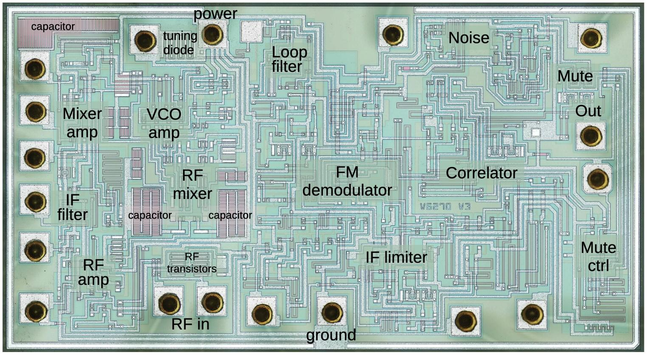
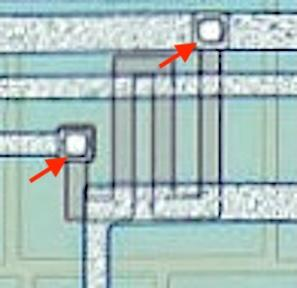
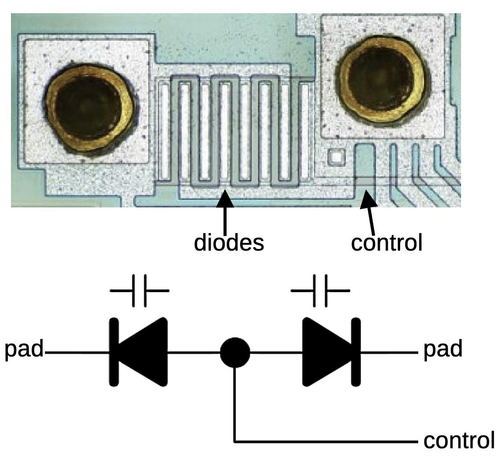
In 1983, Philips produced the first FM radio receiver on a chip, leading to products such as the FM radio wristwatch. Let's look at the tiny silicon die inside this chip and see how it works. 1/N

Wow. How long did batteries last on those?
FM radio must require much more power than a typical wristwatch.
@kenshirriff What's the point of the noise source? Don't you naturally read noise in between channels, is that not sufficient? I'd expect the VCO to be slewing around randomly due to an unlocked control loop.
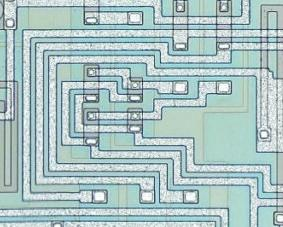
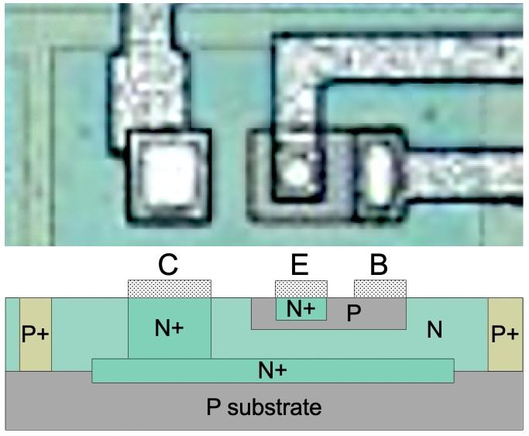
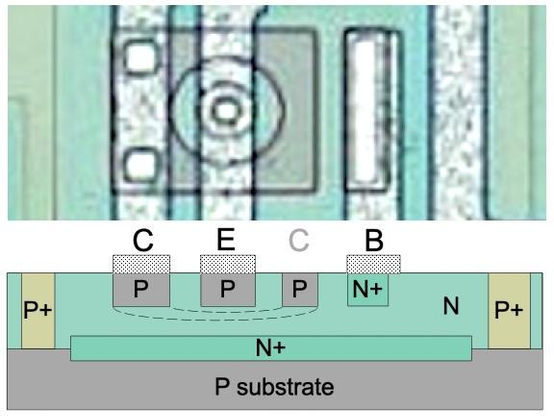
WRT all the crazy single layer routing chips and exotic BJT layouts, I don't know how you do it. The oldest thing I've done any significant RE on was 350nm CMOS and most of what I've done lately has been 180 to 45.
It's sooo much more readable when everything is standard cells, all your NMOS in a nice row, all your PMOS in a nice row, all of your wiring mostly on orthogonal axes, all of your layers mostly planar, etc. Sure you need a SEM and fancier delayering equipment but once you have the data it's so much easier to make sense of.
> Moreover, FM radio provides stereo, while AM radio is mono, but this is due to the implementation of radio stations, not a fundamental characteristic of FM versus AM.
They did try stereo with AM. One method used was Independent Sideband modulation, something like running two SSB stations, the LSB station carrying the left channel and the USB carrying the right … a DSB AM receiver will just get both sidebands mixed together (mono) but a ISB-capable receiver will detect the individual sidebands and receive them separately. This requires very sharp filters which get pricey.
The other way, was Motorola's C-QUAM. Basically it used Quadrature Ampitude Modulation: it relied on the fact that a conventional AM receiver would not detect phase… but using two AM detectors, with reference oscillators with a 90° phase difference, could detect the in-phase (I) amplitude, and the quadrature (Q) amplitude independently.
So I was effectively the mono signal (left + right), and Q contained the differential (left - right). There was some signal processing to the Q signal to ensure it didn't interfere with the I signal.
This was tried here in Australia, but apparently was not that successful, and quickly disappeared once FM stations started appearing in the 1980s (about the time they moved AM stations to a 9kHz separation to make room for stations that would never exist).

 Curioso 🍉 🇺🇦 (jgg)
 TommyTorty10
 Andrew Zonenberg
 Tom Verbeure
 Stuart Longland (VK4MSL)
 Fritz Adalis