TOPIC> Moons Of Saturn

Titan: Moon over Saturn
* Image Credit: NASA, JPL-Caltech, Space Science Institute
https://www.spacescience.org/index.php
https://www.jpl.nasa.gov/
https://www.nasa.gov/

Explanation:
Like Earth's moon, Saturn's largest moon Titan is locked in synchronous rotation with its planet. This mosaic of images recorded by the Cassini spacecraft in May of 2012 shows its anti-Saturn side, the side always facing away from the ringed gas giant. The only moon in the solar system with a dense atmosphere, Titan is the only solar system world besides Earth known to have standing bodies of liquid on its surface and an earthlike cycle of liquid rain and evaporation. Its high altitude layer of atmospheric haze is evident in the Cassini view of the 5,000 kilometer diameter moon over Saturn's rings and cloud tops. Near center is the dark dune-filled region known as Shangri-La. The Cassini-delivered Huygens probe rests below and left of center, after the most distant landing for a spacecraft from Earth.
https://photojournal.jpl.nasa.gov/catalog/PIA19642
https://science.nasa.gov/saturn/moons/titan/facts/

https://apod.nasa.gov/apod/ap141124.html
https://photojournal.jpl.nasa.gov/catalog/PIA20713
https://apod.nasa.gov/apod/ap150116.html
https://apod.nasa.gov/apod/ap161230.html

https://spaceplace.nasa.gov/all-about-saturn/en/
https://spaceplace.nasa.gov/search/Moons/
https://spaceplace.nasa.gov/craters/en/

https://apod.nasa.gov/apod/

>> see more in thread >>

#space #moon #titan #saturn #astrophotography #photography #science #nature #NASA #education

Titan Facts

Titan is Saturn's largest moon, and the only moon in our solar system known to have a substantial atmosphere. Titan is the only place besides Earth known to have liquids on its surface. It has clouds, rain, rivers, lakes and seas of liquid hydrocarbons like methane and ethane.

Introduction
Saturn's largest moon, Titan, is an icy world whose surface is completely obscured by a golden hazy atmosphere. Titan is the second largest moon in our solar system. Only Jupiter's moon Ganymede is larger, by just 2 percent. Titan is bigger than Earth's moon, and larger than even the planet Mercury.

This mammoth moon is the only moon in the solar system with a dense atmosphere, and it’s the only world besides Earth that has standing bodies of liquid, including rivers, lakes and seas, on its surface. Like Earth, Titan’s atmosphere is primarily nitrogen, plus a small amount of methane. It is the sole other place in the solar system known to have an earthlike cycle of liquids raining from clouds, flowing across its surface, filling lakes and seas, and evaporating back into the sky (akin to Earth’s water cycle). Titan is also thought to have a subsurface ocean of water.

Namesake
Dutch astronomer Christiaan Huygens discovered Titan on March 25, 1655.
https://en.wikipedia.org/wiki/Christiaan_Huygens
Huygens called his discovery "Luna Saturni," which is Latin for Saturn moon. The name Titan came from John Herschel, son of astronomer William Herschel. Titans are from Greek mythology.

>> there is more >>
https://science.nasa.gov/saturn/moons/titan/facts/

#space #moon #titan #astrophotography #astronomy #science #NASA

Christiaan Huygens - Wikipedia

It's Raining on Titan
Illustration Credit & Copyright: David A. Hardy (AstroArt)

Explanation:
It's been raining on Titan. In fact, it's likely been raining methane on Titan and that's not an April Fools' joke. The almost familiar scene depicted in this artist's vision of the surface of Saturn's largest moon looks across an eroding landscape into a stormy sky. That scenario is consistent with seasonal rain storms temporarily darkening Titan's surface along the moon's equatorial regions, as seen by instruments onboard the Cassini spacecraft. Of course on frigid Titan, with surface temperatures of about -290 degrees F (-180 degrees C), the cycle of evaporation, cloud formation, and rain involves liquid methane instead of water. Lightning could also be possible in Titan's thick, nitrogen-rich atmosphere.
https://apod.nasa.gov/apod/ap050117.html
https://en.wikipedia.org/wiki/Nitrogen
https://en.wikipedia.org/wiki/Methane

https://apod.nasa.gov/apod/ap110401.html

#space #moon #titan #astroart #astrophotography #photography #science #NASA

APOD: 2005 January 17 - Titan Landscape

A different astronomy and space science related image is featured each day, along with a brief explanation.

Soaring over Titan
* Video Credit: Cassini Radar Mapper, JPL, USGS, ESA, NASA
https://science.nasa.gov/mission/cassini/spacecraft/cassini-orbiter/
(for this post a compressed version of the featured video has been used ..)

Explanation:
What would it look like to fly over Titan? Radar images from NASA's robotic Cassini satellite in orbit around Saturn have been digitally compiled to simulate such a flight. Cassini has swooped past Saturn's cloudiest moon several times since it arrived at the ringed planet in 2004. The virtual flight featured here shows numerous lakes colored black and mountainous terrain colored tan. Surface regions without detailed vertical information appear more flat, while sufficiently mapped regions have their heights digitally stretched. Among the basins visualized is Kraken Mare, Titan's largest lake which spans over 1,000 kilometers long. Titan's lakes are different from Earth's lakes in that they are composed of hydrocarbons with similarities to liquid natural gas. How Titan's lakes were created and why they survive continues to be a topic of research.
https://en.wikipedia.org/wiki/Titan_(moon)
https://en.wikipedia.org/wiki/Hydrocarbon
https://en.wikipedia.org/wiki/Natural_gas

https://en.wikipedia.org/wiki/Kraken

https://apod.nasa.gov/apod/ap141124.html

#space #moon #titan #science #nature

Cassini Orbiter

Cassini-Huygens was one of the most ambitious missions ever launched into space. Loaded with an array of powerful instruments and cameras, the spacecraft was

NASA Science

Huygens Lands on Titan
* Image Credit: ESA / NASA / JPL / University of Arizona

Explanation:
Delivered by Saturn-bound Cassini, ESA's Huygens probe touched down on the ringed planet's largest moon Titan, ten years ago on January 14, 2005. These panels show fisheye images made during its slow descent by parachute through Titan's dense atmosphere. Taken by the probe's descent imager/spectral radiometer instrument they range in altitude from 6 kilometers (upper left) to 0.2 kilometers (lower right) above the moon's surprisingly Earth-like surface of dark channels, floodplains, and bright ridges. But at temperatures near -290 degrees F (-180 degrees C), the liquids flowing across Titan's surface are methane and ethane, hydrocarbons rather than water. After making the most distant landing for a spacecraft from Earth, Huygens transmitted data for more than an hour. The Huygens data and a decade of exploration by Cassini have shown Titan to be a tantalizing world hosting a complex chemistry of organic compounds, dynamic landforms, lakes, seas, and a possible subsurface ocean of liquid water.

#space #moon #titan #astrophotography #photography #science #nature #NASA

Dunes of Shangri-La on Titan
August 31, 2018

Scenes from a frigid alien landscape are coming to light in recent radar images of Saturn's largest moon, Titan.

#space #moon #titan #science #nature #NASA

Potentially Habitable Moons
* Image Credit: Research and compilation - René Heller (McMaster Univ.) et al.
https://arxiv.org/search/astro-ph?searchtype=author&query=Heller,+R
Panels - NASA/JPL/Space Science Institute - Copyright: Ted Stryk
https://planetimages.blogspot.com/

Explanation:
For astrobiologists, these may be the four most tantalizing moons in our Solar System. Shown at the same scale, their exploration by interplanetary spacecraft has launched the idea that moons, not just planets, could have environments supporting life. The Galileo mission to Jupiter discovered Europa's global subsurface ocean of liquid water and indications of Ganymede's interior seas. At Saturn, the Cassini probe detected erupting fountains of water ice from Enceladus indicating warmer subsurface water on even that small moon, while finding surface lakes of frigid but still liquid hydrocarbons beneath the dense atmosphere of large moon Titan. Now looking beyond the Solar System, new research suggests that sizable exomoons, could actually outnumber exoplanets in stellar habitable zones. That would make moons the most common type of habitable world in the Universe.
https://apod.nasa.gov/apod/ap140919.html

Formation, Habitability, and Detection of Extrasolar Moons

The diversity and quantity of moons in the Solar System suggest a manifold population of natural satellites exist around extrasolar planets. Of peculiar interest from an astrobiological perspective, the number of sizable moons in the stellar habitable zones may outnumber planets in these circumstellar regions. With technological and theoretical methods now allowing for the detection of sub-Earth-sized extrasolar planets, the first detection of an extrasolar moon appears feasible. ..
>>
https://arxiv.org/abs/1408.6164

#space #moon #titan #astrophotography #photography #science #astronomy #astrobioligy #nature #NASA

Search | arXiv e-print repository

Remember the Titan (Landing): Twenty years ago today, Jan. 14, 2005, the Huygens probe touched down on Saturn's largest moon, Titan.

This new, narrated movie was created with data collected by Cassini's imaging cameras and the Huygens Descent Imager/Spectral Radiometer (DISR). The first minute shows a zoom into images of Titan from Cassini's cameras, while the remainder of the movie depicts the view from Huygens during the last few hours of its historic descent and landing.

It was October 15, 1997, when NASA's Cassini orbiter embarked on an epic, seven-year voyage to the Saturnian system. Hitching a ride was ESA's Huygens probe, destined for Saturn's largest moon, Titan. The final chapter of the interplanetary trek for Huygens began on 25 December 2004 when it deployed from the orbiter for a 21-day solo cruise toward the haze-shrouded moon. Plunging into Titan's atmosphere, on January 14 2005, the probe survived the hazardous 2 hour 27 minute descent to touch down safely on Titan’s frozen surface. Today, the Cassini spacecraft remains in orbit at Saturn. Its mission will end in 2017, 20 years after its journey began. More information and images from the mission at http://saturn.jpl.nasa.gov

#space #moon #titan #astrophotography #photography #science #astronomy #nature #NASA

2025 July 24

Titan Shadow Transit
* Image Credit & Copyright: Volodymyr Andrienko

Explanation:
Every 15 years or so, Saturn's rings are tilted edge-on to our line of sight. As the bright, beautiful ring system grows narrower and fainter it becomes increasingly difficult to see for denizens of planet Earth. But it does provide the opportunity to watch transits of Saturn's moons and their dark shadows across the ringed gas giant's still bright disk. Of course Saturn's largest moon Titan is the easiest to spot in transit. In this telescopic snapshot from July 18, Titan itself is at the upper left, casting a round dark shadow on Saturn's banded cloudtops above the narrow rings. In fact Titan's transit season is in full swing now with shadow transits every 16 days corresponding to the moon's orbital period. Its final shadow transit will be on October 6, though Titan's pale disk will continue to cross in front of Saturn as seen from telescopes on planet Earth every 16 days through January 25, 2026.

https://apod.nasa.gov/apod/ap250724.html

#space #moon #titan #astrophotography #photography #science #astronomy #nature #NASA

Titan Shadow Transit Season Underway

By Bob King

[...]
Titan transits occur only during the relatively brief time Earth and Saturn both lie nearly on the same plane, which coincides with when the rings appear approximately edge-on. Currently, we see the rings' south side, with the ring plane tilted between 2.7° (May 14th) and 3.2° (May 31st). The rings have been difficult to tease out since the planet's return to the morning sky. Not only have they been backlit by the Sun until recently, but Saturn also continues to lay low in the eastern sky at dawn, especially from mid-northern latitudes. Poor seeing coupled with bright twilight have made it difficult to discern much more than a pale-yellow ball. I finally succeeded on May 14th, when the rings flickered in and out of sight in my 10-inch Dob at 168×. They were nothing short of wispy — on the verge of invisibility.

Shadow transits are common at Jupiter, and they occur when one (or more) of the four Galilean satellites casts its shadow on the gas giant's cloud tops. The size of the dark spot is closely related to the size of the moon. Ganymede is the largest, with an apparent diameter of about 1.7″, and Europa the smallest at about 1.0″. Through the telescope, Ganymede's shadow is a definitive black dot, while Europa looks more like a pinpoint.
[...]

https://skyandtelescope.org/astronomy-news/observing-news/titan-shadow-transit-season-underway/

#space #moon #titan #astrophotography #photography #science #astronomy #nature #NASA

[...]
Saturn's moons likewise cast shadows, with Titan's the easiest to see because it's the largest, with an apparent diameter of 0.8″at opposition on September 21st. This means you'll want to use at least a 3-inch telescope and magnification of 200× or more to discern the inky speck. At times, both moon and shadow will occupy the disk simultaneously. Titan itself appears somewhat smaller than its shadow and paler in tone. Even after the shadow portion of the transit series ends on October 6th, you can continue to observe the moon pass in front of Saturn every 16 days, through January 25, 2026.

When the current transit series began last November, timing favored Eastern Hemisphere observers. Now through early October, skywatchers in the Americas will get a crack at the shadow. Most of the transits occur after midnight, especially for the eastern half of the U.S. The table above lists the Universal Times (UT) of the start, midpoint, and end of each event. To convert to local times, use this UTC time zone converter https://dateful.com/convert/utc.
Notice that the transits occur every 16 days, which is Titan's orbital period.

Titan and its shadow gradually migrate northward across Saturn's oblate disk this spring and summer. The May 15th transit occurs across the planet's Equatorial Zone (EZ) and lasts nearly 6 hours. But on October 6th, when Titan's shadow nibbles the northern limb, the event lasts only about 2 hours.
[...]

Exerpt from:
"Titan Shadow Transit Season Underway"
By Bob King

https://skyandtelescope.org/astronomy-news/observing-news/titan-shadow-transit-season-underway/

#space #moon #titan #astrophotography #photography #science #astronomy #nature #NASA

2009 March 19

Saturn: Moons in Transit
* Credit: NASA, ESA, Hubble Heritage Team (STScI/AURA)
http://www.nasa.gov/
http://www.spacetelescope.org/
http://heritage.stsci.edu/
* Acknowledgment: M.H. Wong (STScI/UC Berkeley), C. Go (Philippines)
https://www.stsci.edu/contents/news-releases/2024/news-2024-401?user=birkmann

Explanation:
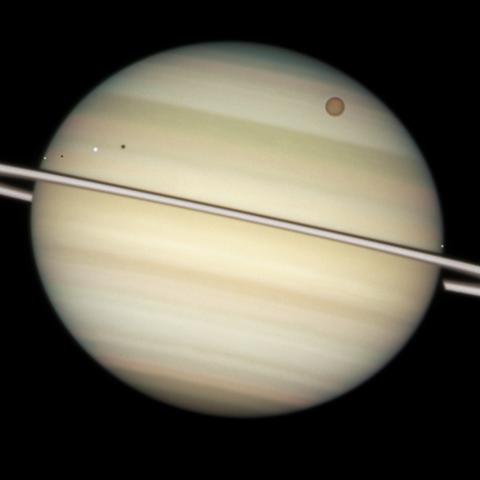
Every 14 to 15 years, Saturn's rings are tilted edge-on to our line of sight. As the bright, beautiful rings seem to grow narrower it becomes increasingly difficult to see them, even with large telescopes. But it does provide the opportunity to watch multiple transits of Saturn's moons. During a transit, a sunlit moon and its shadow glide across the cloudy face of the gas giant. Recorded on February 24, this Hubble image is part of a sequence showing the transit of four of Saturn's moons. From left to right are Enceladus and shadow, Dione and shadow, and Saturn's largest moon Titan. Small moon Mimas is just touching Saturn's disk near the ring plane at the far right. The shadows of Titan and Mimas have both moved off the right side of the disk. Saturn itself has an equatorial diameter of about 120,000 kilometers.

https://apod.nasa.gov/apod/ap090319.html

#space #moon #titan #astrophotography #photography #science #astronomy #nature #NASA

2005 October 21

Ringside
* Credit : Cassini Imaging Team, SSI, JPL, ESA, NASA
http://ciclops.org/
http://www.spacescience.org/
http://www.jpl.nasa.gov/
http://www.esa.int/
http://www.nasa.gov/home/index.html

Explanation:
Orbiting in the plane of Saturn's rings, Dione and the other icy saturnian moons have a perpetual ringside view of the gorgeous gas giant planet. Of course, while passing through the ring plane the Cassini spacecraft also shares their stunning perspective. The rings themselves can be seen slicing across the bottom of this Cassini snapshot. Remarkably thin, the bright rings still cast arcing shadows across the planet's cloud tops. Pale Dione, in the foreground, is about 1,100 kilometers across and orbits over 300,000 kilometers from the visible outer edge of the A ring.

https://apod.nasa.gov/apod/ap051021.html

#space #moon #Dione #saturn #astrophotography #photography #science #astronomy #nature #NASA

2015 August 24

Dione, Rings, Shadows, Saturn
* Credit : Cassini Imaging Team, SSI, JPL, ESA, NASA
http://ciclops.org/
http://www.spacescience.org/
http://www.jpl.nasa.gov/
http://www.esa.int/
http://www.nasa.gov/home/index.html

Explanation:
What's happening in this strange juxtaposition of moon and planet? First and foremost, Saturn's moon Dione was captured here in a dramatic panorama by the robotic Cassini spacecraft currently orbiting the giant planet. The bright and cratered moon itself spans about 1100-km, with the large multi-ringed crater Evander visible on the lower right. Since the rings of Saturn are seen here nearly edge-on, they are directly visible only as a thin horizontal line that passes behind Dione. Arcing across the bottom of the image, however, are shadows of Saturn's rings, showing some of the rich texture that could not be seen directly. In the background, few cloud features are visible on Saturn. The featured image was taken during the last planned flyby of Dione by Cassini, as the spacecraft is scheduled to dive into Saturn's atmosphere during 2017.

https://apod.nasa.gov/apod/ap150824.html

#space #moon #Dione #Saturn #astrophotography #photography #science #astronomy #nature #NASA

2015 July 8

In the Company of Dione
* Image Credit: NASA/JPL-Caltech/Space Science Institute
http://www.nasa.gov/
http://www.spacescience.org/index.php

Explanation:
That is not our Moon. It's Dione, and it's a moon of Saturn. The robotic Cassini spacecraft took the featured image during a flyby of Saturn's cratered Moon last month. Perhaps what makes this image so interesting, though, is the background. First, the large orb looming behind Dione is Saturn itself, faintly lit by sunlight first reflected from the rings. Next, the thin lines running diagonally across the image are the rings of Saturn themselves. The millions of icy rocks that compose Saturn's spectacular rings all orbit Saturn in the same plane, and so appear surprisingly thin when seen nearly edge-on. Front and center, Dione appears in crescent phase, partially lit by the Sun that is off to the lower left. A careful inspection of the ring plane should also locate the moon Enceladus on the upper right.

https://apod.nasa.gov/apod/ap150708.html

#space #moon #Dione #saturn #astrophotography #photography #science #astronomy #nature #NASA

2025 June 10

Enceladus in True Color
* Image Credit: NASA, ESA, JPL, SSI, Cassini Imaging Team
http://ciclops.org/
http://www.spacescience.org/
http://www.jpl.nasa.gov/
http://www.esa.int/
http://www.nasa.gov/home/index.html

Explanation:
Do oceans under the ice of Saturn's moon Enceladus contain life? A reason to think so involves long features -- some dubbed tiger stripes -- that are known to be spewing ice from the moon's icy interior into space. These surface cracks create clouds of fine ice particles over the moon's South Pole and create Saturn's mysterious E-ring. Evidence for this has come from the robot Cassini spacecraft that orbited Saturn from 2004 to 2017. Pictured here, a high resolution image of Enceladus is shown in true color from a close flyby. The deep crevasses are partly shadowed. Why Enceladus is active remains a mystery, as the neighboring moon Mimas, approximately the same size, appears quite dead. An analysis of ejected ice grains has yielded evidence that complex organic molecules exist inside Enceladus. These large carbon-rich molecules bolster -- but do not prove -- that oceans under Enceladus' surface could contain life.
https://science.nasa.gov/saturn/moons/enceladus/

https://apod.nasa.gov/apod/ap250610.html

#space #moon #Enceladus #saturn #astrophotography #photography #science #astronomy #nature #NASA

2007 October 13

Enceladus Ice Geysers
* Credit : Cassini Imaging Team, SSI, JPL, ESA, NASA
http://ciclops.org/
http://www.spacescience.org/
http://www.jpl.nasa.gov/
http://www.esa.int/
http://www.nasa.gov/home/index.html

Explanation:
Ice geysers erupt on Enceladus, bright and shiny inner moon of Saturn. Shown in this false-color image, a backlit view of the moon's southern limb, the majestic, icy plumes were discovered by instruments on the Cassini Spacecraft during close encounters with Enceladus in November of 2005. Eight source locations for these geysers have now been identified along substantial surface fractures in the moon's south polar region. Researchers suspect the geysers arise from near-surface pockets of liquid water with temperatures near 273 kelvins (0 degrees C). That's hot when compared to the distant moon's surface temperature of 73 kelvins (-200 degrees C). The cryovolcanism is a dramatic sign that tiny, 500km-diameter Enceladus is surprisingly active. Enceladus ice geysers also likely produce Saturn's faint but extended E ring.
https://en.wikipedia.org/wiki/Enceladus

https://apod.nasa.gov/apod/ap071013.html

#space #moon #Enceladus #saturn #astrophotography #photography #science #astronomy #nature #NASA

Titan Touchdown: Huygens Descent Movie
* Video Credit: ESA, NASA, JPL, U. Arizona, E. Karkoschka
https://www.esa.int/
https://www.nasa.gov/
https://www.jpl.nasa.gov/
https://www.lpl.arizona.edu/missions/cassini
https://www.lpl.arizona.edu/research-scientists/erich-karkoschka

Explanation:
What would it look like to land on Saturn's moon Titan? The European Space Agency's Huygens probe set down on the Solar System's cloudiest moon in 2005, and a time-lapse video of its descent images was created. Huygens separated from the robotic Cassini spacecraft soon after it achieved orbit around Saturn in late 2004 and began approaching Titan. For two hours after arriving, Huygens plummeted toward Titan's surface, recording at first only the shrouded moon's opaque atmosphere. The computerized truck-tire sized probe soon deployed a parachute to slow its descent, pierced the thick clouds, and began transmitting images of a strange surface far below never before seen in visible light. Landing in a dried sea and surviving for 90 minutes, Huygen's returned unique images of a strange plain of dark sandy soil strewn with smooth, bright, fist-sized rocks of ice.
https://en.wikipedia.org/wiki/Huygens_%28spacecraft%29
https://www.esa.int/Science_Exploration/Space_Science/Cassini-Huygens/Huygens_spacecraft
https://apod.nasa.gov/apod/ap050117.html
https://apod.nasa.gov/apod/ap041028.html

https://apod.nasa.gov/apod/ap250119.html

#space #moon #Titan #saturn #astrophotography #photography #science #astronomy #nature #NASA #ESA

2013 December 20

Titan's Land of Lakes
* Image Credit: Cassini Radar Mapper, JPL, USGS, ESA, NASA
http://saturn.jpl.nasa.gov/spacecraft/cassiniorbiterinstruments/instrumentscassiniradar/
http://www.jpl.nasa.gov/
http://astrogeology.usgs.gov/
http://www.esa.int/
http://www.nasa.gov/

Explanation:
Saturn's large moon Titan would be unique in our solar system, the only world with stable liquid lakes and seas on its surface ... except for planet Earth of course. Centered on the north pole, this colorized map shows Titan's bodies of methane and ethane in blue and black, still liquid at frigid surface temperatures of -180 degrees C (-292 degrees F). The map is based on data from the Cassini spacecraft's radar, taken during flybys between 2004 and 2013. Roughly heart-shaped, the lake above and right of the pole is Ligeia Mare, the second largest known body of liquid on Titan and larger than Lake Superior on Earth. Just below the north pole is Punga Mare. The sprawling sea below and right of Punga is the (hopefully sleeping) Kraken Mare, Titan's largest known sea. Above and left of the pole, the moon's surface is dotted with smalle
https://science.nasa.gov/photojournal/titans-north/
https://science.nasa.gov/solar-system/planets/
https://www.spacedaily.com/reports/Life_Without_Water_And_The_Habitable_Zone_999.html
https://apod.nasa.gov/apod/ap120515.html
https://apod.nasa.gov/apod/ap110401.html
https://science.nasa.gov/science-missions/
https://science.nasa.gov/photojournal/
https://www.planetary.org/articles/20130527-the-shores-of-the-kraken-sea
https://apod.nasa.gov/apod/ap050117.html

https://apod.nasa.gov/apod/ap131220.html

#space #moon #Enceladus #saturn #astrophotography #photography #science #astronomy #nature #NASA #ESA