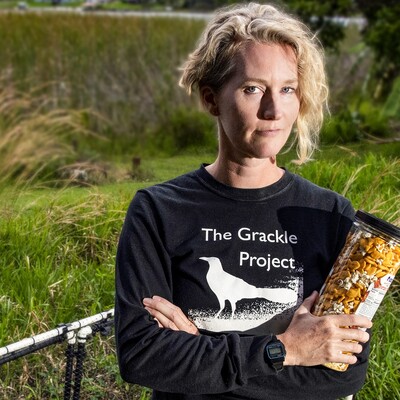
๐Ÿ”ฅ Hot off the press from #TheGrackleProject!
๐ŸŒ‡ When the city comes to you, be #flexible
When you go to the city, be #persistent

Great-tailed grackles who were #trained to be more flexible used a wider variety of foods ๐Ÿฟ and #foraging techniques, but had similar #habitat use patterns and #social behavior as non-trained grackles.

Given that this species is rapidly expanding its geographic #range ๐Ÿ—บ๏ธ and shifting more toward #urban ๐Ÿ™๏ธ and #arid ๐Ÿœ๏ธ environments in recent years, our finding could suggest that foraging breadth (the number of different food types an individual eats) is a factor in #adapting to #Human-modifiedEnvironments

Article: https://doi.org/10.24072/pcjournal.573
Press release: https://www.mpg.de/25000634/0701-evan-when-the-city-comes-to-you-150495-x

โ‰๏ธ How do you train a grackle to be more flexible? Serial reversal learning! #TheGrackleProject has them form a color ๐ŸŽจ preference, and then reverse the preference over and over again until they get fast at reversing (it only takes 6-8 reversals to get fast)
https://nerdculture.de/@CorinaLogan/113551520178546430
https://doi.org/10.24072/pcjournal.284

The wide ranging effects of the flexibility training led us to start the #ManyIndividuals project to see whether we can train threatened and endangered species to be more flexible, and if this helps them survive in human-modified environments (where the grackles shine)
https://github.com/ManyIndividuals/ManyIndividuals

Corina Logan (she/her) (@[email protected])

Attached: 1 video After 9 years of studying them, these grackles continue to amaze me! This field season is the first where we implemented the comparative cognition experiments in the wild instead of in aviaries. I was worried that they wouldn't participate even when they were frustrated with the test (suddenly changing the food from the preferred color feeder to the other color feeder is an annoying thing to do to someone). Not only do they participate as much as, or more than, the grackles in the aviaries, they do all of this in the middle of public spaces where people/cars/dogs walk right by the feeders. WOW! I am so impressed by these birds! Thank you grackles for playing games with me! #TheGrackleProject #ManyIndividuals ALT: Orange made the correct choice (dark gray feeder), eats crackers from the tray, goes to the water cup between the feeders and drinks water. He chooses the dark gray feeder, I press the remote (โ€œboingโ€ sound), food comes out, I record his choice, and he eats from the tray

NerdCulture

In the process of studying #behavioral #flexibility in great-tailed grackles on #TheGrackleProject, we discovered ๐ŸŽ‰ a new measure of flexibility! The grackles that were more flexible in the reversal learning test also switched between eating different food types more often in the wild ๐ŸŒฎ ๐Ÿฟ ๐Ÿช ๐Ÿ’

This is such an exciting discovery because it is really difficult to bring birds into aviaries to measure their flexibility. Now we have the ability to measure their flexibility just by watching them in the wild!

This will make studying flexibility much more accessible to a wide range of researchers because, apart from needing to be able to tell the individuals apart, all that is needed is a pair of binoculars
Article: https://doi.org/10.24072/pcjournal.573
Press release: https://www.mpg.de/25000634/0701-evan-when-the-city-comes-to-you-150495-x

#Behavioral #flexibility is not the primary facilitator of a rapid #range expansion. Although we found high levels of flexibility in 2 successful urban bird species (great-tailed & boat-tailed grackles), only one (great) is rapidly expanding its range. This suggests flexibility alone doesn't drive rapid range expansions

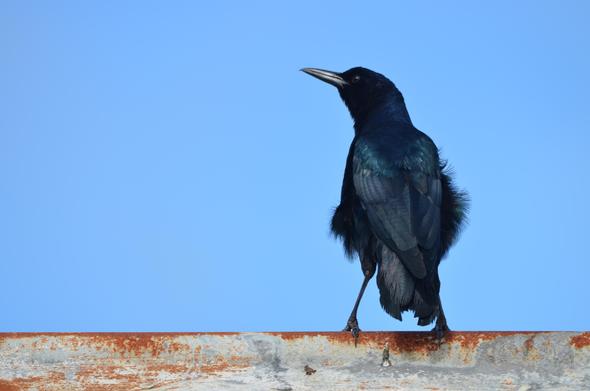
#TheGrackleProject went to Florida to study boat-tailed grackle flexibility and compare it with the great-tailed grackles. These species look and behave so similarly, if they were right next to each other, I couldnโ€™t tell them apart (except greats have yellow irises and these boats had brown irises). They are parking lot birds through & through! ๐Ÿ…ฟ๏ธ

But in the aviaries, it becomes obvious really quickly that the great-tailed grackles are much more persistent - they will try and try to solve something, whereas a boat-tailed grackle often just sits on their perch ๐Ÿฅ, looks at the apparatus & decides not to even try

https://doi.org/10.24072/pcjournal.582
https://www.mpg.de/25000634/0701-evan-when-the-city-comes-to-you-150495-x

The growing body of research we have been conducting on #TheGrackleProject is showing that #behavioral #flexibility enables birds to #adapt to #human #modified #habitats ๐ŸŒ† , but plays a smaller role in expanding into new #geographic areas ๐Ÿ—บ๏ธ

Moving to new towns likely involves more #persistence because we previously found that grackles on the edge of their range in northern California had similar levels of average flexibility (though higher variance), but were more persistent than grackles nearer the center of their range in Arizona https://peercommunityjournal.org/articles/10.24072/pcjournal.320/

This is also supported by the fact that the preliminary data we were able to collect on persistence in boat-tailed grackles (who are not rapidly expanding their geographic range) showed that they are less persistent than great-tailed grackles, while having similar levels of flexibility
Articles: https://doi.org/10.24072/pcjournal.573 and https://doi.org/10.24072/pcjournal.582
Press release: https://www.mpg.de/25000634/0701-evan-when-the-city-comes-to-you-150495-x
There are so many people to thank who were involved in making this research happen! The acknowledgements sections of both articles are massive - it took a village to do this research!

None of it would have been possible without the immense amount of support from Richard McElreath and the Dept. of Human Behavior, Ecology and Culture at the Max Planck Institute for Evolutionary Anthropology ๐Ÿ’•

The University of California Santa Barbara has been the steady supporter over all of the years of #TheGrackleProject - providing a home base for the project, a place to base the (many!) permits out of, and support through cooperation agreements - thank you! ๐Ÿ’“

๐Ÿ’ช These articles started off as #RegisteredReports at #PCIEcology and @pcirr @PeerCommunityIn years ago! This ensures that our research is of a high quality and that the results are robust

๐ŸŽ‰ It is so exciting to see them now completed, and also at @PeerCommunityJournal

Of course, we published the data and code (with metadata), and even have the reproducible manuscripts (Rmarkdown files) where the text and code are written together so you can see exactly what code was used for which analysis or figure ๐Ÿ’•

Articles: https://doi.org/10.24072/pcjournal.573 and https://doi.org/10.24072/pcjournal.582
Press release: https://www.mpg.de/25000634/0701-evan-when-the-city-comes-to-you-150495-x

Behavioral flexibility is related to foraging, but not social or habitat use behaviors, in a species that is rapidly expanding its range