TOPIC> Perseids & Co. Meteor Showers

2023 August 24

Meteors along the Milky Way
* Image Credit & Copyright: Ali Hosseini Nezhad

Explanation:
Under dark and mostly moonless night skies, many denizens of planet Earth were able to watch this year's Perseid meteor shower. Seen from a grassy hillside from Shiraz, Iran these Perseid meteors streak along the northern summer Milky Way before dawn on Sunday, August 13. Frames used to construct the composited image were captured near the active annual meteor shower's peak between 02:00 AM and 04:30 AM local time. Not in this night skyscape, the shower's radiant in the heroic constellation Perseus is far above the camera's field of view. But fans of northern summer nights can still spot a familiar asterism. Formed by bright stars Deneb, Vega, and Altair, the Summer Triangle spans the luminous band of the Milky Way.

https://apod.nasa.gov/apod/ap230824.html

#space #galaxy #perseids #astrophotography #photography #science #astronomy #nature #NASA

Perseids
NASA Science Editorial Team

Perseids Meteor Shower

The Perseids meteor shower peaks in mid-August, and is the most popular meteor shower of the year.

About the Meteor Shower

The Perseids, which peaks in mid-August, is considered the best meteor shower of the year. With swift and bright meteors, Perseids frequently leave long "wakes" of light and color behind them as they streak through Earth's atmosphere. The Perseids are one of the most plentiful showers with about 50 to 100 meteors seen per hour. They occur with warm summer nighttime weather allowing sky watchers to comfortably view them.

Perseids are also known for their fireballs. Fireballs are larger explosions of light and color that can persist longer than an average meteor streak. This is due to the fact that fireballs originate from larger particles of cometary material. Fireballs are also brighter, with apparent magnitudes greater than -3.
Viewing Tips

The Perseids are best viewed in the Northern Hemisphere during the pre-dawn hours, though at times it is possible to view meteors from this shower as early as 10 p.m.
Where Do Meteors Come From?

Meteors come from leftover comet particles and bits from broken asteroids. When comets come around the Sun, they leave a dusty trail behind them. Every year Earth passes through these debris trails, which allows the bits to collide with our atmosphere and disintegrate to create fiery and colorful streaks in the sky.
The Comet

The pieces of space debris that interact with our atmosphere to create the Perseids originate from comet 109P/Swift-Tuttle. Swift-Tuttle takes 133 years to orbit the Sun once. It was Giovanni Schiaparelli who realized in 1865 that this comet was the source of the Perseids. Comet Swift-Tuttle last visited the inner solar system in 1992.

https://science.nasa.gov/solar-system/meteors-meteorites/perseids/

#space #galaxy #perseids #astrophotography #photography #science #astronomy #nature #NASA

2024 August 9

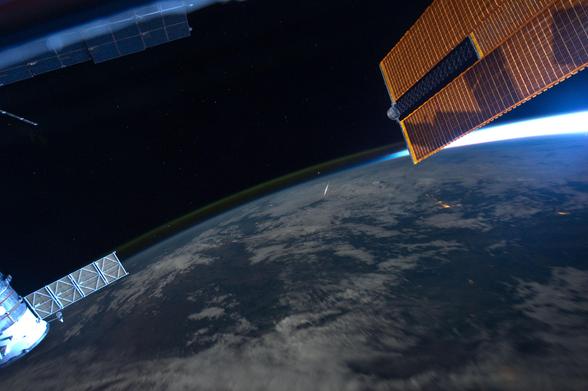
A Perseid Below
* Image Credit: Ron Garan, ISS Expedition 28 Crew, NASA
https://www.nasa.gov/mission/expedition-28/
https://www.nasa.gov/

Explanation:
Denizens of planet Earth typically watch meteor showers by looking up. But this remarkable view, captured on August 13, 2011 by astronaut Ron Garan, caught a Perseid meteor by looking down. From Garan's perspective on board the International Space Station orbiting at an altitude of about 380 kilometers, the Perseid meteors streak below, swept up dust from comet Swift-Tuttle. The vaporizing comet dust grains are traveling at about 60 kilometers per second through the denser atmosphere around 100 kilometers above Earth's surface. In this case, the foreshortened meteor flash is near frame center, below the curving limb of the Earth and a layer of greenish airglow, just below bright star Arcturus. Want to look up at a meteor shower? You're in luck, as the 2024 Perseid meteor shower is active now and predicted to peak near August 12. With interfering bright moonlight absent, this year you'll likely see many Perseid meteors under clear, dark skies after midnight.

https://apod.nasa.gov/apod/ap240809.html

#space #galaxy #perseids #astrophotography #photography #science #astronomy #nature #NASA

"Our pets and farm animals also enjoy the annual variety full of short surprises in the night sky. It will start again soon! Do you already know when and where to look? Look here, there is everything:https://earthsky.org/astronomy-essentials/everything-you-need-to-know-perseid-meteor-shower/"

2019 August 15

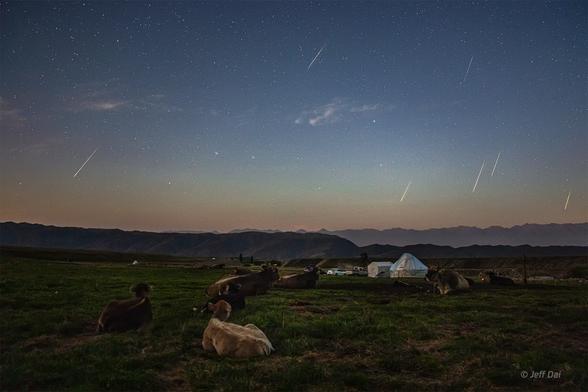
The Perseids and the Plough
* Image Credit & Copyright: Jeff Dai (TWAN)
https://twanight.org/profile/jeff-dai/

Explanation:
Despite interfering moonlight, many denizens of planet Earth were able to watch this year's Perseid meteor shower. This pastoral scene includes local skygazers admiring the shower's brief, heavenly flashes in predawn hours near peak activity on August 13 from Nalati Grassland in Xinjiang, China. A composite, the image registers seven frames taken during a two hour span recording Perseid meteor streaks against a starry sky. Centered along the horizon is the Plough, the north's most famous asterism, though some might see the familiar celestial kitchen utensil known as the Big Dipper. Perhaps the year's most easily enjoyed meteor shower, Perseid meteors are produced as Earth itself sweeps through dust from periodic comet Swift-Tuttle. The dust particles are vaporized at altitudes of 100 kilometers or so as they plow through the atmosphere at 60 kilometers per second.

https://apod.nasa.gov/apod/ap190815.html

#space #galaxy #perseids #astrophotography #photography #science #astronomy #nature #NASA
2018 September 8

Real Time Perseid
* Video Credit & Copyright: Till Credner, AlltheSky.com
http://www.allthesky.com/

Explanation:
Bright meteors and dark night skies made this year's Perseid meteor shower a great time for a weekend campout. And while packing away their equipment, skygazers at a campsite in the mountains of southern Germany found at least one more reason to linger under the stars, witnessing this brief but colorful flash with their own eyes. Presented as a 50 frame gif, the two second long video was captured during the morning twilight of August 12. In real time it shows the development of the typical green train of a bright Perseid meteor. A much fainter Perseid is just visible farther to the right. Plowing through Earth's atmosphere at 60 kilometers per second, Perseids are fast enough to excite the characteristic green emission of atomic oxygen at altitudes of 100 kilometers or so.

https://apod.nasa.gov/apod/ap180908.html

#space #galaxy #perseids #astrophotography #photography #science #astronomy #nature #NASA
2022 August 16

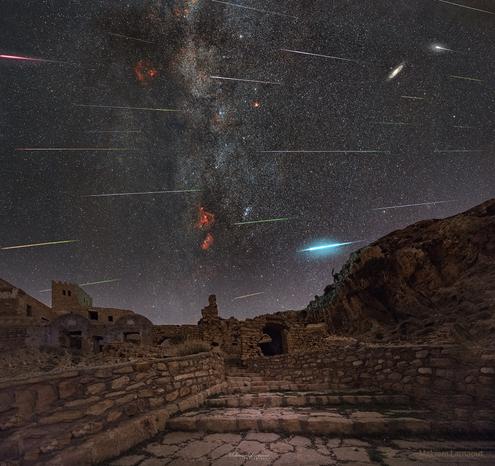
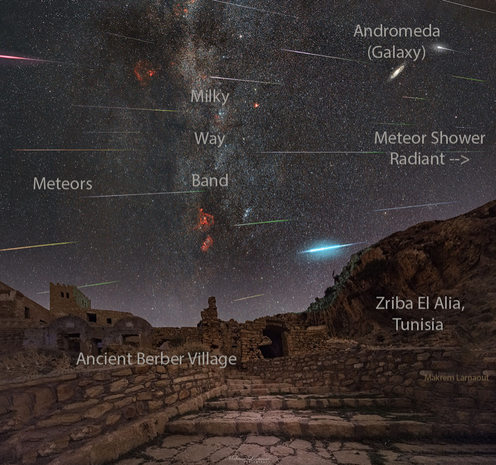
A Meteor Wind over Tunisia
* Image Credit & Copyright: Makrem Larnaout
https://www.facebook.com/TheRoyalAstronomicalSociety

Explanation:
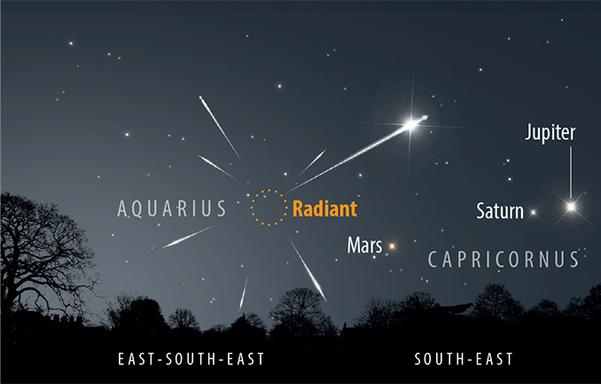
Does the Earth ever pass through a wind of meteors? Yes, and they are frequently visible as meteor showers. Almost all meteors are sand-sized debris that escaped from a Sun-orbiting comet or asteroid, debris that continues in an elongated orbit around the Sun. Circling the same Sun, our Earth can move through an orbiting debris stream, where it can appear, over time, as a meteor wind. The meteors that light up in Earth's atmosphere, however, are usually destroyed. Their streaks, though, can all be traced back to a single point on the sky called the radiant. The featured image composite was taken over two days in late July near the ancient Berber village Zriba El Alia in Tunisia, during the peak of the Southern Delta Aquariids meteor shower. The radiant is to the right of the image. A few days ago our Earth experienced the peak of a more famous meteor wind -- the Perseids.

https://apod.nasa.gov/apod/ap220816.html

#space #galaxy #perseids #astrophotography #photography #science #astronomy #nature #NASA
2022 August 11

Perseids and MAGIC
* Image Credit & Copyright: Urs Leutenegger
https://www.instagram.com/urs.leutenegger/?hl=en

Explanation:
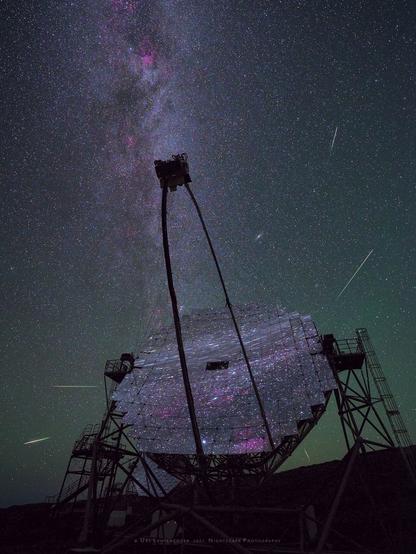
On August 11, 2021 a multi-mirror, 17 meter-diameter MAGIC telescope reflected this starry night sky from the Roque de los Muchachos European Northern Observatory on the Canary Island of La Palma. MAGIC stands for Major Atmospheric Gamma Imaging Cherenkov. The telescopes can see the brief flashes of optical light produced in particle air showers as high-energy gamma rays impact the Earth's upper atmosphere. To the dark-adapted eye the mirror segments offer a tantalizing reflection of stars and nebulae along the plane of our Milky Way galaxy. But directly behind the segmented mirror telescope, low on the horizon, lies the constellation Perseus. And on that date the dramatic composite nightscape also captured meteors streaming from the radiant of the annual Perseid meteor shower. This year the Perseid shower activity will again peak around August 13 but perseid meteors will have to compete with the bright light of a Full Moon.

https://apod.nasa.gov/apod/ap220811.html

#space #galaxy #perseids #astrophotography #photography #science #astronomy #nature #NASA
2016 August 20

Gamma-rays and Comet Dust
* Image Credit & Copyright: Daniel López (El Cielo de Canarias)
https://www.elcielodecanarias.com/

Explanation:
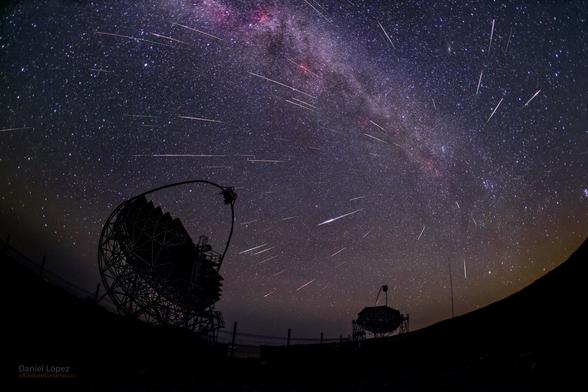
Gamma-rays and dust from periodic Comet Swift-Tuttle plowed through planet Earth's atmosphere on the night of August 11/12. Impacting at about 60 kilometers per second the grains of comet dust produced this year's remarkably active Perseid meteor shower. This composite wide-angle image of aligned shower meteors covers a 4.5 hour period on that Perseid night. In it the flashing meteor streaks can be traced back to the shower's origin on the sky. Alongside the Milky Way in the constellation Perseus, the radiant marks the direction along the perodic comet's orbit. Traveling at the speed of light, cosmic gamma-rays impacting Earth's atmosphere generated showers too, showers of high energy particles. Just as the meteor streaks point back to their origin, the even briefer flashes of light from the particles can be used to reconstruct the direction of the particle shower, to point back to the origin on the sky of the incoming gamma-ray. Unlike the meteors, the incredibly fast particle shower flashes can't be followed by eye. But both can be followed by the high speed cameras on the multi-mirrored dishes in the foreground. Of course, the dishes are MAGIC (Major Atmospheric Gamma Imaging Cherenkov) telescopes, an Earth-based gamma-ray observatory on the Canary Island of La Palma.

https://apod.nasa.gov/apod/ap160820.html

#space #galaxy #perseids #astrophotography #photography #science #astronomy #nature #NASA
"To upload this video, I converted it and compressed it to a smaller file-size under #linux with the free software ffmpeg and the corresponding command:

'ffmpeg -i video_in.mkv -vcodec libx265 -crf 30 video_out.mp4'

Maybe you would like to post a corresponding video on a scientifically related topic, but it is perhaps too big? Then try ffmpeg.

Just for now let's enjoy this Perseids Night Timelaps together"

2021 September 28

Night of the Perseids
* Video Credit & Copyright: Vikas Chander & Dorje Angchuk
https://www.youtube.com/channel/UCa_53XIkP1fYEbHCWoMgIrg
* Music: Tea Time via PremiumBeat
https://www.premiumbeat.com/artist/yellow-tea

Explanation:
Have you ever experienced a meteor shower? To help capture the wonder, a video was taken during the peak of the recent Perseid meteor shower above the Indian Astronomical Observatory in Hanle, India, high up in the Himalayan mountains. Night descends as the video begins, with the central plane of our Milky Way Galaxy approaching from the left and Earth-orbiting satellites zipping by overhead. During the night, the flash of meteors that usually takes less than a second is artificially extended. The green glow of most meteors is typically caused by vaporizing nickel. As the video continues, Orion rises and meteors flare above the 2-meter Himalayan Chandra Telescope and the seven barrels of the High Energy Gamma Ray Telescope (Hagar). The 2 minute 30 second movie ends with the Sun rising, preceded by a false dawn of zodiacal light.

https://apod.nasa.gov/apod/ap210928.html

#space #galaxy #perseids #astrophotography #photography #science #astronomy #nature #NASA
2023 August 23 (*)

The Meteor and the Galaxy
* Credit & Copyright: Jose Pedrero
https://www.instagram.com/josepedrero.jpart/

Explanation:
It came from outer space. It -- in this case a sand-sized bit of a comet nucleus -- was likely ejected many years ago from Sun-orbiting Comet Swift-Tuttle, but then continued to orbit the Sun alone. When the Earth crossed through this orbit, the piece of comet debris impacted the atmosphere of our fair planet and was seen as a meteor. This meteor deteriorated, causing gases to be emitted that glowed in colors emitted by its component elements. The featured image was taken last week(*) from Castilla La Mancha, Spain, during the peak night of the Perseids meteor shower. The picturesque meteor streak happened to appear in the only one of 50 frames that also included the Andromeda galaxy. Stars dot the frame, each much further away than the meteor. Compared to the stars, the Andromeda galaxy (M31) is, again, much further away.

https://apod.nasa.gov/apod/ap230823.html

#space #galaxy #perseids #astrophotography #photography #astroart #science #astronomy #nature #NASA

2018 August 17

Perseid Fireball and Persistent Train
* Image Credit & Copyright: Petr Horálek
http://www.astronom.cz/horalek/?page_id=20

Explanation:
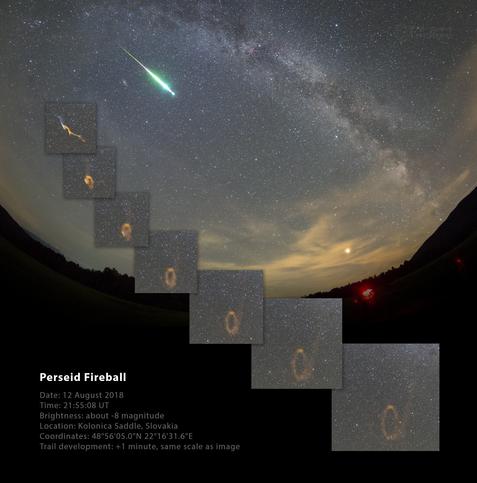
Before local midnight on August 12, this brilliant Perseid meteor flashed above the Poloniny Dark Sky Park, Slovakia, planet Earth. Streaking beside the summer Milky Way, its initial color is likely due to the shower meteor's characteristically high speed. Moving at about 60 kilometers per second, Perseid meteors can excite green emission from oxygen atoms while passing through the thin atmosphere at high altitudes. Also characteristic of bright meteors, this Perseid left a lingering visible trail known as a persistent train, wafting in the upper atmosphere. Its development is followed in the inset frames, exposures separated by one minute and shown at the scale of the original image. Compared to the brief flash of the meteor, the wraith-like trail really is persistent. After an hour faint remnants of this one could still be traced, expanding to over 80 degrees on the sky.

https://apod.nasa.gov/apod/ap180817.html

#space #galaxy #perseids #astrophotography #photography #science #astronomy #nature #NASA

Radiant (meteor shower)

From Wikipedia, the free encyclopedia

The radiant or apparent radiant of a meteor shower is the celestial point in the sky from which (from the point of view of a terrestrial observer) the paths of meteors appear to originate. The Perseids, for example, are meteors which appear to come from a point within the constellation of Perseus.

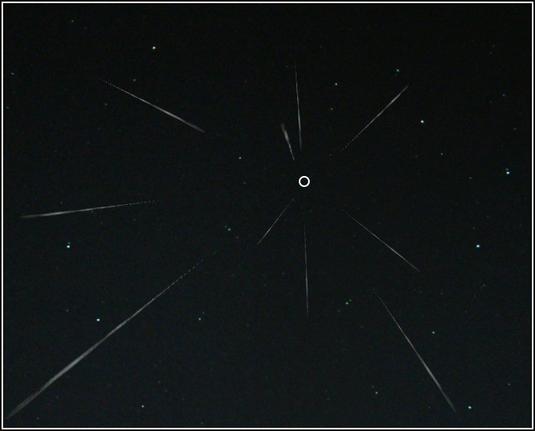
Meteor paths appear at random locations in the sky, but the apparent paths of two or more meteors from the same shower will diverge from the radiant. The radiant is the vanishing point of the meteor paths, which are parallel lines in three-dimensional space, as seen from the perspective of the observer, who views a two-dimensional projection against the sky. The geometric effect is identical to crepuscular rays, where parallel sunbeams appear to diverge.

A meteor that does not point back to the known radiant for a given shower is known as a sporadic and is not considered part of that shower.

Shower meteors may appear a short time before the radiant has risen in the observer's eastern sky. The radiant in such cases is above the horizon at the meteor's altitude.

During the active period of most showers, the radiant moves nearly one degree eastwards, parallel to the ecliptic, against the stellar background each day. This is called the radiant's diurnal drift, and is to a large degree due to the Earth's own orbital motion around the Sun, which also proceeds at nearly one degree a day. As the radiant is determined by the superposition of the motions of Earth and meteoroid, the changing orbital direction of the Earth towards the east causes the radiant to move to the east as well.
[...]
https://en.wikipedia.org/wiki/Radiant_(meteor_shower)

#space #galaxy #perseids #astrophotography #photography #science #astronomy #nature #NASA
From Wikipedia, the free encyclopedia
Radiant (meteor shower)

[...]
Meteor showers are mostly caused by the trails of dust and debris left in the wake of a comet. This dust continues to move along the comet's wake, and when the Earth moves through such debris, a meteor shower results. Because all of the debris is moving in roughly the same direction, the meteors which strike the atmosphere all "point" back to the direction of the comet's path.

As an exception, the Geminids are a shower caused by the object 3200 Phaethon, which is thought to be a Palladian asteroid.

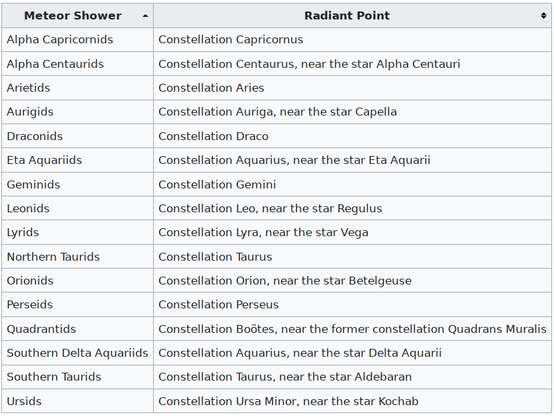
The radiant is an important factor in observation. If the radiant point is at or below the horizon, then few if any meteors will be observed. This is because the atmosphere shields the Earth from most of the debris, and only those meteors which happen to be travelling exactly (or very near) tangential to the Earth's surface will be viewable.

Here are the radiant points of some major meteor showers of the year.

CREDIT
Contributors to Wikimedia projects

https://en.wikipedia.org/wiki/Radiant_(meteor_shower)

#space #galaxy #perseids #astrophotography #photography #science #astronomy #nature #NASA
2023 August 9

Meteor Shower: Perseids from Perseus
* Credit & Copyright: Petr Horálek / Institute of Physics in Opava
https://www.petrhoralek.com/#about-1
https://www.slu.cz/phys/en/

Explanation:
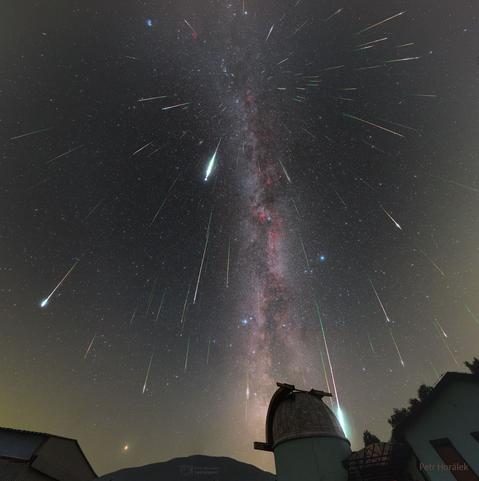
This is a good week to see meteors. Comet dust will rain down on planet Earth, streaking through dark skies during peak nights of the annual Perseid Meteor Shower. The featured composite image was taken during the 2018 Perseids from the Poloniny Dark Sky Park in Slovakia. The dome of the observatory in the foreground is on the grounds of Kolonica Observatory. Although the comet dust particles travel parallel to each other, the resulting shower meteors clearly seem to radiate from a single point on the sky in the eponymous constellation Perseus. The radiant effect is due to perspective, as the parallel tracks appear to converge at a distance, like train tracks. The Perseid Meteor Shower is expected to reach its highest peak on Saturday after midnight. Since a crescent Moon will rise only very late that night, cloudless skies will be darker than usual, making a high number of faint meteors potentially visible this year.

https://apod.nasa.gov/apod/ap230809.html

#space #galaxy #perseids #astrophotography #photography #science #astronomy #nature #NASA
2025 August 2

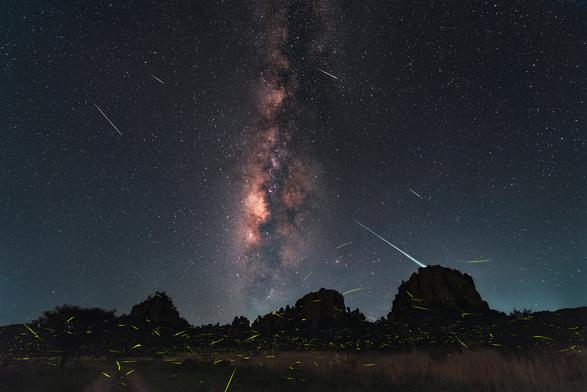
Fireflies, Meteors, and Milky Way
* Image Credit & Copyright: Daniel Korona

Explanation:
Taken on July 29 and July 30, a registered and stacked series of exposures creates this dreamlike view of a northern summer night. Multiple firefly flashes streak across the foreground as the luminous Milky Way arcs above the horizon in the Sierra de Órganos national park of central Mexico, The collection of bright streaks aligned across the sky toward the upper left in the timelapse image are Delta Aquariid meteors. Currently active, the annual Delta Aquarid meteor shower shares August nights though, overlapping with the better-known Perseid meteor shower. This year that makes post-midnight, mostly moonless skies in early August very popular with late night skygazers. How can you tell a Delta Aquariid from a Perseid meteor? The streaks of Perseid meteors can be traced back to an apparent radiant in the constellation Perseus. Delta Aquariids appear to emerge from the more southerly constellation Aquarius, beyond the top left of this frame. Of course, the bioluminescent flashes of fireflies are common too on these northern summer nights. But how can you tell a firefly from a meteor? Just try to catch one.

https://apod.nasa.gov/apod/ap250802.html

#space #galaxy #perseids #astrophotography #photography #science #astronomy #nature #NASA
2025 August 3

Milky Way and Exploding Meteor
* Image Credit & Copyright: Andre van der Hoeven
https://www.flickr.com/photos/avdhoeven/

Explanation:
In about a week the Perseid Meteor Shower will reach its maximum. Grains of icy rock will streak across the sky as they evaporate during entry into Earth's atmosphere. These grains were shed from Comet Swift-Tuttle. The Perseids result from the annual crossing of the Earth through Comet Swift-Tuttle's orbit, and are typically the most active meteor shower of the year. Although it is hard to predict the level of activity in any meteor shower, in a clear dark sky an observer might see a meteor a minute. This year's Perseids peak just a few days after full moon, and so some faint meteors will be lost to the lunar skyglow. Meteor showers in general are best seen from a relaxing position, away from lights. Featured here is a meteor caught exploding during the 2015 Perseids above Austria next to the central band of our Milky Way Galaxy.
https://science.nasa.gov/solar-system/meteors-meteorites/perseids/
https://www.amsmeteors.org/meteor-showers/meteor-shower-calendar/
https://www.nasa.gov/general/what-is-earths-atmosphere/
https://apod.nasa.gov/apod/ap960219.html
https://en.wikipedia.org/wiki/Meteoroid#Meteors
https://www.space.com/32868-perseid-meteor-shower-guide.html

https://apod.nasa.gov/apod/ap250803.html

#space #galaxy #perseids #astrophotography #photography #science #astronomy #nature #NASA
2025 August 12

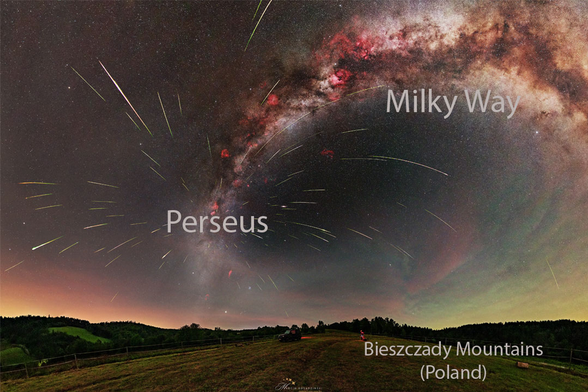
Perseids from Perseus
* Image Credit & Copyright: Marcin Rosadziński
https://astrodream.pl/o-mnie/

Explanation:
Where are all of these meteors coming from? In terms of direction on the sky, the pointed answer is the constellation of Perseus. That is why the meteor shower that peaks tonight is known as the Perseids -- the meteors all appear to come from a radiant toward Perseus. In terms of parent body, though, the sand-sized debris that makes up the Perseids meteors come from Comet Swift-Tuttle. The comet follows a well-defined orbit around our Sun, and the part of the orbit that approaches Earth is superposed in front of Perseus. Therefore, when Earth crosses this orbit, the radiant point of falling debris appears in Perseus. Featured here, a composite image taken over six nights and containing over 100 meteors from 2024 August Perseids meteor shower shows many bright meteors that streaked over the Bieszczady Mountains in Poland. This year's Perseids, usually one of the best meteor showers of the year, will compete with a bright moon that will rise, for many locations, soon after sunset.
https://astrodream.pl/galeria/

https://www.youtube.com/watch?v=CwrvN0Q9_Sg
https://apod.nasa.gov/apod/ap960219.html

https://en.wikipedia.org/wiki/Perseids
https://en.wikipedia.org/wiki/Meteoroid#Meteor
https://en.wikipedia.org/wiki/Radiant_(meteor_shower)
https://www.timeanddate.com/news/astronomy/perseid-meteor-shower-2025
https://www.amsmeteors.org/meteor-showers/2020-meteor-shower-list/
https://apod.nasa.gov/apod/ap180808.html

https://apod.nasa.gov/apod/ap250812.html

#space #galaxy #perseids #astrophotography #photography #science #astronomy #nature #NASA
Meteor Moment: Viewing Tips.

Rhiannon Blaauw, of NASA's Meteoroid Environment Office -- located at NASA's Marshall Space Flight Center in Huntsville, Alabama -- shares some tips and strategies to best view a meteor shower.

CREDIT
NASA's Marshall Space Flight Center - Huntsville, Alabama

#space #galaxy #perseids #astrophotography #photography #science #astronomy #nature #NASA
2007 August 12

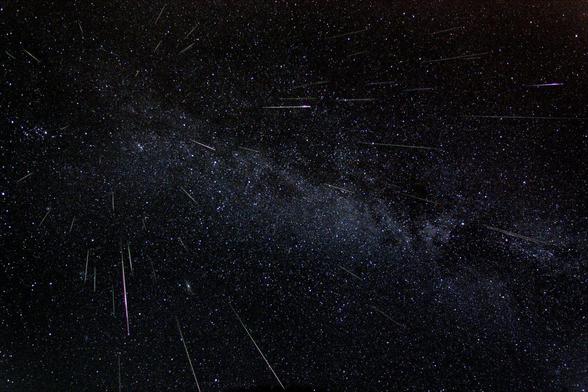
Raining Perseids
* Credit & Copyright: Fred Bruenjes
http://www.moonglow.net/ccd/index.html

Explanation:
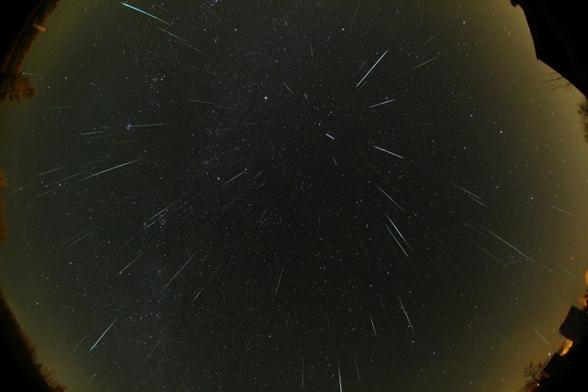
Tonight is a good night to see meteors. Comet dust will rain down on planet Earth, streaking through dark skies in the annual Perseid meteor shower. While enjoying the anticipated space weather, astronomer Fred Bruenjes recorded a series of many 30 second long exposures spanning about six hours on the night of 2004 August 11/12 using a wide angle lens. Combining those frames which captured meteor flashes, he produced this dramatic view of the Perseids of summer. Although the comet dust particles are traveling parallel to each other, the resulting shower meteors clearly seem to radiate from a single point on the sky in the eponymous constellation Perseus. The radiant effect is due to perspective, as the parallel tracks appear to converge at a distance. Bruenjes notes that there are 51 Perseid meteors in the composite image, including one seen nearly head-on. This year, the Perseids Meteor Shower is expected to peak after midnight tonight, in the moonless early morning hours of August 12.

https://apod.nasa.gov/apod/ap070812.html

#space #galaxy #perseids #astrophotography #photography #science #astronomy #nature #NASA

The 2025 Perseid meteor shower peaks on the night between August 12 and August 13. The Perseids usually put on a good show and this year may produce 50 to 75 meteors per hour at a dark site.

Like most meteor showers, the Lyrids are caused by the debris of a comet or asteroid that once crossed Earth's path. In this case, the shower is caused by debris from the comet Swift-Tuttle. Sightings of comet Swift-Tuttle have been recorded throughout history, with the comet’s orbit bringing it near Earth every 133 or so years. It last entered the inner Solar System in 1992. The debris from this comet is known to cause fireballs often.

The Perseid radiant is somewhat north on the sky’s dome, making it more visible from the Northern Hemisphere, but may also be somewhat visible from the Southern Hemisphere. Meteors will appear to come from an area near the constellation Perseus. Meteors will streak out from this area of the sky in all directions.

The best way to watch a meteor shower is from a dark sky site, so it helps to get away from city lights as much as you can. Skywatchers should go to the darkest place they can, let their eyes adjust, and look overhead — but avoid staring directly at the Moon.

Meteors are also known as shooting stars, but they aren't actually stars at all. Meteors are streaks of light in the sky caused by dust and small rocks burning up as they hit Earth's atmosphere at very high speeds — tens of kilometers per second.

These small particles create bright streaks of light you can see from the ground at night. In general, the bigger the piece of space dust, the brighter the meteor. If any pieces of the streaking rock survive to make it to the ground, they're called meteorites.

CREDITS:
The Planetary Society

#space #galaxy #perseids #astrophotography #photography #science #astronomy #nature #NASA
2008 November 25

Fireball Over Edmonton
* Credit & Copyright Global Television Edmonton, YouTube
https://www.globaltv.com/

Explanation:
What if you're driving down the street and an object from space shoots across the sky right in front of you? Such was the case last week for many people in south central Canada. Specifically, an extremely bright fireball, presumably a desk-sized meteor from deep space, flashed across the sky just after sunset on 2008 November 20. The bright fireball was recorded on many images and movies, including the spectacular video shown above that was captured by a dashboard camera of a police cruiser in Edmonton, Alberta, Canada. Because at least two streaks appear to be visible, the falling object likely broke up into pieces as it fell deep into Earth's atmosphere. By triangulating fireball images from several simultaneously recorded sources, astronomers hope to find an approximate orbit from whence the object came, as well as the likely place(s) on Earth where large pieces would have impacted, were they to have survived entry. In the best case scenario, pieces would be recovered from a known deep space comet or asteroid, giving humanity an unprecedented look at an ancient object that likely holds clues to the early years of our Earth and the Solar System.

https://apod.nasa.gov/apod/ap081125.html

#space #galaxy #perseids #astrophotography #photography #science #astronomy #nature #NASA
Earthgrazer: The Great Daylight Fireball of 1972
* Credit & Copyright: James M. Baker

Explanation:
What is that streaking across the sky? A bright earthgrazing meteor. In 1972, an unusually bright meteor from space was witnessed bouncing off Earth's atmosphere, much like a skipping stone can bounce off of a calm lake. The impressive event lasted several seconds, was visible in daylight, and reportedly visible all the way from Utah, USA to Alberta, Canada. Pictured above, the fireball was photographed streaking above Teton mountains behind Jackson Lake, Wyoming, USA. The Great Daylight Fireball of 1972 was possibly the size of a small truck, and would likely have created an impressive airburst were it to have struck Earth more directly. Earthgrazing meteors are rare but are more commonly seen when the radiant of a meteor shower is just rising or setting. At that time, meteors closer to the Earth than earthgrazers would more usually strike the Earth near the horizon, while meteors further than earthgrazers would miss the Earth entirely.
https://en.wikipedia.org/wiki/1972_Great_Daylight_Fireball

https://apod.nasa.gov/apod/ap090302.html

#space #galaxy #perseids #astrophotography #photography #science #astronomy #nature #NASA