 UnifiedPush
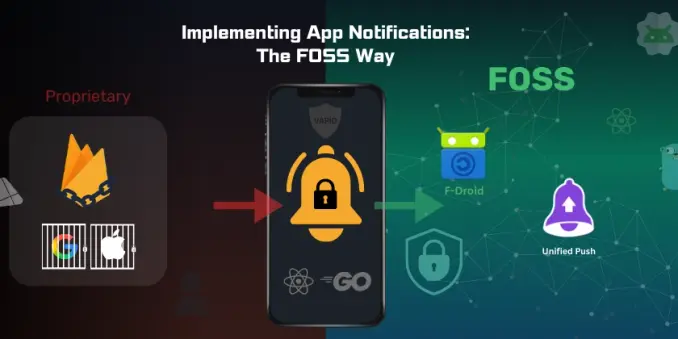
Thank you @notnotrachit for sharing your experience of implementing notifications "the FOSS way" in this blog post!
https://dev.to/dilutewater/implementing-app-notifications-the-foss-way-lc2
Thank you @notnotrachit for sharing your experience of implementing notifications "the FOSS way" in this blog post!
https://dev.to/dilutewater/implementing-app-notifications-the-foss-way-lc2
@unifiedpush
Even as a non-developer, I found this well written article of great interest. It explained a few things about #UnifiedPush I wasn't aware of, and has given me better insight into how it functions.
It's clear now that there simply isn't any excuse for developers to use #FCM for notifications. I sincerely hope UnifiedPush will gain traction, not only amongst #FOSS developers, but the Android developer community at large.
It's perhaps worth noting that users of #Conversations (and its forks) already have a distributor included in their client, thus further lowering the bar of entry.
@aerion @unifiedpush @notnotrachit @daniel @snikket_im This is a really great write-up.
One thing I still don't understand is, how does the backend know which server to send the notification to?
When the user chooses a distributor, is the app sending the distributor's URL to the backend, which then associates the app/user with that URL?
@dotslash @aerion @unifiedpush @daniel @snikket_im
Hi, yes, great question, I think I should have cleared it in the blog as well.
Yes, when the device registers for the notifications, it should send the registration data: endpoint, auth token and the p256dh encryption key.
The backend will then use this to send the notification. (you can use any webpush library on the backend to handle this)
 Ærion
Ærion dotslash
 Rachit Khurana