#paperday (submitted to A&A) on #astroph:

"On the interpretation of XRISM X-ray measurements of turbulence in the intracluster medium: a comparison with cosmological simulations" by myself and G. Brunetti.

https://arxiv.org/abs/2507.04727

It's short reaction paper to the latest (cool) XRISM measurements of gas motions in the Coma cluster (and others), which were interpreted as evidence of weak and much-steeper-than-Kolomogorov turbulence.
We think this is wrong..
#science #astrodon #astronomy
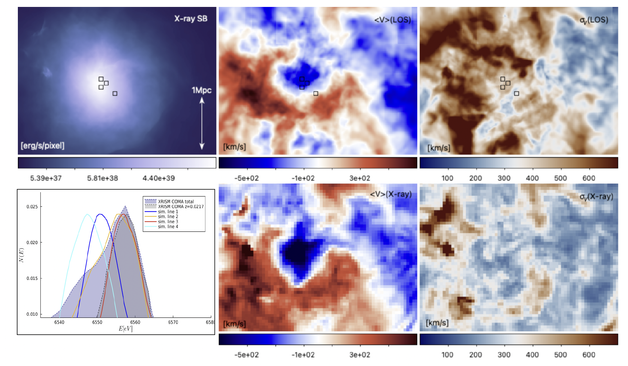
In a nutshell, we used a standard hydro-MHD simulation of a Coma-like cluster of galaxies (from 2018) and analyse the 3D dimensional properties of gas motions in this system, and compared them with the ones one would infer with the same approach used by the recent XRISM Collaboration paper (https://arxiv.org/abs/2504.20928).

We argue that X-ray spectroscopic observations bias the measurements of turbulence and move them away from the ground truth.

XRISM forecast for the Coma cluster: stormy, with a steep power spectrum

The XRISM Resolve microcalorimeter array measured the velocities of hot intracluster gas at two positions in the Coma galaxy cluster: 3'x3' squares at the center and at 6' (170 kpc) to the south. We find the line-of-sight velocity dispersions in those regions to be sigma_z=208+-12 km/s and 202+-24 km/s, respectively. The central value corresponds to a 3D Mach number of M=0.24+-0.015 and the ratio of the kinetic pressure of small-scale motions to thermal pressure in the intracluster plasma of only 3.1+-0.4%, at the lower end of predictions from cosmological simulations for merging clusters like Coma, and similar to that observed in the cool core of the relaxed cluster A2029. Meanwhile, the gas in both regions exhibits high line-of-sight velocity differences from the mean velocity of the cluster galaxies, Delta v_z=450+-15 km/s and 730+-30 km/s, respectively. A small contribution from an additional gas velocity component, consistent with the cluster optical mean, is detected along a sightline near the cluster center. The combination of the observed velocity dispersions and bulk velocities is not described by a Kolmogorov velocity power spectrum of steady-state turbulence; instead, the data imply a much steeper effective slope (i.e., relatively more power at larger linear scales). This may indicate either a very large dissipation scale resulting in the suppression of small-scale motions, or a transient dynamic state of the cluster, where large-scale gas flows generated by an ongoing merger have not yet cascaded down to small scales.

arXiv.org
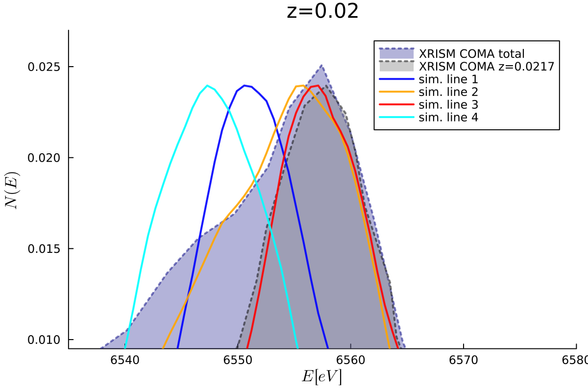
Despite this cluster simulation is extremely simple, and only contains gravity, fluid dynamics and magnetic fields, in the standard (and wrong in many ways!) ideal MHD treatment of plasmas, it can easily reproduce the observed line profile of the Iron line measured by XRISM - see picture.

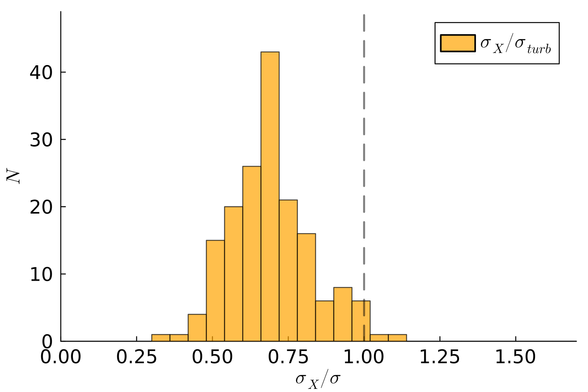
By simulating many possible measurements of the turbulence along the line of sight of potential XRIMS-like integrations, we find that systematically these only get ~60% of the true (energy-weighted) turbulence along the line of sight.

Why? because X-ray weights more dense regions along the line of sight, which are systematically closer to the centre, where clusters tend to have (at least in the world of simulation) lower budgets of turbulence

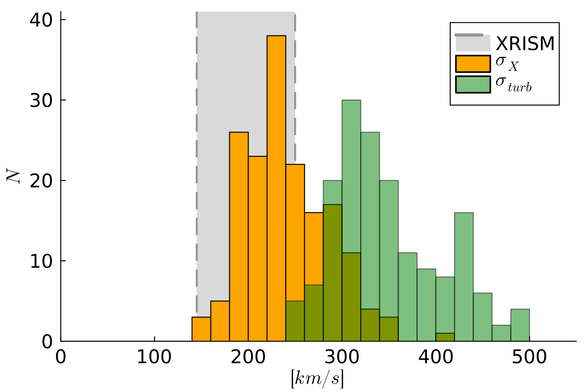
The grey are are XRISM measurements- which we can reproduce in the mock observation, while the true velocities are the green ones.

So through X-rays, one can only probe a fraction of the turbulence within the same area been observed. Which is fine, except one needs to take this into account when interpreting gas motions in the grand scheme of things.

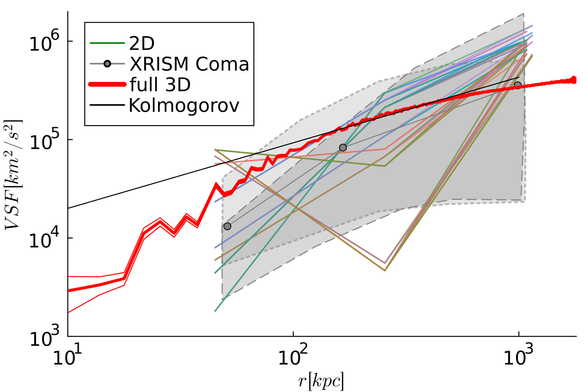
The XRISM analysis had a limited amount of observed fields of view (integrations are expensive!!) and tried to reconstruct the "velocity structure function" (VSF), i.e. a standard way to study turbulence in many different environments.

Textbook turbulence (isotropic, incompressible) has a very distinct trend of VSF, first derived by genius A. #Kolmogorov in 1941.

The XRISM paper reported that the VSF in the Coma cluster is way different than this, hence turbulence must be weird there.

Again, we showed that this is likely not the case, and turbulence still behave pretty much close to the Kolomogorov expectations (as seen by all simulations of the latest 20 years). The red line is the true VSF measure in the simulation, the dots are XRISM measurements with their errorbars, the bundle of lines are our mock XRISM reconstruction of the VSF, using limited fields of view. In many cases, we can get their same VSF..but that's a poor reconstruction of the ground truth, again.
More turbulence, less turbulence, who cares?
First, this is important to identify at which spatial scales (i.e. smaller than 100kpc? smaller than 10kpc? than 0.1kpc?) the intracluster gas displays non-collisional effects.
In the (magic) world of simulations we treat this as a perfect fluid, and solve its evolution under Euler equation or MHD equations, essentially.
But although we treat it as a fluid, collisions between particles happens every few tens of Myr.

It's the magnetic field to cause particles to stick together like a fluid, but not the simple one we have in mind! this gives rise to many kinetic plasma effects (@jaztrophysicist being the local master) which it would be nice to observe.

However, the expectation was that these effects should be affecting global gas dynamics only on <<10kpc, so it would be very cool to have surprisingly detected them already on the big scales observed by XRISM!
But we argue we did not, as their VSF is biased 😩

The second important consequence of having more or less turbulence in gas motions is the "hydrostatic mass bias" Weighting clusters based on their X-ray observables to derive their mass is a big deal for cosmology: from the actual census of clusters masses we can infer cosmological parameters.
Little turbulence equals to small perturbations to the usual measurements, higher turbulence means more uncertainty and additional bias to these mass estimates, e.g.
https://arxiv.org/pdf/1902.10837
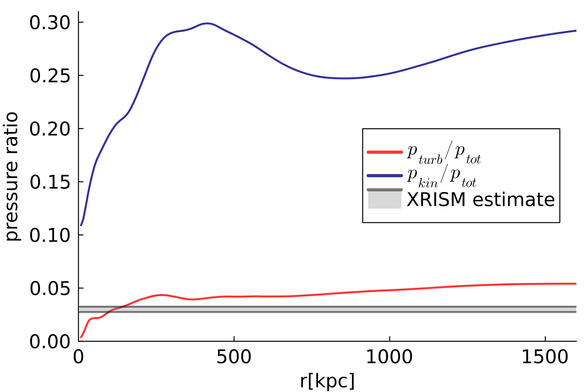
Again, by accessing the "true" turbulent content of the simulation of our Coma-like cluster, we could show that the real budget is higher than the surprisingly low estimates derived by XRISM (almost by a factor 2 in turbulent pressure), and that this allows for the existence of a ~10 times higher budget of random kinetic energy which can be stored in the cluster, which having only a few X-ray observations is very hard to measure.
So the non-hydrostatic mass bias can remain as previously thought.
This work means no criticism to the beautiful and crucial measurements that the XRISM Collaboration 8https://en.wikipedia.org/wiki/X-Ray_Imaging_and_Spectroscopy_Mission) is performing, in Coma and in other clusters, which presently is just the best we have to study gas motions in these systems.
We just wanted to show how even simple models of gas motions in clusters can apparently easily account for the phenomenology reported by the first observations, helping us in their interpretation.
[EoT]