
Liquid Glass’ blurred content everywhere is especially cruel to those of us who use reading glasses or progressives.

The reflex to seeing blurry text on our phones is to adjust our sight angle or distance to sharpen it. But, of course, it’s not our fault, doesn’t sharpen, and just causes eyestrain.

Text on my phone should never be blurry.
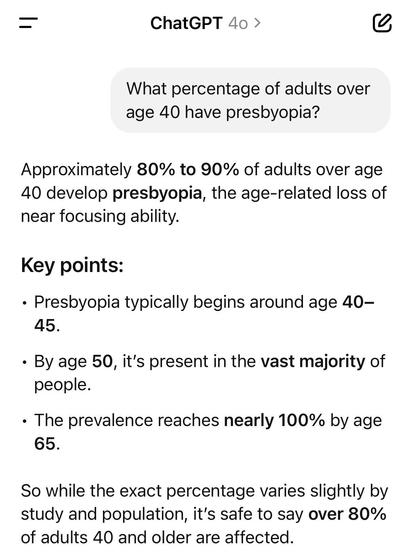
You may ask, “How many people could this possibly affect?”

Well…

@marcoarment Don’t ask an LLM a factual question that you can’t test!
@siracusa at least use one that's hooked up to a search engine and cites sources!
@fifthrocket The sources are only useful if you click the links and read them! In which case, maybe just try a web search instead.
@siracusa both of these provide website snippets that I find are quite satisfactory (Gemini’s UI attached)
But I think the important part is that I have much much more confidence in an LLM’s ability to summarize content that’s loaded into the context window.
@fifthrocket Still gotta click through the links. LLM summaries can be wrong.
@siracusa I’m not sure how likely that really is.
That was your whole point back in episode 589. If the answer is in the context window, you shouldn’t be surprised if it gets it right. You should expect it to be right basically every time! Pulling stuff out of the context window is quite easy.
@fifthrocket You can expect all you want, but in practice it’s sometimes wrong. You’ve gotta click the link, otherwise what are you citing? A probabilistic summary of a thing? Maybe it’s an accurate summary. Maybe it’s not. If only there were some way to tell…
@siracusa that “sources” view shows snippets, not ai summaries.
@fifthrocket Are you sure? Only one way to find out…

@siracusa I mean, yea, I checked before telling you they’re snippets. But one doesn’t need to do that each time.

You wouldn't re-read the terms and conditions every time you open an app

@fifthrocket Google search used to show snippets too, but you still need to click the links.
@siracusa on desktop you still get the standard snippet for that. Would you have really admonished @marcoarment for posting this??
@fifthrocket I think many (most?) Google “snippets” are now generated summaries. And that thing at the top in your screenshot looks like the generated “answer” that Google has been putting at the top of its search results for years now.
@siracusa that’s a “featured snippet”. It’s not generated and never has been as far as I know.
@fifthrocket It’s hard to keep up with the ever-changing Google search results page (which may even vary from user to user). The point is, you can’t cite a search results page. If you can’t easily test the answer yourself, click the links.

@siracusa but why does it end there? You’re deciding whether to believe the Google snippet is really on the NIH website. Why do you think it's accurate just because it’s published on the NIH website, you haven’t looked at the spreadsheet they loaded the results. Maybe they made a math mistake. And that’s only one study. You really want a literature review or meta analysis.
No such analysis exists, but a search results screenshot can fit a bunch of snippets from multiple sources all next to each other.
Maybe screenshot of a bunch of snippets is as good as it gets for an answer to this question in the short form post format. And an LLM summary of the literature might be nearly as good

(I’m so sorry to be pedantic, but I actually didn’t realize this was my opinion going in. I appreciate the chance to figure this out through discussion)

@fifthrocket The info on the NIH website could be right or wrong, but citing it is straightforward: this is what the NIH says. Citing instead what your friend thinks might be on the NIH website is a waste of everyone’s time. Cite the NIH or don’t, but adding an extra, unreliable party in the middle is unserious.