In the 1960s, this absurdly large camera was used to make masks for integrated circuits. The layers of the integrated circuit were drawn at large scale and then optically shrunk to make the glass masks that were used in manufacturing.
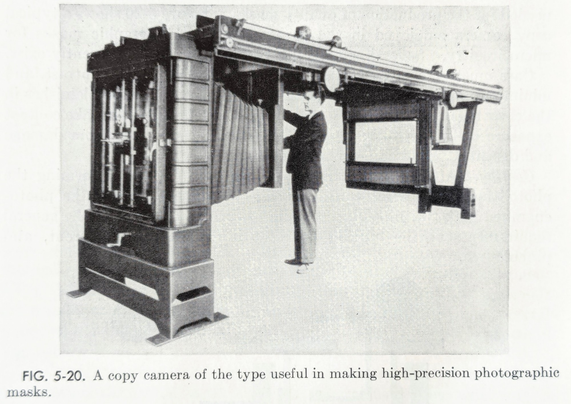
Source: "Semiconductor Integrated Circuits" by Gordon Moore in "Microelectronic", 1963. Moore (of Moore's Law fame) was at Fairchild at the time. He co-founded Intel in 1968. Thanks to Philip F. for the book.
@kenshirriff Those tiny little employees must have been really useful in the early days of microelectronics.
@marshray @kenshirriff they are still useful, we've just made great strides in miniaturization
@kenshirriff Hmm, I've seen pictures of people drafting the massive schematics but never the optical printing setup used to make the masks, interesting
@kenshirriff Dude should try stepping into a modern ASML EUV machine for an instant thorough tan.
@kenshirriff We had broadly similar gear in the small tech college I attended. Finally removed around 1997 or so: used for creating negatives of print graphics layouts that could be used to make plates for printing.

@MacBalance @kenshirriff

Yeah my high school had one about half that size in the printing / photography / graphic arts classroom

@jonhendry @kenshirriff We also had some sort of analog โ€œscannerโ€ for negatives. Spinning drum (are drum scanners a thing still?) and some basic exposure controls but no controlling computer.

I wish I had a pic: it really looked like a prop from the original Star Trek.

@MacBalance @kenshirriff

We had one of them optical typesetters that used negative film discs of fonts, with the letter forms projected onto light-sensitive paper.

@kenshirriff

I feel like the absurdly large camera era lasted along time with various niche applications. In this case it seems like an art "repro" camera run in reverse.

https://camera-wiki.org/wiki/Repro_camera

Repro camera - Camera-wiki.org - The free camera encyclopedia

@elithebearded Or a print enlarger for very large pictures with the lens reversed, or whatever they used to make microfiche and microdots, etc.

@kenshirriff

@kenshirriff I wonder why they decided to have the bed suspended above instead of on the ground, they way it would be on a small camera like a Graflex.
@maccruiskeen Given where the man is standing, it seems that it would be something to trip over.
@theohonohan Yeah, from the operator's perspective, this was probably easier.
@kenshirriff tsk absurdly large camera.. modern lithography machine are absurdly large cameras and they are absurd in other ways too!

@kenshirriff That's not even surprisingly large to anyone who has ever worked in prepress reprographics.

When the company I worked for dismantled its photostat cameras for junk in the early-mid 1990s, I liberated the gigantic apochromatic lens of the 24 x 36" (film size) camera that took up most of a room.
@gcvsa @kenshirriff Just curious, what did you end up doing with that big salvaged lens? Telescope?
@galacticstone @kenshirriff Nothing at all. It would make a killer view camera lens, if I had the wherewithal to do such a thing.
@gcvsa @kenshirriff Do you know what the focal length is? If it's a quality apochromat with a focal length suitable for ATM, it might be worth a tidy sum.
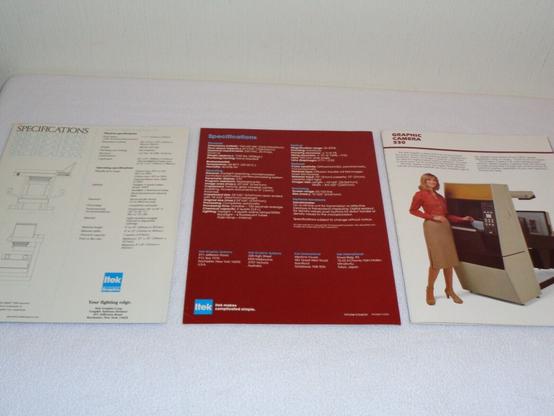
@galacticstone @kenshirriff Off the top of my head, I think it's 240 mm? It's packed away, and I haven't touched it in years. I know it doesn't have a leaf shutter built-in. It came out of an Itek color photostat camera.
@gcvsa @kenshirriff - 240mm is pretty small and fast. It might make a good wide-field imaging lens. Probably not great for visual observing due to the fast focal ratio. Still, it's an interesting piece and it's good that you saved it from the landfill.
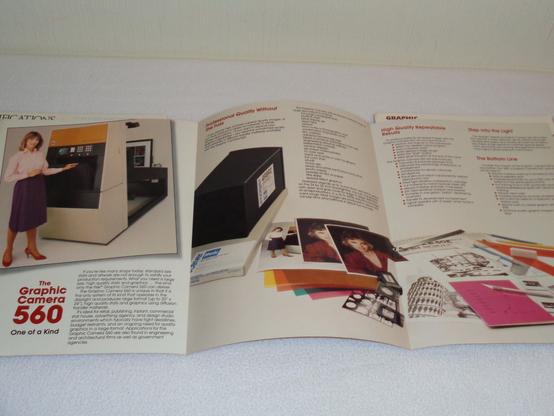
@galacticstone @kenshirriff Here's an image of a brochure for the Itek Graphix Graphic Camera 560. It was designed to photograph camera-ready artwork for the printing industry. The vacuum table was 24x36", and the maximum film size was 20x24", I think.
@galacticstone @kenshirriff Our shop had a 560 and two 530s. I shudder to think how much money these cameras cost to purchase, and we sent it to the dump as scrap metal, because everything was going digital desktop publishing in the early-mid 1990s.

@gcvsa @kenshirriff - Lost the reply I was typing out. I feel like this period was the end of quality manufacturing for tech. Things were still built with attention to detail. There was craftsmanship involved. These machines would still work fine if they were extant today (minus a fried out capacitor).

And, you know the device came with a hardbound owner's reference manual, repair schematics, order form for replacement parts, and a felt-lined wooden storage case made in Japan.

@kenshirriff

I used a similar camera (maybe 24 inches square) in high school printing class to make plates for offset printing. It was mounted in a wall with the film side inside the darkroom. ๐Ÿ™‚

@kenshirriff The line camera I used in high school (graphics/press lab) wasn't quite that large, but was able to handle 1:1 exposures of 11x17-ish lithographic film for plate-making, so still pretty big. Fun stuff.