
In the 1960s, this absurdly large camera was used to make masks for integrated circuits. The layers of the integrated circuit were drawn at large scale and then optically shrunk to make the glass masks that were used in manufacturing.

@kenshirriff That's not even surprisingly large to anyone who has ever worked in prepress reprographics.

When the company I worked for dismantled its photostat cameras for junk in the early-mid 1990s, I liberated the gigantic apochromatic lens of the 24 x 36" (film size) camera that took up most of a room.
@gcvsa @kenshirriff Just curious, what did you end up doing with that big salvaged lens? Telescope?
@galacticstone @kenshirriff Nothing at all. It would make a killer view camera lens, if I had the wherewithal to do such a thing.
@gcvsa @kenshirriff Do you know what the focal length is? If it's a quality apochromat with a focal length suitable for ATM, it might be worth a tidy sum.
@galacticstone @kenshirriff Off the top of my head, I think it's 240 mm? It's packed away, and I haven't touched it in years. I know it doesn't have a leaf shutter built-in. It came out of an Itek color photostat camera.
@gcvsa @kenshirriff - 240mm is pretty small and fast. It might make a good wide-field imaging lens. Probably not great for visual observing due to the fast focal ratio. Still, it's an interesting piece and it's good that you saved it from the landfill.
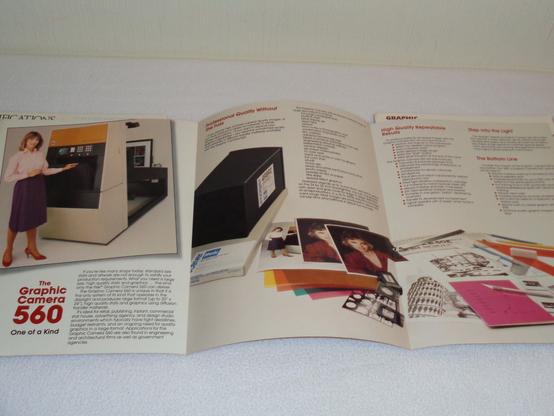
@galacticstone @kenshirriff Here's an image of a brochure for the Itek Graphix Graphic Camera 560. It was designed to photograph camera-ready artwork for the printing industry. The vacuum table was 24x36", and the maximum film size was 20x24", I think.
@galacticstone @kenshirriff Our shop had a 560 and two 530s. I shudder to think how much money these cameras cost to purchase, and we sent it to the dump as scrap metal, because everything was going digital desktop publishing in the early-mid 1990s.

@gcvsa @kenshirriff - Lost the reply I was typing out. I feel like this period was the end of quality manufacturing for tech. Things were still built with attention to detail. There was craftsmanship involved. These machines would still work fine if they were extant today (minus a fried out capacitor).

And, you know the device came with a hardbound owner's reference manual, repair schematics, order form for replacement parts, and a felt-lined wooden storage case made in Japan.