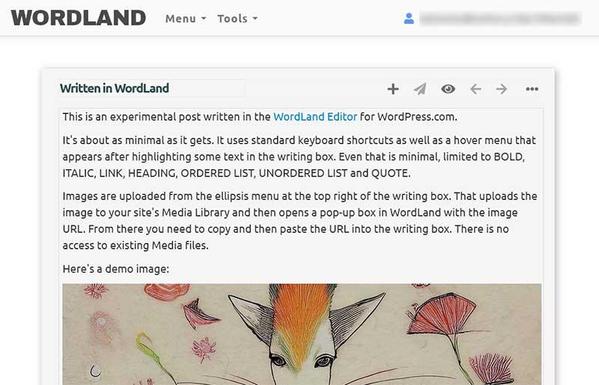
Earlier today, @davew published a blog post titled WordPress and me. He talked about WordLand, his focused and fast editor for writers and bloggers. Through developing the editor, he’s discovered WordPress again.

WordPress as the OS of the open social web

I think WordPress has all that’s needed to be the OS of the open social web. We needed it and it’s always been there, and I saw something that I want to show everyone else, that the web can grow from here, we should build on everything that the WordPress community has created. It’s a lot stronger foundation that the other candidates for the basic needs of the open social web, imho.

@davew

I’ve been following Dave’s work with WordLand for the past few months, and it’s been really nice and encouraging to see him work on a product that aligns with my values. And now, Dave will get to present his tool and his ideas to others in the WordPress community! He will be talking at WordCamp Canada in October.

It should come as no surprise that someone so involved with some of the key concepts of the Open Web, like RSS, values ideals of openness and giving writers control over their content. WordLand’s approach to “what you see is what you get” is something that aligns so well with WordPress’ own ideals. It clashes with walled gardens like Twitter or Bluesky where you’re limited in length, format, content, and where you ultimately do not own your writing. It’s super motivating and empowering when someone newer to the WordPress ecosystem recognizes those shared values and the power of the platform.

Rediscovering WordPress

In his post, Dave talked about his journey of rediscovering WordPress through a new lens. The WordPress.com REST API, its endpoints and its authentication layer, gave him the tools to build the editor he needed, while still benefiting from everything the WordPress community has created in the past 22 years.

This is also what we had in mind when Automattic released Calypso 10 years ago:

Calypso is…

  • Incredibly fast. It’ll charm you.
  • Written purely in JavaScript, leveraging libraries like Node and React.
  • 100% API-powered. Those APIs are open, and now available to every developer in the world.

Matt — Dance to Calypso

Calypso and its underlying API paved the way for the first REST API endpoints that made it to WordPress itself a year later. That API then became a cornerstone of the Gutenberg project:

WordPress has always been about the user experience, and that needs to continue to evolve under newer demands. Gutenberg is an attempt at fundamentally addressing those needs, based on the idea of content blocks. It’s an attempt to improve how users interact with their content in a fundamentally visual way, while at the same time giving developers the tools to create more fulfilling experiences for the people they are helping.

Matías Ventura — Gutenberg, or the Ship of Theseus

WordPress.com REST API vs. WordPress REST API

On a more technical note, the folks more familiar with WordPress will wonder why WordLand uses the WordPress.com REST API, and not the core WordPress REST API.

Dave chose to use the WordPress.com API for WordLand — and that makes perfect sense for the goals of the project. It provides built-in authentication and opinionated endpoints that would otherwise need to be built on top of the core REST API, and would need to be shipped to every site that wants to use the WordLand editor. That’s simply not what WordLand was designed to do.

Perhaps more importantly, the WordPress.com REST API is just one of the many ways to interact with WordPress. That’s the beauty of WordPress: it’s open and flexible, allowing different tools and solutions to thrive. In this case, it’s nice to see how WordLand, WordPress, and WordPress.com came together to empower writers, each bringing their own strengths to the table. It’s a great example of how open tools and platforms can work hand-in-hand to create something truly special.

It’s always exciting to see new tools emerge from old foundations — and even more so when they help bring us closer to the open web we want to build. Funny enough, the WordPress.com REST API still relies on XML-RPC — a technology built by Dave 27 years ago 🙂

Go write something!

If you haven’t tried WordLand yet, go give it a try! All you need is a WordPress site, either hosted on WordPress.com or running the Jetpack plugin.

#Automattic #EN #OpenWeb #WCEH #WordLand #WordPress

@jeremy @davew Interesting and thanks for this, Dave.

I did a quick (OK, maybe not so quick) post on a standalone private test site. Who can I invite as an Editor to see the results? (And thanks for taking my mind off "things".)

@wpcommaven Happy to test things with you if you need any help. Although I think you’ll find that posts published via WordLand should be displayed just like any other post on you site. 🙂

@wpcommaven @jeremy

this is a great thread.

this is where we're going to build, for writers. it's such a huge place.

@jeremy @davew Hmm
J’ai laissé une réponse fédérée sur cet article : https://herve.bzh/wordpress-wordland-and-the-open-web/, mais elle ne semble pas apparaître.
De plus, les publications que j’ai faites depuis Wordland ne sont pas visibles sur Mastodon non plus.
https://kowporg.wordpress.com/2025/06/24/wordpress-wordland-and-the-open-web/
WordPress, WordLand, and the Open Web

Earlier today, @[email protected] published a blog post titled WordPress and me. He talked about WordLand, his focused and fast editor for writers and bloggers. Through developing the editor, h…

Famille Hervé

@thaumiel999 Cette réponse n’apparaît pas parce que j’ai choisi de ne pas l’afficher sur mon site. Cette réponse semble en fait être une traduction complète de mon message. Ce message n’apportant pas de valeur ajoutée au message d’origine, j’ai donc choisi de ne pas l’afficher.

les publications que j’ai faites depuis Wordland ne sont pas visibles sur Mastodon non plus

L’éditeur que vous utilisez (l’éditeur de base de WordPress, l’éditeur classique, WordLand, Tusky, ou bien d’autres) n’a aucun impact sur la visibilité de vos articles sur le Fediverse. Ceci est entièrement géré par votre site.

Dans le cas du dernier article de votre site, il a bien été fédéré. Voici ce que je vois sur mon propre client par exemple :

@jeremy J’ai ajouté ce lien dans le bloc de réponse fédérée : https://herve.bzh/wordpress-wordland-and-the-open-web/#comment-3066. Est-ce qu’il est bien pris en compte dans la réponse ? Ou bien la partie #comment-3066 n’est-elle pas encore incluse dans le lien fédéré ?
WordPress, WordLand, and the Open Web

Earlier today, @[email protected] published a blog post titled WordPress and me. He talked about WordLand, his focused and fast editor for writers and bloggers. Through developing the editor, h…

Famille Hervé
@thaumiel999 Cela fonctionne, pas de souci de ce côté-là.
@jeremy À l’origine, ce message (https://mastodon.social/@kowporg.wordp[email protected]/114737858181744468) était une réponse à celui-ci : https://mastodon.social/@jeremy@herve.bzh/114737747994447194.
Cependant, comme ce message a été publié en tant que commentaire sur l’article original, il semble que le bloc de réponse fédérée (federated reply block) ne fonctionne pas correctement avec les URLs de type commentaire (format : /#comment-3066).
@jeremy @davew I have a problem with the fact that you can only use it with either Mullenwegs walled garden itself or with Jetpack where you also need to connect to wordpress.com. So sorry, but IMHO the plugin stands against the idea of an open social web especially considering the recent problems with Mullenweg.

@LinHead @jeremy

re your philosophy-- if wordland also supported outbound RSS would you consider it to be part of the open web?

@LinHead Yes, I can understand some of that.

One should be able to build an editor like WordLand with WordPress core alone, without any plugins. You’d leverage the core REST API instead of the WordPress.com REST API. You’d have to build an authentication layer (probably using Application Passwords, and then either build your own library to leverage the core endpoints or use the node-wpapi library. That library isn’t maintained though ; it hasn’t been updated in the last 4 years, so you may run into issues.

WordPress.com has an edge there with and authentication layer. I can’t speak to @davew’s past and future plans with WordLand, but I do know that the wpcom.js JavaScript library was a big help in getting WordLand to work. Check his podcast yesterday to learn more.

I should say, however, that I would not qualify WordPress.com as a walled garden, just like I wouldn’t qualify GoDaddy as a walled garden. Hosting providers are very different from Facebook or Twitter for example ; they host your content, but you retain control over it. You can export it, you can move to a different hosting provider at any time, you control your content’s visibility too.
Similarly, I wouldn’t say services that leverage a cloud infrastructure, like Jetpack, stand against the idea of an open social web. They offer additional functionality (here authentication and content management endpoints) that wouldn’t otherwise be readily available, but your content remains yours, and your site remains as open as it would be without the service.

REST API Handbook | Developer.WordPress.org

The WordPress REST API provides an interface for applications to interact with your WordPress site by sending and receiving data as JSON…

WordPress Developer Resources