Finally. I have a way to "properly" read unmodified Atari paddle controllers from an Arduino.

That was a lot more complicated than I expected it to be.

And arguably it still isn't finished as the code needs optimising to read all four paddles in a useful way that doesn't lock out everything else!

It would be a /lot/ simpler to hack the controllers and just wire the pots across 5V and GND...

https://diyelectromusic.com/2025/06/16/atari-2600-controller-shield-pcb-revisited/
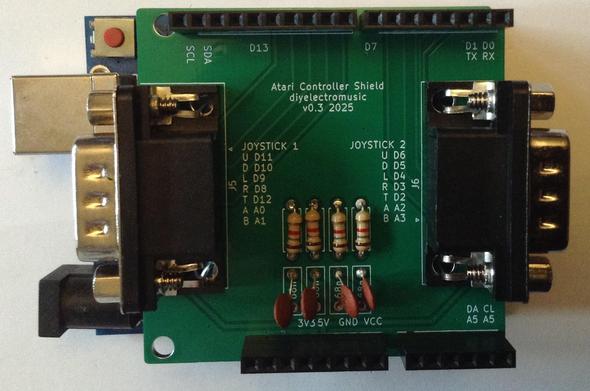
#Arduino #Atari2600

And now I can properly "properly" read all four paddles.

But that was a lot more complicated than I thought it would be. Even by the standards of my previous "that was a lot more complicated" statement!

Maybe I'm just a bit slow with this one! (or getting old) :)

Anyway, I finally have something I'm happy with. Now to actually do something with it!

(the things one does to avoid cracking open some vintage gear and changing it...)

https://diyelectromusic.com/2025/06/22/atari-2600-controller-shield-pcb-revisited-part-2/

#Atari #Atari2600 #Arduino

Atari 2600 Controller Shield PCB Revisited – Part 2

This has another look at my updated Atari 2600 Controller Shield PCB in order to attempt to read all four paddle controllers a bit more accurately and efficiently. Warning! I strongly recommend usi…

Simple DIY Electronic Music Projects
@diyelectromusic So I know the RC timer is the classic way to sense analog paddles but they also didn’t have cheap ADCs back then. Why not just wire them up as a potential divider and do ADC on that?

@bytex64 Yeah, that was a previous iteration, kind of.

But if I want to do that without changing them, then I get a much more limited voltage range.

Or I could do what a lot of people seem to do and rewire them internally to be a potential divider themselves :)

Was that the reason for the RC timer? Cost? I did wonder :)

@diyelectromusic Ah. And I guess adding op amps to improve the range would kind of defeat the simplicity of it.

Yeah, RC timing using digital circuitry was just a really inexpensive way to do it.

@diyelectromusic I was also thinking that a lot of microcontrollers have counter/timer peripherals that might be able to do the timing work for you. The end of counting could only be triggered by a logic high/low on an input, but that will probably still work (that’s how it worked on the old circuits).

@bytex64 Yes, I'm now thinking it was over complicated to read the voltage via the ADC in the first place... why not just wait for the digital IO to read HIGH again?

Am rewriting with a simpler version to see what it does! :)

@bytex64 Yes, it perhaps could be made to work.

The only issue is, I think the ATmega328 is probably working with an IO voltage level of ~0.6xVCC which is around 3V or around 600 in the 10-bit range, so I'd need to do some scaling anyway...

But it appears this works too :)

@diyelectromusic The voltage level shouldn’t matter as long as it’s consistent (well I guess it has to be high enough that it’s not going to be triggered by noise). The thing that changes is how long it takes to reach that voltage. And if you have a high enough resolution timer you might be able to do better than 10 bits (though it will be noisy either way).

@bytex64 Absolutely. Seems to be working fine - a significant simplification and quite a "doh" moment :)

Thank you for that prompt.

It all makes so much more sense now!!

Just goes to show how our modern tools with less constraints, still weirdly constrain our thinking!

And immediately followed by a simpler version, thanks to the observation by @bytex64 that the originals wouldn't have used ADCs at all! :)

https://diyelectromusic.com/2025/06/22/atari-2600-controller-shield-pcb-revisited-part-3/

Just goes to show that sometimes we can't "see the wood for the trees" in some of these things! And we are spoiled by our modern tools.

#Atari #Arduino

Was this a #MakerFail ? Not sure. Certainly some learning going on there though :)

Atari 2600 Controller Shield PCB Revisited – Part 3

Following on from Atari 2600 Controller Shield PCB Revisited – Part 2 someone on Mastodon made the point that the reason they tended to use RC circuits to read paddles “back in the day”…

Simple DIY Electronic Music Projects
@diyelectromusic Nah, no fail here. You applied your knowledge to a problem and it worked. :)

@diyelectromusic Oh - *paddles* - I initially read this and thought, "aren't they just five switches?"

Good stuff!