#paperday

“Radio Observations as a Probe of Cosmic Web Magnetism” written with four hands with Ettore Carretti, on #astroph today

https://arxiv.org/abs/2505.18619

and also open.-access here: https://www.mdpi.com/2218-1997/11/5/164

We review the current state of affairs in using radio observations of cosmic magnetic fields (from synchrotron emission and through the Faraday Rotation effect) to constrain the origin of cosmic magnetism.
#astrodon #astronomy #science #physics
I have devoted many threads already to the topic of understanding the origin of cosmic magnetism 🧲

using radio observations

https://mastodon.social/@franco_vazza/113519951147357770
https://mastodon.social/@franco_vazza/110995561776303266
https://mastodon.social/@franco_vazza/109392506591218762

so let me condense the main idea just in the next toot:

1.There exist weak (~μG) magnetic fields in the intergalactic gas in between galaxies.
2. They might be a by product of galaxy evolution (stellar winds, AGN jets) or they may originate from phase transitions in the infancy of the Universe.
3. If we detect in radio even weaker (~nG) magnetic fields further away from galaxies we might understand their real origin - since only primordial events could significantly magnetised very empty regions away from galaxies.
4. got it?
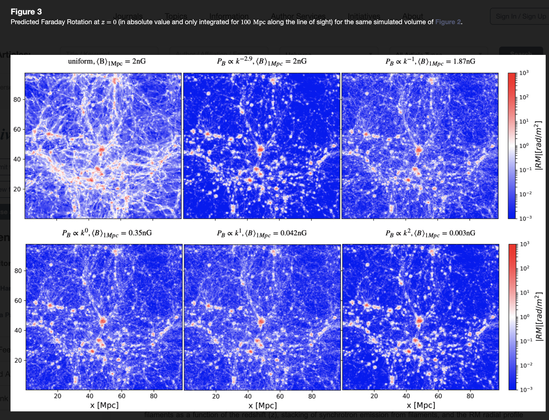
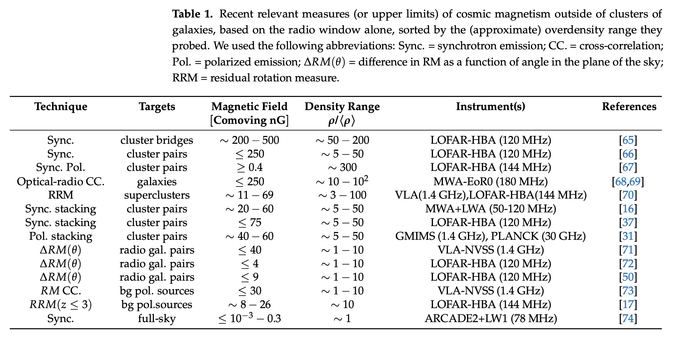
You can find in the paper a timely overview of existing constraints coming solely from radio investigations, using either synchrotron detections/upper limits from filaments (which constrain the product of the cosmic ray electron density x the magnetic field amplitude square) and Faraday Rotation (which constrain the product between the thermal electron density along the line of sight and the magnetic field component parallel to the line of sight).

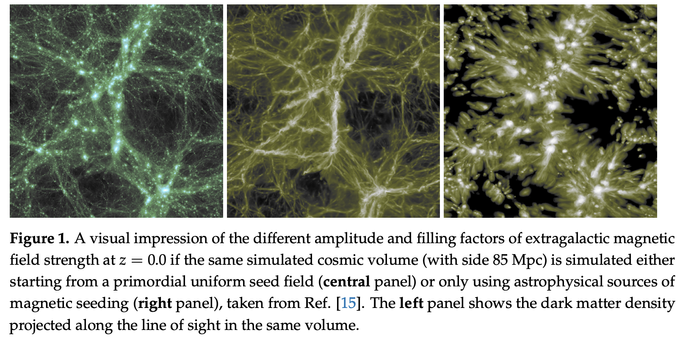
Then we review the joint modelling which can be currently done, trying to interpret radio data with cosmological (ideal MHD) simulations of the Universe.

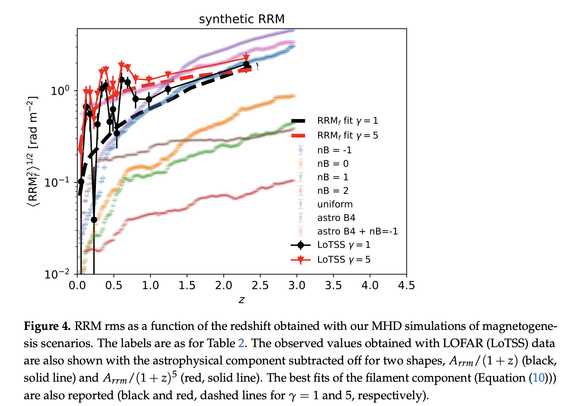
Different models clearly give different signatures, some of which are probably already detected in real observations (like in Faraday Rotation, which probes a large fraction of the volume of filaments along the line of sight)

The analysis of Faraday Rotation obtained using LOFAR on several thousands of background galaxies, distributed at different redshifts, already allows us to discard some models for the origin of magnetic fields (i.e. the one which are exclusively using galaxies) and additionally other primordial ones (i.e. very strong or very week, and with particular topological arrangements of B).

There are TWO cool brand new things in this paper.

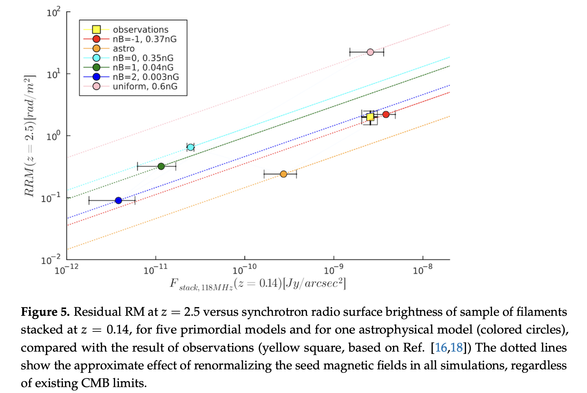
The first, is a joint comparison of the expected synchrotron signature from a certain class of filaments, and of the Faraday Rotation excess shown by observations up to z=3.

The combination of the two REAL observations of these effects is the fat yellow cross. The other points show where simulation are:

only one model can apparently match both measurements, i.e. the one with a tangled magnetic field of primordial origin.

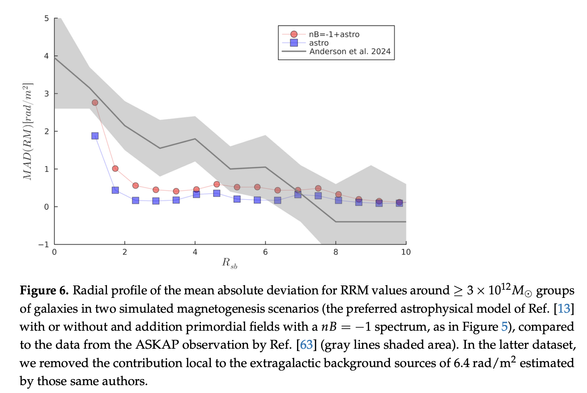
The second is the first numerical comparison with a recent work by Anderson+ using ASKAP (https://academic.oup.com/mnras/article/533/4/4068/7746154) who studied the profiles of Faraday Rotation at some distance from galaxy groups in the near Universe.

We compared that with my simulations, showing that simulated models cannot entirely reproduce the observed profile - however to an extent which looks of the order of finite resolution effects. The profiles do not look particularly challenging for existing models.

Bottom line: radio observations combined with sophisticated modelling are capable already to investigate the origin of cosmic magnetism, putting limits which are stronger than other more traditional probes (i.e. analysis of the cosmic microwave background) can do.

And we are reasonably confident we are getting some detection already, which only magnetic fields with a primordial origin can explain!

[EoT]