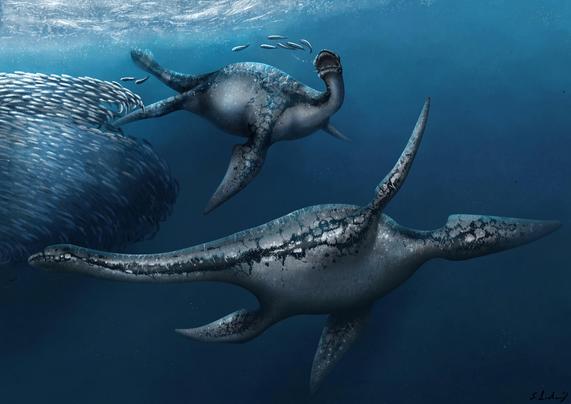
Happy #fossilfriday!

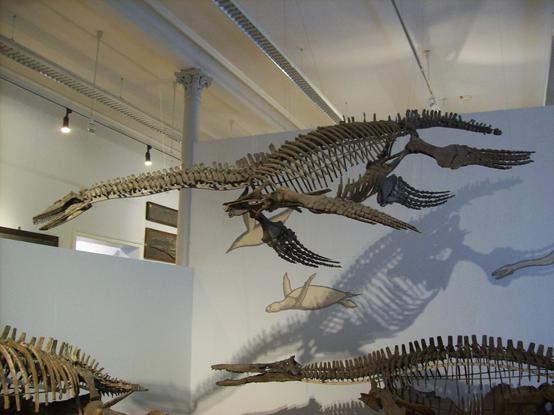
This is a cast of Cryptoclidus at the palaeontological collection of the University of Tübingen.

These Jurassic marine reptiles were perfectly adapted to their environment, possessing four hydrofoil-like flippers that allowed them to efficiently ‘fly’ through the water.

Life reconstruction based on the mounted skeleton (IGPB R 324) on display at the Goldfuß-Museum in Bonn. ⚒️

#science #paleontology #fossils #jurassic #plesiosaur #cryptoclidus #wwd #tübingen #germany
@stellaludwig y so fat? buyancy? large fermenting stomachs? weird.

@stellaludwig Not a cast, the actual fossil bones. I recently co-wrote a short paper about how the fore and hind limbs in this specimen are transposed: https://link.springer.com/article/10.1007/s12542-022-00616-8

#plesiosaur #paleontology

Historically transposed flipper pairs in a mounted plesiosaurian skeleton - PalZ

Plesiosaurians evolved four wing-like flippers that are morphologically similar to each other and were most likely used in underwater flight. Plesiosaurians have been the subject of a long research history as well as a long history of misidentifications and misinterpretations, especially transposition of parts of or entire fore- and hind flippers. We identified the transposed fore- and hind flippers in a mounted Cryptoclidus eurymerus specimen (GPIT-PV-30092) on display in the Paleontological Collection of Tübingen University. It is likely that the fore- and hind flippers were accidentally transposed when the skeleton was mounted, although, amongst plesiosaurians, the fore- and hind flippers of Cryptoclidus eurymerus are some of the least similar-looking ones. This occurred either during a remounting of the skeleton from a free-standing armature on the ground to a freely “flying” skeleton hanging from the ceiling, or after a research project conducted on the specimen in the 1970s. We summarize osteological characteristics that can be used to correctly identify fore- and hind flippers of this species, and for better future assessment of the plesiosaurian locomotory system.

SpringerLink