


Did you see this? It's an artist's conception of how gravity from the tiny moon Daphnis creates ripples in Saturn's rings - created by Kevin Gill of NASA.

This image was pretty popular here, and elsewhere on the web - but people often don't come out and say from the start that it's not a photo. The actual photos are less beautiful but... hey, they're real! And the ripples look different in the photos. Let's take a look.

(1/n)

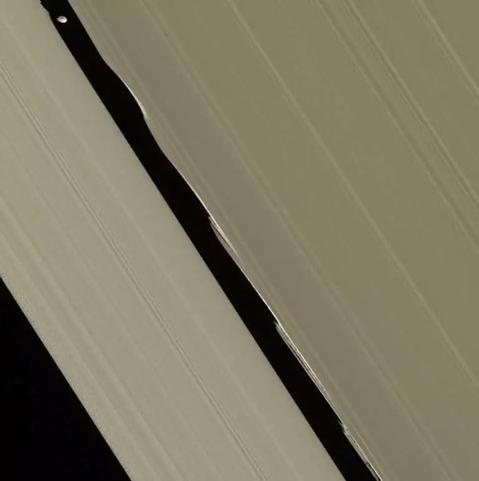
This 2005 photo, taken by the Cassini probe, was the first time anyone actually saw Saturn's moon Daphnis! It's only 8 kilometers across.

This gap in Saturn's A ring was first discovered by Voyager, and it was named the Keeler Gap. It's 35 kilometers wide. I guess this gap let people guess the existence of a moon, and later the ripples in the A ring let people guess where the moon must be! I don't really know the history here.

(2/n)

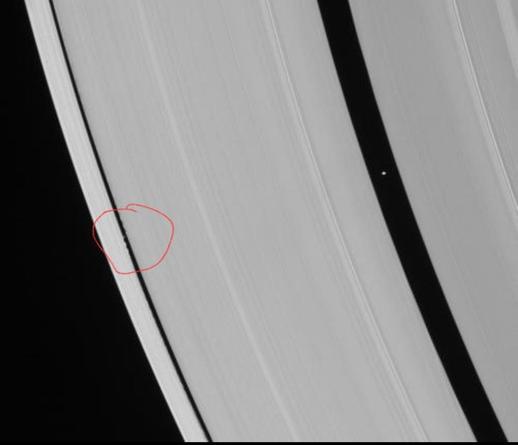
There's a larger gap in the A ring called the Encke cap, created by a larger moon called Pan, which you can see clearly here.

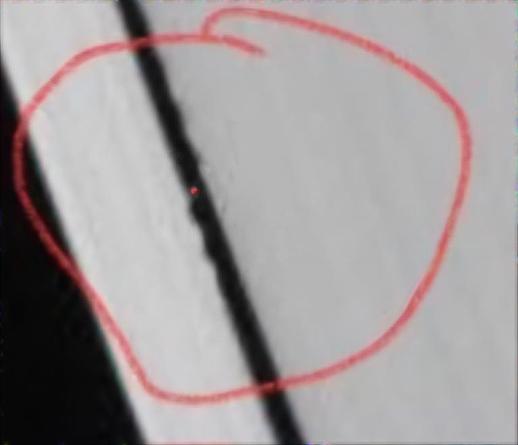
To the left you see the smaller Keeler gap. If you look very closely you can see the ripples near the Keeler gap... and if you look *very* closely you can see, or at least imagine, the moon Daphnis.

(3/n)

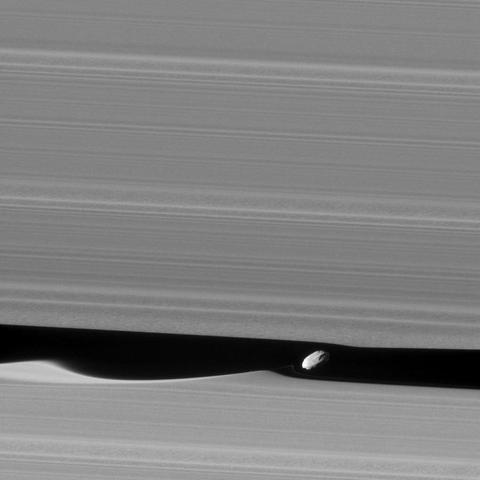
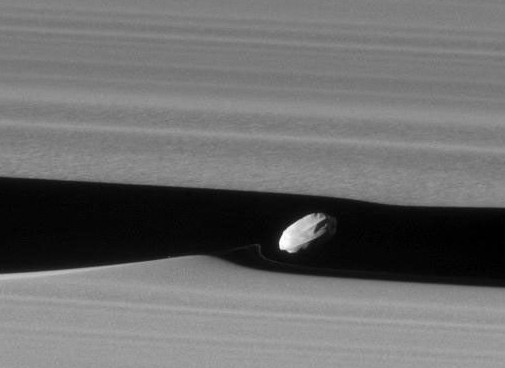
Now here is a really *great* actual photo of Daphnis and the ripples it creates in Saturn's rings!

It was taken by the Cassini probe and released in February 2017. It was taken in visible light using Cassini’s narrow-angle camera. Cassini was 28,000 kilometers away from Daphnis, and the image scale is 168 meters per pixel.

https://www.esa.int/About_Us/ESAC/Saturn_s_moon_Daphnis_in_the_Keeler_Gap

What other really good photos can we find?

(4/n)

Saturn’s moon Daphnis in the Keeler Gap

Daphnis, one of Saturn’s small ring-embedded moons, is seen here kicking up waves as it orbits within a gap between rows of icy ring particles.

Here's a nice photo of Daphnis in the Keeler gap in real color! It was taken by Cassini on July 5, 2010 - taken in red, green, and blue and then recombined.

https://www.planetary.org/space-images/daphnis-in-keeler-gap

(5/n)

Daphnis makes waves in the Keeler Gap

Daphnis and waves of ring particles kicked up by gravity, imaged by Cassini in true color on July 5, 2010.

The Planetary Society

And here's an excellent image of Daphnis taken by the Cassini spacecraft on one of its ring-grazing passes on January 16, 2017 - the closest to Daphnis it's gotten so far, I believe!

NASA says:

"Material on the inner edge of the gap orbits faster than the moon, so the waves there lead the moon in its orbit. Material on the outer edge moves slower than the moon, so waves there trail the moon. The waves Daphnis causes cast shadows on Saturn during its equinox when the sun is in line with the plane of the rings."

(5/n)

Finally, here's a really crazy picture by Kevin Gill - a view you could only see if you sailed through the Keeler gap!

Someday I hope humanity does this.

You can see more images by Kevin Gill here:

https://www.flickr.com/photos/kevinmgill/

(6/n, n = 6)

Kevin Gill

Explore Kevin Gill’s 9,991 photos on Flickr!

Flickr
@johncarlosbaez they say the rings are stupid thin and flat. not in this region apparently! wonder what % of teh ring surface is so thin and flat

@johncarlosbaez A cruise around the Rings of Saturn is a bit more interesting that Katy Perry's 10 minute hop into 'almost Space'

#SpaceTourism #Saturn #KatyPerry

@johncarlosbaez
Great pictures, interesting thread with interesting commentary from readers and you responding, and you provided links to interesting material.

I don't usually say such things, but today I get the impression that you *do* like such feedback instead of your readers being briskly business-like and terse.

@dougmerritt - holy moly, I *live* for feedback, as long as it's intelligent and friendly. Even amateurs trying to grapple with celestial mechanics concepts like the inner rings rotating faster please me! The only things I don't like are rudeness or people who wildly overestimate their expertise.

@johncarlosbaez
Ah; I should have guessed that. Maybe I misunderstood because *I* wildly overestimated my expertise in some interaction with you, and suffered the consequences. I don't recall such a thing specifically, but it's believable! 🙂

I will try to make a point of giving you (friendly and hopefully intelligent) feedback from now on.

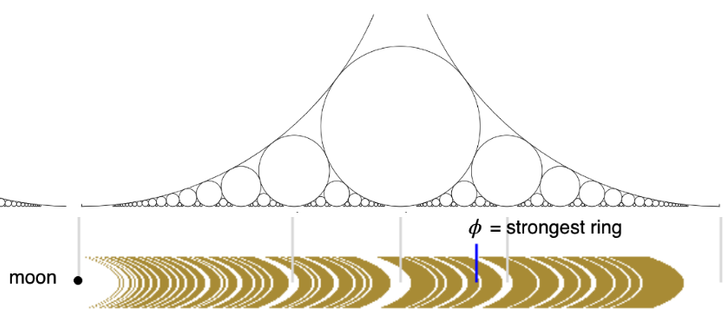
@johncarlosbaez There's a connection with Ford circles too. If you have one moon then you get gaps when the orbital period of the debris is a rational fraction of the moon's. Simpler fractions making larger gaps, so the base of the larger circles are the larger gaps.
So the thickest rings should be the periods hardest to approximate by a rational multiple of the moon's, such as phi. They're least resonant.

Orbital radius having a simple relationship with orbital period.

@johncarlosbaez Oh! That drawing had me thinking it was real as well - wth didn't they just use that lovely photo of the real thing!

@penguin42 - btw, Kevin Gill doesn't just do space art, he also creates photographs for NASA. (It takes work to make them look good.) Check out his Flickr account!

https://www.flickr.com/photos/kevinmgill/

Kevin Gill

Explore Kevin Gill’s 9,991 photos on Flickr!

Flickr

@johncarlosbaez

I remember a physics colloquium in the 80s (maybe the late 70s?! prob early 80s, though) when we saw some of the first images of the sheer *complexity* of the rings, and how much is going on in the "gaps".

That was the first time I heard the phrase "shepherd moon". Nobody, as I recall, predicted them. But the moment you saw them, it was clear they were inducing waves and even braids.

Absolutely gorgeous.

(Though a quick search didn't find any images of braided rings, so maybe that memory is unreliable.)

@weekend_editor - I could spend a lifetime studying the rings of Saturn! So rich in physics structure!

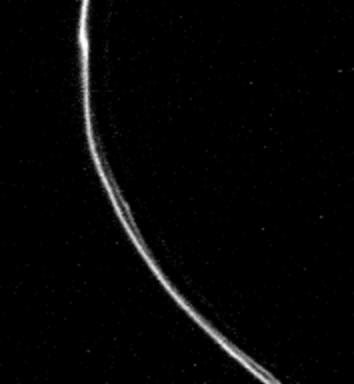
Here NASA says the F ring is "braided", though it's hard to see that.

https://www.jpl.nasa.gov/images/pia02283-saturns-f-ring/

Saturn's F Ring

Saturn's F, or outermost ring was photographed from the un-illuminated face of the rings by NASA's Voyager 1 at a range of 750,000 kilometers (470,000 miles).

NASA Jet Propulsion Laboratory (JPL)
@johncarlosbaez upon first glance, i thought this was a white cat's paw reaching underneath a closed door.
@rothko - great! Now it looks like that to me too!
@johncarlosbaez After seeing the photos, can we declare that "actual photos are less beautiful" is a not true?

@xgebi - you're right, I found some truly beautiful ones. I would still love one taken from the viewpoint of the artist's conception, but I don't think Cassini will get that close to the rings.

It's like the difference between an actual photo of someone you love and an AI-generated picture. Reality is better because it's real.

@johncarlosbaez That thread was fantastic. Thank you for posting it. 🤌
@johncarlosbaez I believe "taken in red, green, and blue and then recombined" is how all digital cameras work.
@yora @johncarlosbaez
Not simultaneously is the implied meaning. Like the earliest color photographs, that took three B/W shots one after another with red, green and blue color filters, then colorized and recombined afterwards.
@johncarlosbaez This whole thread is all about so much of amazing science. Observing a disturbance in patterns, and looking for what might be causing it. Seeing the artifacts of existence, before knowing what is existing.

@kristinHenry - yes, it's great how starting by seeing a mysterious gap in the A ring and trying to figure it out, people eventually built a space probe that could see what's going on in gorgeous detail. And someday I hope we see it even better.

Look at that little faint trail of white material near Daphnis!

@johncarlosbaez I was curious if the impression image was from fairly rigorous simulation / other very accurate modelling? Makes me want to find / build a gravity simulator for huge numbers or particles!

@benjohn - I'm pretty sure that Kevin Gill's images were *not* generated from simulations. Here's the only paper I've found on modeling this sort of system:

https://arxiv.org/abs/2403.03012

The math and physics are tough but some of the pictures are great!

Global N-body Simulation of Gap Edge Structures Created by Perturbations from a Small Satellite Embedded in Saturn's Rings

Observations by the Voyager and Cassini spacecrafts have revealed various striking features of the gap structure in Saturn's ring, such as the density waves, sharp edge, and vertical wall structure. In order to explain these features in a single simulation, we perform a high-resolution (N~10^6-10^7) global full N-body simulation of gap formation by an embedded satellite considering gravitational interactions and inelastic collisions among all ring particles and the satellite, while these features have been mostly investigated separately with different theoretical approaches: the streamline models, 1D diffusion models, and local N-body simulation. As a first attempt of a series of papers, we here focus on the gap formation by separating satellite migration with fixing the satellite orbit in a Keplerian circular orbit. We reveal how the striking gap features - the density waves, sharp edge, and vertical wall structure - are simultaneously formed by an interplay of the satellite-ring and ring particle-particle interactions. In particular, we propose a new mechanism to quantitatively explain the creation of the vertical wall structure at the gap edge. Inelastic collisions between ring particles damp their eccentricity excited by the satellite's perturbations to enhance the surface density at the gap edge, making its sharp edges more pronounced. We find the eccentricity damping process inevitably raises the vertical wall structures the most effectively in the second epicycle waves. Particle-particle collisions generally convert their lateral epicyclic motion into vertical motion. Because the excited epicyclic motion is the greatest near the ring edge and the epicycle motions are aligned in the first waves, the conversion is the most efficient in the gap edge of the second waves and the wall height is scaled by the satellite Hill radius, which are consistent with the observations.

arXiv.org
@johncarlosbaez cool! The pictures are great 🙂

@johncarlosbaez

I did see this! But, I didn't know if it was a reconstruction and if it was one how accurate it was so I didn't share it. I thought "I ought to find out if that really happens..." so I'm delighted to see this thread.

@johncarlosbaez

Sometimes cool things really do exist!

@johncarlosbaez

are there clues here about how we could shepherd our Low Earth Orbit debris?

@benh - great question! I bet some experts on celestial dynamics and/or spacecraft could tell us if people have thought about that.

It may be that gravitational shepherding is a rather slow process and people are too impatient to use that method.

In the Keeler Gap with Daphnis

www.universetoday.com/130351/new-jpl-visualization-waves-...

Flickr
@johncarlosbaez Ok.. it's time to send a space probe up there and take some real pictures close-up, so we can use them instead of some renderings!
@johncarlosbaez Interesting images. I wonder: why are the ripples ahead of Daphnis on one side of the gap and behind it on the other side?
@ArtHarg @johncarlosbaez My uneducated guess: rings don't rotate as a solid, i.e. outer ring rotates slower then the moon and the inner one rotates faster.
Why ripples dissipate though? I mean, it's probably the same mechanism that keeps rings stable in the first place, but what is it actually?

@Yuras - you're right, the inner rings rotate faster.

You wrote: "Why ripples dissipate though?"

Great question! I'm a physicist but the answer is not obvious to me. It would require actual calculations, I think. People do such calculations:

https://arxiv.org/abs/2403.03012v1

@ArtHarg

Global N-body Simulation of Gap Edge Structures Created by Perturbations from a Small Satellite Embedded in Saturn's Rings

Observations by the Voyager and Cassini spacecrafts have revealed various striking features of the gap structure in Saturn's ring, such as the density waves, sharp edge, and vertical wall structure. In order to explain these features in a single simulation, we perform a high-resolution (N~10^6-10^7) global full N-body simulation of gap formation by an embedded satellite considering gravitational interactions and inelastic collisions among all ring particles and the satellite, while these features have been mostly investigated separately with different theoretical approaches: the streamline models, 1D diffusion models, and local N-body simulation. As a first attempt of a series of papers, we here focus on the gap formation by separating satellite migration with fixing the satellite orbit in a Keplerian circular orbit. We reveal how the striking gap features - the density waves, sharp edge, and vertical wall structure - are simultaneously formed by an interplay of the satellite-ring and ring particle-particle interactions. In particular, we propose a new mechanism to quantitatively explain the creation of the vertical wall structure at the gap edge. Inelastic collisions between ring particles damp their eccentricity excited by the satellite's perturbations to enhance the surface density at the gap edge, making its sharp edges more pronounced. We find the eccentricity damping process inevitably raises the vertical wall structures the most effectively in the second epicycle waves. Particle-particle collisions generally convert their lateral epicyclic motion into vertical motion. Because the excited epicyclic motion is the greatest near the ring edge and the epicycle motions are aligned in the first waves, the conversion is the most efficient in the gap edge of the second waves and the wall height is scaled by the satellite Hill radius, which are consistent with the observations.

arXiv.org
@johncarlosbaez @Yuras Fascinating article, thank you! I thought those waves were undulations in the width of the wake, but apparently they’re perpendicular to the disk. Amazing that those rings are only 10m thick. That’s not even three full storeys!
@johncarlosbaez science is beautiful. Especially if theoretical calculations and real life observations are matching this well.

@duncan_blues - I don't know how well the calculations match the observations, but people are working on it:

https://arxiv.org/abs/2403.03012v1

Global N-body Simulation of Gap Edge Structures Created by Perturbations from a Small Satellite Embedded in Saturn's Rings

Observations by the Voyager and Cassini spacecrafts have revealed various striking features of the gap structure in Saturn's ring, such as the density waves, sharp edge, and vertical wall structure. In order to explain these features in a single simulation, we perform a high-resolution (N~10^6-10^7) global full N-body simulation of gap formation by an embedded satellite considering gravitational interactions and inelastic collisions among all ring particles and the satellite, while these features have been mostly investigated separately with different theoretical approaches: the streamline models, 1D diffusion models, and local N-body simulation. As a first attempt of a series of papers, we here focus on the gap formation by separating satellite migration with fixing the satellite orbit in a Keplerian circular orbit. We reveal how the striking gap features - the density waves, sharp edge, and vertical wall structure - are simultaneously formed by an interplay of the satellite-ring and ring particle-particle interactions. In particular, we propose a new mechanism to quantitatively explain the creation of the vertical wall structure at the gap edge. Inelastic collisions between ring particles damp their eccentricity excited by the satellite's perturbations to enhance the surface density at the gap edge, making its sharp edges more pronounced. We find the eccentricity damping process inevitably raises the vertical wall structures the most effectively in the second epicycle waves. Particle-particle collisions generally convert their lateral epicyclic motion into vertical motion. Because the excited epicyclic motion is the greatest near the ring edge and the epicycle motions are aligned in the first waves, the conversion is the most efficient in the gap edge of the second waves and the wall height is scaled by the satellite Hill radius, which are consistent with the observations.

arXiv.org
@johncarlosbaez
Is the inner debris moving faster than Daphnis and the outer moving slower?
@Sable_Shade - yes, that must be true, by how Newtonian gravity works.
@johncarlosbaez Great thread. Thanks for getting all these images together and for adding the useful information.
5 stars, would read again.

@johncarlosbaez

The first and second (5/n) were my favorites. I love real ;)
Althoug (6/n) is great because you can actually feel the movement as in a dance.

@johncarlosbaez

This is a really nice thread. Thank you very much für sharing it with us!