Did you see this? It's an artist's conception of how gravity from the tiny moon Daphnis creates ripples in Saturn's rings - created by Kevin Gill of NASA.

This image was pretty popular here, and elsewhere on the web - but people often don't come out and say from the start that it's not a photo. The actual photos are less beautiful but... hey, they're real! And the ripples look different in the photos. Let's take a look.

(1/n)

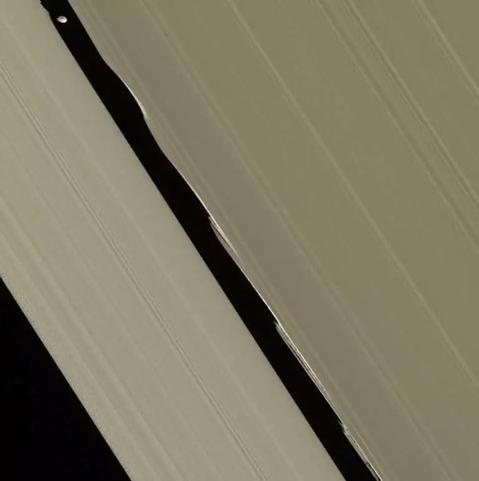
This 2005 photo, taken by the Cassini probe, was the first time anyone actually saw Saturn's moon Daphnis! It's only 8 kilometers across.

This gap in Saturn's A ring was first discovered by Voyager, and it was named the Keeler Gap. It's 35 kilometers wide. I guess this gap let people guess the existence of a moon, and later the ripples in the A ring let people guess where the moon must be! I don't really know the history here.

(2/n)

There's a larger gap in the A ring called the Encke cap, created by a larger moon called Pan, which you can see clearly here.

To the left you see the smaller Keeler gap. If you look very closely you can see the ripples near the Keeler gap... and if you look *very* closely you can see, or at least imagine, the moon Daphnis.

(3/n)

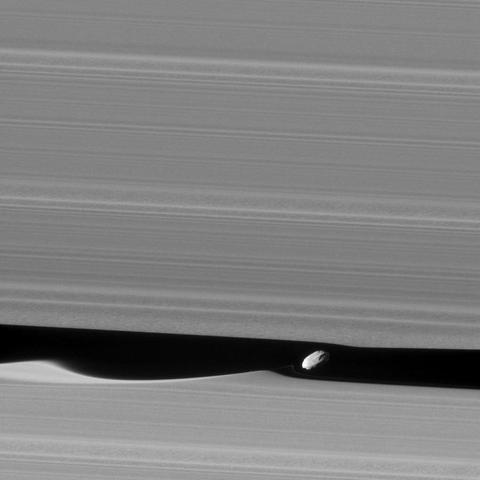
Now here is a really *great* actual photo of Daphnis and the ripples it creates in Saturn's rings!

It was taken by the Cassini probe and released in February 2017. It was taken in visible light using Cassini’s narrow-angle camera. Cassini was 28,000 kilometers away from Daphnis, and the image scale is 168 meters per pixel.

https://www.esa.int/About_Us/ESAC/Saturn_s_moon_Daphnis_in_the_Keeler_Gap

What other really good photos can we find?

(4/n)

Saturn’s moon Daphnis in the Keeler Gap

Daphnis, one of Saturn’s small ring-embedded moons, is seen here kicking up waves as it orbits within a gap between rows of icy ring particles.

Here's a nice photo of Daphnis in the Keeler gap in real color! It was taken by Cassini on July 5, 2010 - taken in red, green, and blue and then recombined.

https://www.planetary.org/space-images/daphnis-in-keeler-gap

(5/n)

Daphnis makes waves in the Keeler Gap

Daphnis and waves of ring particles kicked up by gravity, imaged by Cassini in true color on July 5, 2010.

The Planetary Society

And here's an excellent image of Daphnis taken by the Cassini spacecraft on one of its ring-grazing passes on January 16, 2017 - the closest to Daphnis it's gotten so far, I believe!

NASA says:

"Material on the inner edge of the gap orbits faster than the moon, so the waves there lead the moon in its orbit. Material on the outer edge moves slower than the moon, so waves there trail the moon. The waves Daphnis causes cast shadows on Saturn during its equinox when the sun is in line with the plane of the rings."

(5/n)

Finally, here's a really crazy picture by Kevin Gill - a view you could only see if you sailed through the Keeler gap!

Someday I hope humanity does this.

You can see more images by Kevin Gill here:

https://www.flickr.com/photos/kevinmgill/

(6/n, n = 6)

Kevin Gill

Explore Kevin Gill’s 9,991 photos on Flickr!

Flickr
@johncarlosbaez they say the rings are stupid thin and flat. not in this region apparently! wonder what % of teh ring surface is so thin and flat

@johncarlosbaez A cruise around the Rings of Saturn is a bit more interesting that Katy Perry's 10 minute hop into 'almost Space'

#SpaceTourism #Saturn #KatyPerry

@johncarlosbaez
Great pictures, interesting thread with interesting commentary from readers and you responding, and you provided links to interesting material.

I don't usually say such things, but today I get the impression that you *do* like such feedback instead of your readers being briskly business-like and terse.

@dougmerritt - holy moly, I *live* for feedback, as long as it's intelligent and friendly. Even amateurs trying to grapple with celestial mechanics concepts like the inner rings rotating faster please me! The only things I don't like are rudeness or people who wildly overestimate their expertise.

@johncarlosbaez
Ah; I should have guessed that. Maybe I misunderstood because *I* wildly overestimated my expertise in some interaction with you, and suffered the consequences. I don't recall such a thing specifically, but it's believable! 🙂

I will try to make a point of giving you (friendly and hopefully intelligent) feedback from now on.

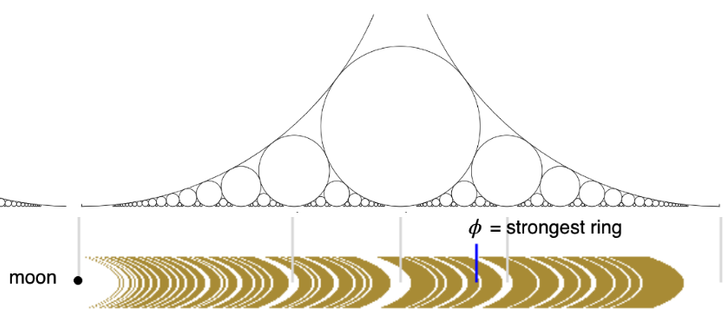
@johncarlosbaez There's a connection with Ford circles too. If you have one moon then you get gaps when the orbital period of the debris is a rational fraction of the moon's. Simpler fractions making larger gaps, so the base of the larger circles are the larger gaps.
So the thickest rings should be the periods hardest to approximate by a rational multiple of the moon's, such as phi. They're least resonant.

Orbital radius having a simple relationship with orbital period.