Well I've just made an absolutely gut-wrenching discovery.
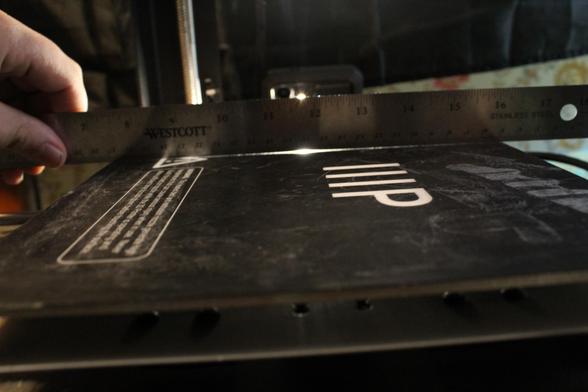
I've been fighting with adhesion issues on my 3D printer for months, and after making Z-Offset adjustments, temperature changes, leveling and re-leveling the bed countless times... I decided to check the extruder nozzle height at more than just the corners, and I've discovered the bed is warped. Fuck.
This is a manually-leveled machine so there's no way to compensate for this. I don't know what to do.
#3dprinting
@FyxTheProto Any chances that you could install a firmware with mesh bed leveling? I had one installed in my former Anycubic i3 Mega and IT worked quite well.
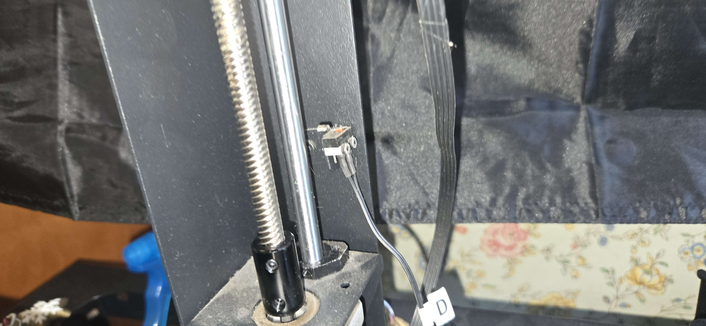
@fantexander Thing is this little microswitch mounted near the left z-axis lead screw is the only way the machine has to know its z height. It has no interaction with the bed itself. Unless there's an easy way to do mesh leveling manually, the second I adjust the bed height for anything it'll throw it wildly off, won't it?
@FyxTheProto Manual Mesh Leveling just needs one endstop. The process for Marlin ist described here: https://marlinfw.org/docs/gcode/G029-mbl.html
My machine also had only one z-switch.
Bed Leveling (Manual)

Mesh Bed Leveling (MBL) allows interactively measuring a Z height mesh without a bed probe. The only tool required is a piece of paper or a feeler gauge. MBL uses the mesh to compensate for variations in height across the bed.

Marlin Firmware

@FyxTheProto

These printbeds from aluminium-core pcb material have these problems from the beginning, especially for the bigger beds.

All beds made from rolled sheetmetal.
Bigger like 100*150mm big.

Switch to cast aluminium plates and slilicon heater mats to get around this. Yes its not that cheap, and heater power for the heavier plate is needed, 0,25w per cm2 at least, better a bit more if ABS like bed temperatures are needed.

Dont know what kinematics your printer have, the heavier beds may better build in printers with ulti/corexy/hbot/delta kinematics or cartesic with vertical-only bed axis

@gafu @FyxTheProto If they have to change the whole heat bed they could alternatively also upgrade their printer with a Z probe. This would be an improvement in every way.

@Natanox @FyxTheProto

Then you print every part with a bow on the downside, but reliable the same bow as your bowed bed plate.

Every print take longer start time.

Your bed probe sensor can get broken.

The measurements have thermal related errors. Maybe you should have different custom start gcode for different heating bed temperatures to probe different by filamentspecific bed temperatures.

I dont see the part where it get better in every manner.

@gafu @FyxTheProto That's why it's probing after the bed is already heated up. The longer start time isn't necessarily the case, it depends on how you configure Klipper (it may also only measures on demand and otherwise use one measurement to zero in on the known profile).

The thing with the bow is true. However from my experience with both printers that have and don't have a Z probe I'll definitely take the one with the probe every time. No matter if the plate is warped or not.

@Natanox @FyxTheProto

Maybe your "nonprobe" printer isnt reliable, besides the probe thing

On my side the old wooden makerbot clone was the sqishy one, who likes to fail the first Print sometimes midsummer when the wood soakes the moisture up and the wooden enclosure get bigger and so the mechanical z endstop wanders with the enclosure.

After preheat again to ABS temperature in the enclosure it get back to normal shape.

I could modify it to have the endstop related to same height as the XY kinematics mountings to cancel this, but overall it doesnt bother me enough. If i use this machine often it even doest applycat all.
Printed some kilometers of filament on this one, whondering about this thig still works 😉

@gafu @FyxTheProto That sounds more like a wood problem. 😅 I'm confused though. With such a machine zeroing and probing before every print would've made sense, it would've taken care of all the problems?

@Natanox @FyxTheProto

I got the metal sheet out, disassembled the heater pcb (on this old printer it is two parts) and bend the aluminium plate back to flat over my knee, 2 years ago.

For this little one (maybe 120*200mm?) it worked, with first layer 0.3mm it is error-proof enough to work reliable most time of the year.
Dont want to change the whole electronics, its still the old makerbot board inside, "hacked" two silent steppers into for x and y. (Mirrored pins on thr stepsticks)

This printer was inspiring about how to build an easy to maintain printer, a bit low tech but "good enough". Made years later a bigger one with similar kinematics from alu extrusion profiles with a thick cast metal plate. Works nice, medium acceleration of 1500mms^2 is doable without problems with the stacked xy axes setup.

I dont miss the fiddely bed probes at all.

@FyxTheProto On some of those older printers it was common to have to find (or make) a sheet of glass to match the heat bed size and clip it to the bed for a surface that is flatter than the metal bed. That or glass with a PEI sheet on top. That's what I ended up doing with my old Monoprice Select Mini v2 and my CR-10S years ago.

That's usually fairly cheap to do, especially if you have a hardware store nearby that can cut you a custom piece of glass.

@FyxTheProto try packing under the bed with something like aluminum foil.
@roller This is an i3 style printer that moves the bed on a pair of linear rails. I don't think that would work
@FyxTheProto I thought that might be a magnetic plate. Sorry.
@roller Ah, makes sense. Sadly not. I do plan on getting a sheet of G-10 to see if that helps at least in some way but we'll have to see