
🚀 Happy to share that our paper "**Ad-Blocked Reality: Evaluating User Perceptions of Content Blocking Concepts Using Extended Reality**" has been accepted at @chi #CHI2025!

This research was conducted in collaboration by Christopher Katins, myself, Jan Hinrichs, Pascal Knierim, Bastian Pfleging, and Thomas Kosch. Thank you all!

We explored how #XR could be used to block content in the physical world, such as advertisements on billboards, and how users perceive this idea.
👇 1/2
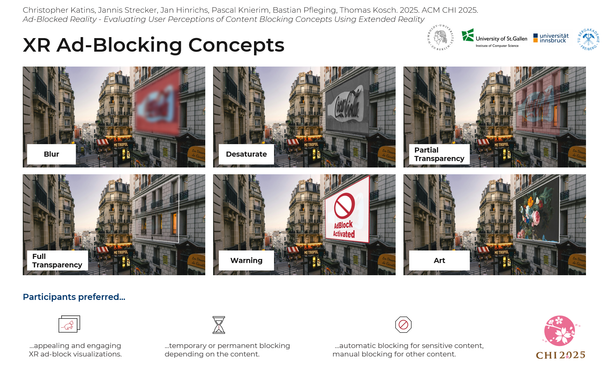
While participants saw benefits like improved focus and privacy, concerns around missing important information and isolation also emerged.
Our findings highlight the need for intuitive #XR ad-blocking controls and we provide guidelines for future content-blocking XR design.

👉 Read the full paper here: https://www.alexandria.unisg.ch/handle/20.500.14171/121943

#AdBlocking #AugmentedReality #Advertising #DiminishedReality #AdBlock #ExtendedReality
2/2

Ad-Blocked Reality: Evaluating User Perceptions of Content Blocking Concepts Using Extended Reality

Inspired by the concepts of diminishing reality and ad-blocking in browsers, this study investigates the perceived benefits and concerns of blocking physical, real-world content, particularly ads, through Extended Reality (XR). To understand how users perceive this concept, we first conducted a user study (n=18) with an adblocking prototype to gather initial insights. The results revealed a mixed willingness to adopt XR blockers, with participants appreciating aspects such as customizability, convenience, and privacy. Expected benefits included enhanced focus and reduced stress, while concerns centered on missing important information and increased feelings of isolation. Hence, we investigated the user acceptance of different ad-blocking visualizations through a follow-up online survey (n=120), comparing six concepts based on related work. The results indicated that the XR ad-blocker visualizations play a significant role in how and for what kinds of advertisements such a concept might be used, paving the path for future feedback-driven prototyping.

@jannis @chi As intriguing as I find the idea of walking around and seeing photos of kittens and flowers everywhere there is now a billboard, based on a quick browse of the article it sounds like your participants were fairly sophisticated and were asking questions like "wait, who is in control of this and what are they going to prevent me from seeing?"
@soaproot In the first study we were more interested in such questions, as it did not have nice visualizations (just a grey block instead). You are right, who has control over what people will see while using an XR ad-blocker will be a very crucial point to consider before apps like this are widely deployed.
Any kind of dynamic reality mediation through XR devices (beyond our use case) gives a lot of power to whoever controls it! As part of my PhD, I try to find responsble approaches for this.