 Bruce Sterling @bruces
*Slop weather.
*What the heck, if it's .99 cents, everybody will buy it
*Slop weather.
*What the heck, if it's .99 cents, everybody will buy it
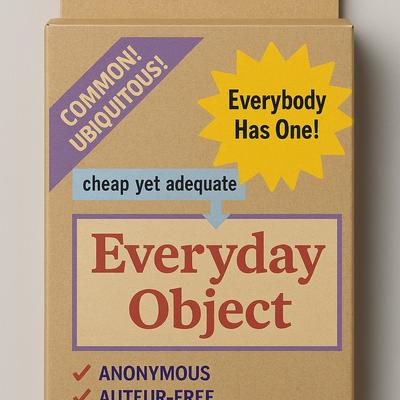
*I like "slop" as a handy punk term-of-art for AI-LLM product
*It's like recognizing that sausages are made of ground-meat and filler
"Is this shiny cylinder an amazing high-tech super-steak"
*Well no, that's a hot dog

... or as the Yes Minister Xmas Special had it, the "Emulsified High-Fat Offal Tube"
@bruces Yes, it is slop.
Next
why "slop"? is this because it is using AI tools? and the AI tools are not procedural therefore not decomposable and debuggable in the familiar ways?
OCR recently went from hand coded feature extraction and rules based identification to the machine-learning system in tesseract. Is this also "slop" ?
trying to understand why "slop". Seriously, I'm curious.
@brewsterkahle @bruces Let's distinguish between two contemporary uses of the word "AI". There is deep learning, analytical AI: stuff like image recognition, OCR, machine translation, etc. Almost all of this is good. And there is generative AI, LLMs, which are mostly used to spew bullshit and lies and plagiarize art and media. Almost invariably sub-par derivative slop.
Unfortunately it's the generative slop that has caught the imagination of media and investors (who throw money at it).
Clear?
@cstross @brewsterkahle @bruces And yet everyone gets all surprised and defensive when you call them out on "AI", and they say "oh, we didn't mean the LLMs".
If you or your marketing department hasn't worked out that you're going to get that reaction from saying "AI", then you're reading a large chunk of the room very very wrong.
And if you're ignoring that part of the room because "AI" is popular, then that's just flat out culpable idiocy, like everyone else I've seen involved in marketing.
@brewsterkahle @cstross @bruces There seems to be a big difference between generating weather forecasts by modelling the atmosphere, vs generating a weather forecast by assuming tomorrow will be similar to today, that "past performance is indicative of future results", contrary to the SEC's rule 156 in the finance world and a world with large-scale climate changes.
The paper that was linked from the article was just a summary itself, and very very light on details, so more of a tech-hype than actual science.
However, for short-range forecasts, and ones for specific microclimate areas, it may well be a great approach. The global climate models can rarely get the sort of resolution needed for small areas. You want them for longer-term forecasts though!
@brewsterkahle
@cstross @bruces
There's also the fact that the current state of things is such that, despite this being a scientific paper published in Nature, an AI "breakthrough" is honestly hard to believe exists at this point. We have been so radically oversold on supposedly new and radical AI ideas that turn out to be significantly inferior to the systems we have now that without long-term testing and verification with somehow trusted third parties (do those even exist anymore?) that it would be hard to believe the kind of revolutionary predictive power described here is real.
"a new AI weather prediction approach that is tens of times faster and uses thousands of times less computing power than conventional systems."
I am reminded of the saying "if it doesn't have to work I can make it run as fast as you like"
@letterror @bruces as a kid one of my favourite TV shows was called Beyond 2000. It was science/tech journalism on our public broadcaster –mostly about new technology that could see broader adoption in an optimistic future.
I want that future. I like feeling positive about the future! I don’t feel any positivity from the LLM hype. None at all. Seeing others who plainly do is disconcerting.
Perhaps it’s the omnipresent billionaire vibe that makes this tech smell iffy.
@bruces please don't be knee-jerk about this. The ECMWF is Europe's forecasting model, generally considered the best in the world, and they found using AI improves their forecasts by 20%:
https://www.ecmwf.int/en/about/media-centre/news/2025/ecmwfs-ai-forecasts-become-operational
@bruces Using purely associative #AI methods, their system may in fact be be able to make reasonable short term predictions. I know because In the olden days of AI (1980’s), I used a different associative technique based Mill’s method of induction to build a demo of a local weather forecast system. It worked fine at small scale (temporal and spatial) but computers were simple not good enough yet to scale it up.
What is “slop” is the misleading overblown language the Cambridge group is using. They are known for this.
Their system, like all associative reasoning, has no conceptual model of weather and climate. It does nothing to help scientists, or forecasters, explain weather. They can’t even explain why this model comes up with particular forecasts. Additionally, stochastic factors are significant causal influences in systems like weather. These add up as current models predict farther into the future, degrading the temporal and spatial resolution of predictions. No purely associative system can ever handle stochastic features without degradation.
Ok, yeah. Slop is a good word to use.
 Bytebro 🇬🇧 🇺🇦 🇬🇱
 child of baphomet
 Kevin Riggle
 Jeff Atwood
 Luke Kanies
 Ann H
Ann H Chupacabra 78704
 Speed demon 🇪🇺 🇳🇴🇺🇦🇵🇸
 Brewster Kahle
 Charlie Stross
 Hugo Mills
 CMDR Yojimbosan 🅅⁂
 mav
mav 
 Pete Alex Harris🦡🕸️🌲/∞🪐∫
 Erik
Erik Ollie Boermans
 Fazal Majid
 David J. Atkinson