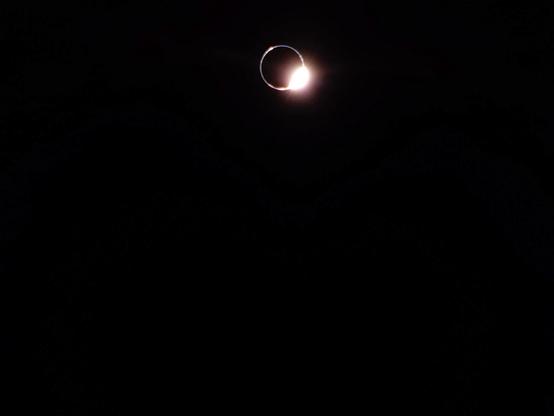
Here it is: The first clear image of an eclipse of the Sun by the Earth, taken from the surface of the Moon.

This is what last night's lunar eclipse looked like from the Blue Ghost lander's perspective on the Moon. Amazing!

https://www.flickr.com/photos/fireflyspace/54386246629/in/dateposted/ #space #science #art #tech

Blue Ghost Mission 1 - Solar Eclipse Diamond Ring Effect

Flickr
@coreyspowell It looks like there's a slight bright spot on the opposite side from he sun. Any idea why that would happen?

@ryanjyoder Do you mean in the 'north-west' (top left) of the ring of light? I'd assume an irregularity in the Earth's surface - similar to the effect of Baily's beads (https://en.wikipedia.org/wiki/Baily%27s_beads) in the case of when the moon eclipses the sun.

@coreyspowell

Baily's beads - Wikipedia

@zeborah @coreyspowell yeah exactly, top left. It seems to large to be irregularities. But I have no idea.

@ryanjyoder @zeborah @coreyspowell

If you consider that the earth is far from round, it's reasonable.

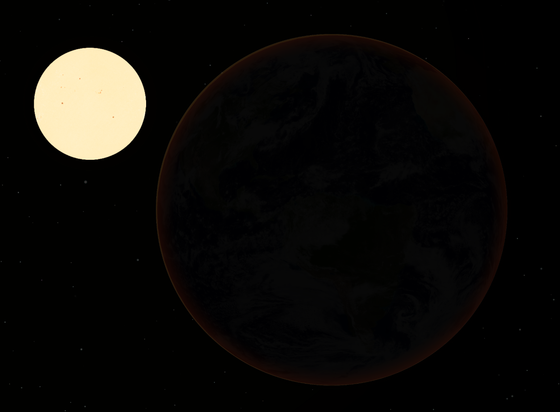
@deirdrebeth @ryanjyoder @zeborah @coreyspowell Viewed from the surface of the Moon, the Earth is a little more than three times the apparent diameter of the Sun. See the pic below – it is a simulated view from the surface of the Moon about two hours before totality (so the entire disk of the Sun can be seen).

The light at the upper left in the Blue Ghost pic is not a bit of sun peeking through mountains (as you get with Bailey's Beads during a solar eclipse)–the Earth is too smooth (relatively) to produce such a pronounced effect. The ring of light that you see around the Earth is due to refraction of sunlight as it passes through our atmosphere. Red light gets bent the most, *and* the violet end of the spectrum is scattered by the atmosphere, so you get reddish light lighting up the Moon.

What determines the bright and dim regions around the ring is probably mostly atmospheric clarity - places where there are no clouds will be bright, places with some weather will be dim/dark.

@MichaelPorter @deirdrebeth @ryanjyoder @zeborah @coreyspowell Thank you! I did not understand how the Earth and Moon could be the right size and distance to produce perfect total eclipses in both directions.

@Annaspanner @deirdrebeth @zeborah @coreyspowell

Based on @MichaelPorter excellent answer here, I think we can rule out solar flares (I think...). Since the apparent size of the earth is so much larger compared to the sun, I don't think you could see solar flares.

@ryanjyoder @deirdrebeth @zeborah @coreyspowell @MichaelPorter Yes, agreed. Busted - I just wanted to post my eclipse photo πŸ˜†
@Annaspanner I'm enjoying the photos in this thread!