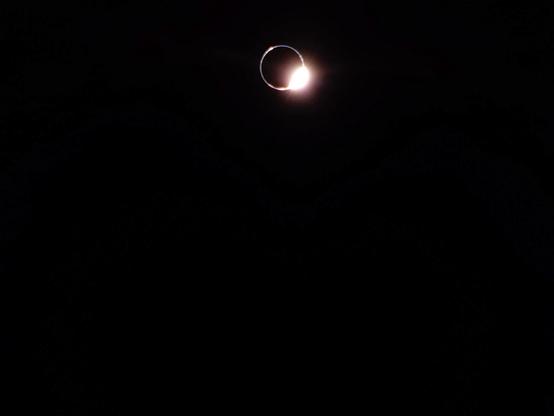
Here it is: The first clear image of an eclipse of the Sun by the Earth, taken from the surface of the Moon.

This is what last night's lunar eclipse looked like from the Blue Ghost lander's perspective on the Moon. Amazing!

https://www.flickr.com/photos/fireflyspace/54386246629/in/dateposted/ #space #science #art #tech

Blue Ghost Mission 1 - Solar Eclipse Diamond Ring Effect

Flickr
@coreyspowell It looks like there's a slight bright spot on the opposite side from he sun. Any idea why that would happen?

@ryanjyoder Do you mean in the 'north-west' (top left) of the ring of light? I'd assume an irregularity in the Earth's surface - similar to the effect of Baily's beads (https://en.wikipedia.org/wiki/Baily%27s_beads) in the case of when the moon eclipses the sun.

@coreyspowell

Baily's beads - Wikipedia

@zeborah @coreyspowell yeah exactly, top left. It seems to large to be irregularities. But I have no idea.

@ryanjyoder @zeborah @coreyspowell

If you consider that the earth is far from round, it's reasonable.

@deirdrebeth @zeborah @coreyspowell I was thinking that too but it's mostly at the poles that it's narrower, so it still didn't make sense to me

@ryanjyoder @zeborah @coreyspowell

Where are the poles in that picture? It's not like "up" and "down" mean anything.

@deirdrebeth @zeborah @coreyspowell I guess my assumption was the sun would rise near the equator.
@ryanjyoder @deirdrebeth @zeborah @coreyspowell Could be solar flares. Here’s my pic of the total eclipse of 2024 (taken from Earth but still amazing for me!) in which you can clearly see the flares.

@ryanjyoder
I suspect that the reason is more mundane:
That ring happens because sunlight is refracted, reflected and diffused through the atmosphere, and some of it reaches the moon even when the sun is geometrically fully obscured by Earth.
The amount of light that makes it through in a given place is likely affected by local
cloud cover, or whether or not a place is over water. That should explain the asymmetric brighter and darker regions.

@deirdrebeth @zeborah @coreyspowell

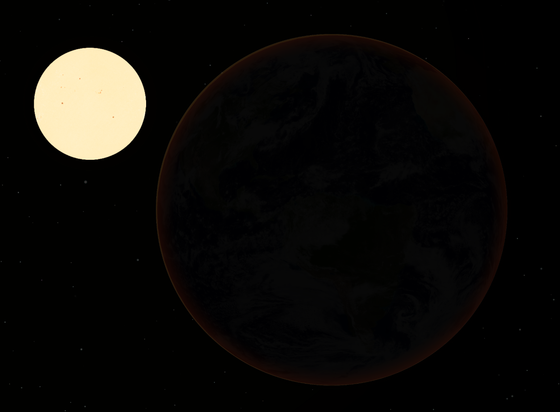
@deirdrebeth @ryanjyoder @zeborah @coreyspowell Viewed from the surface of the Moon, the Earth is a little more than three times the apparent diameter of the Sun. See the pic below – it is a simulated view from the surface of the Moon about two hours before totality (so the entire disk of the Sun can be seen).

The light at the upper left in the Blue Ghost pic is not a bit of sun peeking through mountains (as you get with Bailey's Beads during a solar eclipse)–the Earth is too smooth (relatively) to produce such a pronounced effect. The ring of light that you see around the Earth is due to refraction of sunlight as it passes through our atmosphere. Red light gets bent the most, *and* the violet end of the spectrum is scattered by the atmosphere, so you get reddish light lighting up the Moon.

What determines the bright and dim regions around the ring is probably mostly atmospheric clarity - places where there are no clouds will be bright, places with some weather will be dim/dark.

@deirdrebeth @ryanjyoder @zeborah @coreyspowell Hmmm, if we're simulating the view from Mare Crisium, maybe that pic should be rotated about 60Β° clockwise. I always figure these things out afterwards πŸ™„
@MichaelPorter @deirdrebeth @ryanjyoder @zeborah @coreyspowell Thank you! I did not understand how the Earth and Moon could be the right size and distance to produce perfect total eclipses in both directions.

@Annaspanner @deirdrebeth @zeborah @coreyspowell

Based on @MichaelPorter excellent answer here, I think we can rule out solar flares (I think...). Since the apparent size of the earth is so much larger compared to the sun, I don't think you could see solar flares.