 Colin the Mathmo
"Never make fun of someone if they mispronounce a word. It means they learned it by reading." -- Anonymous
 Atelerix
@ColinTheMathmo that someone might be me…😅
 Karen D 🇨🇦
@ColinTheMathmo
Oh my, Yes! So many words I didn't recognize when I heard others say them, yet I knew what they meant written. And the names of people I still (@60+yo) trip over trying to say: Penelope (penny-lope) Sean (scene) Then you add in a dash of dyslexia and stir. What a f*cking mess. 🤣
Oh my, Yes! So many words I didn't recognize when I heard others say them, yet I knew what they meant written. And the names of people I still (@60+yo) trip over trying to say: Penelope (penny-lope) Sean (scene) Then you add in a dash of dyslexia and stir. What a f*cking mess. 🤣
@KarenDorman Oh yes ... feels so familiar.
(I don't have dyslexia, but I have *so* many words I learned by reading before hearing them)
 Weekend Editor
I had a friend in grad school who did this with all the Greek philosopher's names.
Turns out, in middle school and high school, he just read through them in his local public library.
He may have said the names wrong, but he was right about what they *said*.
 R E K
R E K@ColinTheMathmo this reminds me of when I said the city name Whangarei out loud for the first time to a New Zealander XD...
I pronounced it as "wan-gah-ray", but the proper way to say it was "fah-ngah-ray".
I pronounced it as "wan-gah-ray", but the proper way to say it was "fah-ngah-ray".
 LisPi
LisPi@rek @ColinTheMathmo Got to "love" wildly inaccurate romanization.
 TobyBartels
@lispi314 @ColinTheMathmo @rek : It's because the sound was originally [ɸ] (the unvoiced bilabial fricative), which isn't used in English but lies between [f] (the unvoiced labiodental fricative, the usual sound of the phoneme /f/ with the typical spelling ⟨f⟩) and [ʍ] (the unvoiced labiovelar fricative, the usual sound of the phoneme /ʍ/ in conservative speech with the typical spelling ⟨wh⟩), which are. But [ʍ] is now largely obsolete, increasingly replaced with [w] (the voiced labiovelar approximant, the sound of the phoneme /w/ with the typical spelling ⟨w⟩). So the first English speakers to transliterate Maori heard /ɸ/ as /ʍ/ rather than /f/ and so wrote it as ⟨wh⟩, even though English speakers today almost always hear it as /f/. And to make the choice even stranger, many Maori speakers today say [f], thanks to the influence of English. So the spelling only makes any sense if you compare conservative Maori pronunciation and conservative English pronunciation.
@TobyBartels @rek @ColinTheMathmo So in other words, inaccuracy was acquired and the English spelling would need updating.
@lispi314 @ColinTheMathmo @rek : There's a mismatch that was acquired over time. But it's not English anymore; it's the Maori alphabet, and they (Maori speakers) wouldn't want to change it anymore than we (English speakers) would want to change the English alphabet because it no longer matches Latin.
@TobyBartels @rek @ColinTheMathmo > There's a mismatch that was acquired over time. But it's not English anymore; it's the Maori alphabet
Ah I see.
> anymore than we (English speakers) would want to change the English alphabet because it no longer matches Latin.
I've found myself wishing, as a foreign speaker, that English would drop its use of the alphabet and use a runic-derived syllabary instead, so that one wouldn't have to guess the proper sound.
Of course alphabets are commonly syllabaries that got corrupted into their current state so that's not actually a fix.
Ah I see.
> anymore than we (English speakers) would want to change the English alphabet because it no longer matches Latin.
I've found myself wishing, as a foreign speaker, that English would drop its use of the alphabet and use a runic-derived syllabary instead, so that one wouldn't have to guess the proper sound.
Of course alphabets are commonly syllabaries that got corrupted into their current state so that's not actually a fix.
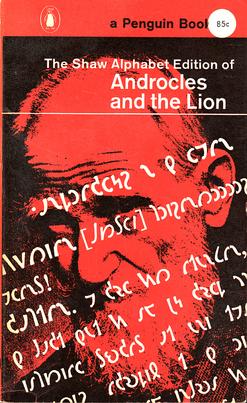
@lispi314 @ColinTheMathmo @rek : It's not a syllabary, but you might like this for English: https://en.wikipedia.org/wiki/Shavian_alphabet
 Yora
Yora@ColinTheMathmo "It means their learning by reading..."
😛
 Hazelnoot
@ColinTheMathmo thanks for this 
 J C Lawrence
@ColinTheMathmo I've had so many conversations sprinkled with, "I've only read this word and am unsure how to say it," or "Is that (thing you said) this word (spells it)? Yes? Oh cool, I never knew how that was properly pronounced."
The rate of those being delightfully banger chats is also much higher.
@jcl It's selecting for people who have read widely, and beyond their usual conversations. Such people are often intellectually curious and have a broad knowledge.
It's a statistical bias, not a certainty, but it's definitely an effect I've experienced.
 sunflowerinrain
@ColinTheMathmo Ohh yes. At a wild guess (apologies if this upsets a mathmo), I thinking my reading vocabulary could be twice the size of my speaking vocabulary.
@sunflowerinrain Doesn't upset me at all ... wild guesses at a rough proportion is stock in trade for pure mathematicians when they're in the exploration phrase.
 psj
psj@ColinTheMathmo indeed. In English in particular, even a native speaker generally can’t see a new-to-them word, and know for absolutely sure how to pronounce it. One interesting side effect of my learning Spanish as an adult was a newfound appreciation for how nuts English pronunciation is, and how hard and weird it must be for (non-child) learners.
 Martin Escardo
@ColinTheMathmo In my case, I first learned English by reading a lot (and mostly mathematics and computer science). So I was in this boat. This was in the late 1980's.
One more thing: I shared an office with a British native speaker when I was doing my PhD in the early 1990's. I remember more than one occasion when I asked him how a certain word in pronounced, and he couldn't tell, because he also learned by reading and not conversation.
@MartinEscardo So much easier learning a language like Spanish, which (as far as I know) has a very regular pronunciation.
So far I'm finding Portuguese not to be too bad.
@ColinTheMathmo I speak both. One is my native tongue, and the other is my mother tong.