
Okay. Please help me as I ask COMPUTER BABBY QUESTIONS.

I have a Thinkpad T14 Gen 3 (AMD).
It has a 256 GB HD. That's too small. I want to buy a new, bigger one. I have a sense the good hard drives these days are "M.2".

Lenovo's specs page

https://www.lenovo.com/ca/en/p/laptops/thinkpad/thinkpadt/thinkpad-t14-gen-3-(14-inch-amd)/len101t0013

doesn't say anything about "M.2". It says the hd is "PCIe".

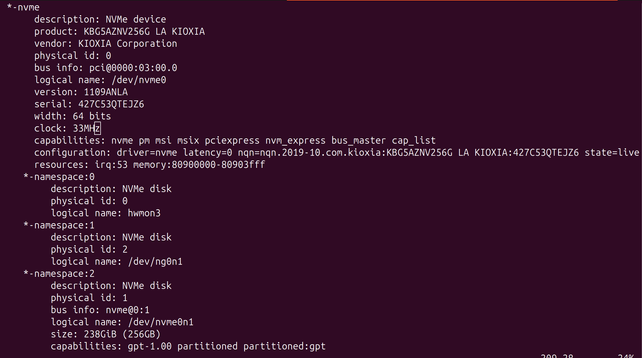
I run "lshw" to see what's on the computer. It says "NVMe".

How do I find out the bestest fastest aftermarket drive Canada Computers carries that my computer will support

I only understand computation as the MANIPULATION OF ABSTRACT PLATONIC FORMS. I do not understand this realm where computers are "physical objects" you manipulate with "screwdrivers". I would prefer to use Math to translate my thoughts directly into action, as if I am casting magic spells
Okay thank you all for explaining. I have one more question: Is there actually, like, a difference between drive vendors. Like if I pick WD vs Samsung vs Lexar (vs… "crucial"?!) will it ever make any difference
@mcc Their firmwares have different bugs (I.e. the secure erase function might not work). And of course 1000 vs 1024 for size. From the OS perspective they’re interchangeable. They might have different r/w speed, and MTTF/MTBF, and maybe a different percentage of spare flash cells. I usually add drives I’m interested in to the compare list on https://skinflint.co.uk/?cat=hdssd&xf=4836_7 for easy comparison.
Hard Drives & SSDs Solid State Drives (SSD) with Form factor: M.2 2280 Price Comparison Skinflint UK

compare prices and read user reviews for Hard Drives & SSDs Solid State Drives (SSD) with Form factor: M.2 2280

Skinflint.co.uk
@schrotthaufen wait wait who defines tb as 1000 and who defines it as 1024. is this documented somewhere
Binary prefix - Wikipedia

@null_aleph yeah but uhh if they say KB does that actually mean KB or does it mean "KiB but we wrote KB"

@mcc storage brands these days virtually always label their (nonvolatile mass storage) products with powers of 10. they very commonly have a footnote that says "1 GB = 1000 MB = 1,000,000,000 bytes" or some such on the packaging

as for software, Windows uses "KB", "MB", etc. to label power-of-two sizes, technically incorrectly, because it's what people are used to, or something (pretty sure there's a Raymond Chen post to that effect). other systems vary... I think many Linux file browsers use binary prefixes ("MiB") correctly, but several CLI tools (notably, coreutils) use single letters ("M") for power-of-two sizes of bytes! it's usually clear in context though...