Holy Crap I almost got T-Boned an hour ago. Middle lane at green light, wet road. Instinctively let car to my left go into intersection first. Car I couldn't see blasts thru intersection against a solid red. If I had gone faster out of the gate I would be totaled right now into my drivers side door.
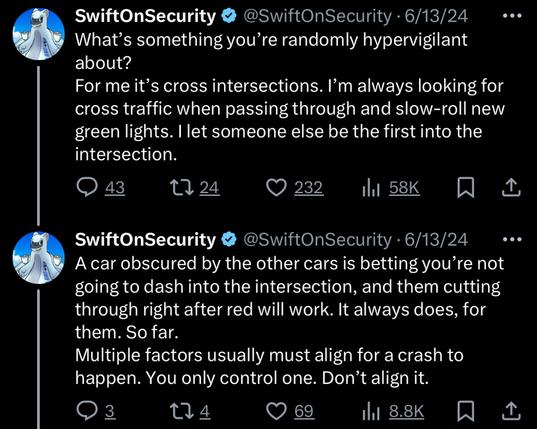

@SwiftOnSecurity This is the embodiment of one of the core things we teach in advanced driving. Seeing the accident pinch points in time and not being there. Observation and understanding of your surroundings are key.

For folk who don't have extensive experience or depth of understanding, watch dash-cam vids on youtube, seriously (preferably from your own locale ― local driving habits can vary significantly). You get the chance to study and understand the anatomy of the accident. See how it unfolds and what led up to it. Learn from their mistakes. It's free and there are literally millions of them.

@McCovican @SwiftOnSecurity
When I worked on autonomous vehicles, we had a whole test dataset transcribed from youtube dashcam videos.
Between those and the NHTSA|FARS reports, you can build a really good intuition of how fatal/photogenic crashes move and develop.
@nonnihil tell me more?
@SwiftOnSecurity Well, I've been out of that line of work for a while, but as of 2016ish:
Almost no crash is one thing, but if you focus on the first detectable deviation from normality, it's nearly always a lane divergence or a late/missing braking.
Which means that the ability to detect the first hint of a change in acceleration or curvature is the whole ballgame.
(Well, that and good lane divergence sensors. If you invest in only one piece of modern auto ADAS tech, that one.)
@SwiftOnSecurity There's [EDIT There was a wrong number here previously] 12 fatalities per billion miles of travel. IIRC about a third of those are intoxication; about a fifth are too unique to prevent. The remaining 40%, about half lane divergence, the other half failing to stop/slow.
Of those, you could usually get a solid third of a second over human reaction times with a fast detection pipeline. That's forever in steering time, but much less braking energy, so steer-to-avoid was the focus.

@nonnihil @SwiftOnSecurity
> 3-4 fatalities per million VMT
Wait, either I don't understand what that means, or that number is wrong. 3-4 fatalities per million vehicle miles travelled would be a 3-4% *annual* chance of death for people driving 10,000 miles per year, which is actually less than the average miles driven. (You can quibble about occupancy, but the median vehicle has a driver and no passengers anyway.)

Does VMT mean something else?

[Edit - ok, 12 fatalities per billion VMT makes a lot more sense - thanks!]

@gfwellman
Yeah, no, it's 6.9 per billion km VMT, pet Wikipedia.
@nonnihil @SwiftOnSecurity