 Esteban Küber
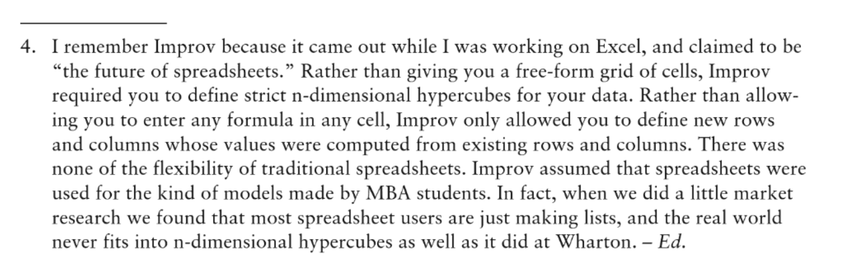
Just finding out about Lotus Improv, which is exactly the kind of spreadsheet design I've been saying for years we should have, yet it failed to gain any adoption, being fully killed in 1996. Reminds me a bit of Resolver One, which was killed in 2012.
I wish we had a spreadsheet today that leaned heavily into structured data, effectively an interactive UI for SQL tables, but much easy to create and modify. But the consensus seems to be that such a thing dies at the hands of "worse is better".
I wish we had a spreadsheet today that leaned heavily into structured data, effectively an interactive UI for SQL tables, but much easy to create and modify. But the consensus seems to be that such a thing dies at the hands of "worse is better".
 Owen Nelson
 Thomas Guyot-Sionnest
 mpe
mpe glyn
glyn
 Hubert Figuière
 Chris Petrilli
 David Pollak
 Tommy Þ
 Eric Bender
 Keunwoo Lee
 Ames
Ames