
Just finding out about Lotus Improv, which is exactly the kind of spreadsheet design I've been saying for years we should have, yet it failed to gain any adoption, being fully killed in 1996. Reminds me a bit of Resolver One, which was killed in 2012.
I wish we had a spreadsheet today that leaned heavily into structured data, effectively an interactive UI for SQL tables, but much easy to create and modify. But the consensus seems to be that such a thing dies at the hands of "worse is better".
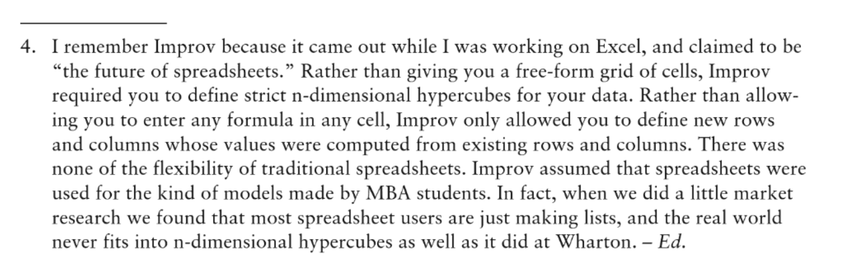

Now we live in a world where free-form Excel spreadsheets *can* have some structure imposed on them, but that rarely do, instead of one where structure is the default, but with free-form sheets available.

I guess it is the dynamic vs static typing argument all over again, but playing out on a field where people don't necessarily see themselves as programmers.

BTW, spreadsheets with logic are programming. Don't let anyone tell you otherwise. Spreadsheet software are simultaneously eons ahead of conventional IDEs (fully reactive, live data modification and presentation!) and hopelessly behind (logic and data live in the same place, in an, for all intents and purposes, opaque binary data format).

@ekuber Are you basing this on the fact that Excel with LAMBDA is Turing-complete? Or would you say Excel enabled programming before LAMBDA was added?

"With the addition of custom functions that can call each other and recursively call themselves, Excel’s formula language becomes Turing-complete, effectively meaning that Excel users can compute anything without resorting to another programming language."

https://www.infoq.com/articles/excel-lambda-turing-complete/

The Excel Formula Language Is Now Turing-Complete

The Excel team announced LAMBDA, a new feature that lets users define and name formula functions. LAMBDA functions admit parameters, can call other LAMBDA functions and recursively call themselves.

InfoQ
@underlap the later. Even without VBscript, Excel can be used for programming.