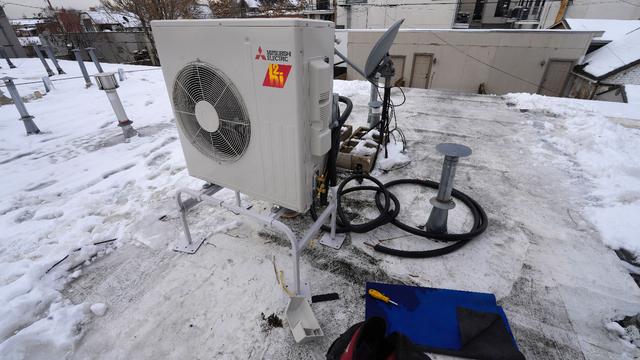
Heat pumps WORK at outside temps down to at least 0F (–18C).

"Under the DOE’s Cold Climate #HeatPump Challenge, three Carrier Infinity variable speed heat pumps with Greenspeed Intelligence and advanced cold climate technology trial units were installed in #Syracuse homes for the 2022-2023 heating and cooling seasons.

The units are reported to have operated reliably at 100% capacity at 0ºF, down to -13ºF in the field and down to -23ºF in Carrier labs."

https://www.coolingpost.com/world-news/carriers-cold-climate-heat-pumps-ready-to-roll/

Carrier's cold climate heat pumps ready to roll - Cooling Post

USA: Carrier has completed the US Department of Energy’s Cold Climate Challenge and will now begin production of cold climate residential heat pumps at its factory in Collierville, Tennessee....Read More...

Cooling Post

A few things you need to know about heat pumps in very cold climates.

"Every heat pump owner interviewed for this story said one of the trickiest parts of getting a heat pump was finding a contractor. "

https://yaleclimateconnections.org/2023/03/do-heat-pumps-work-in-cold-places-heres-what-you-need-to-know/

This checks off: I have friends whose plumber dissuaded them from getting a heat pump, and sold them a gas unit plus a separate AC instead.

Do heat pumps work in cold places? Here’s what you need to know.

Heat pump technology has come a long way, fast. Newer pumps are even delivering warm air to homes north of the Arctic Circle.

Yale Climate Connections

When we got our heat pump, my first step was to research which heat pump I wanted.

Then I looked for installers for that specific brand. It worked out well for us.

Don't let anyone - not even your HVAC guy - tell you that #HeatPumps don't work in cold regions.

"Sweden, Norway and Finland have the coldest climates in Europe. In all three countries, there are now more than 40 heat pumps per 100 households, more than in any other country in the world. "

https://www.carbonbrief.org/guest-post-how-heat-pumps-became-a-nordic-success-story/
by @janrosenow

Guest post: How heat pumps became a Nordic success story - Carbon Brief

A common criticism of heat pumps is that they do not work in cold weather. But how did heat pumps became a Nordic success story?

Carbon Brief

Ready to switch to heat pump?

- Do your research first.
- Find someone who has one, and ask them to demo it.
- If you live in a colder climate, get a cold-ready heat pump.
- Find an installer *who does heat pumps*. I've heard installers tell lies ("It won't work for you because it's too cold where you live") simply because they want you to buy the gas heater they do know how to install.
- For anything big like this, always get more than one bid.

https://www.nytimes.com/2024/10/17/climate/switching-to-a-heat-pump.html?unlocked_article_code=1.S04.tv5I.k6A0ZiEXwg3B

How Times Readers Made the Switch to Heat Pumps

Hundreds of Times readers wrote to us and shared their experiences of installing heat pumps, including the good, the bad and the daunting.

The New York Times

In our case, I figured I wanted a MItsubishi cold-ready heat pump, then I found installers who could do it (the company helpfully provides a list), then I asked two for bids. One came highly recommended, and their bid was also 30% lower than the other, so that was easy.

I geeked out and asked the rep a LOT of questions; he was patient with me even if some questions had to go to the Mitsubishi engineers.

We're very happy with the switch.

https://www.nytimes.com/2024/10/17/climate/switching-to-a-heat-pump.html?unlocked_article_code=1.S04.tv5I.k6A0ZiEXwg3B

How Times Readers Made the Switch to Heat Pumps

Hundreds of Times readers wrote to us and shared their experiences of installing heat pumps, including the good, the bad and the daunting.

The New York Times

A good installer will grill you about the state of insulation in your house (windows and roof), and will advise you to get that up to par first, even though that means they can now sell you a smaller unit.

Because negawatts are cool: the best kind of energy is the energy that you don't need! This requires another upfront cost, but will save you big in the long run. Lucky there's federal tax credit for insulation as well as heat pumps.

Again: if an HVAC installer tells you that your home is in a climate "too cold" for a heat pump, they are wrong, and probably not trained to install a heat pump. Look elsewhere.

Cold winters are no match for modern cold-climate heat pumps

"In fact, Norway, Finland, and Sweden have some of the highest heat pump adoption rates in the world."

https://yaleclimateconnections.org/2026/03/cold-winters-are-no-match-for-modern-cold-climate-heat-pumps/

Cold winters are no match for modern cold-climate heat pumps

In fact, several chilly Nordic countries lead the world in heat pump adoption.

Yale Climate Connections

@CelloMomOnCars

We’re about due for a new HVAC system and I am seriously looking into heat pumps. They’re magic.

@rk

Yeah. I used to say about my handheld blender that it was probably wrong to love an appliance this much. But since the heat pump was installed .....

@rk My parents live in a recent building, and in summer, the heat pump can be set to cooling. It just sends the fluid to the ground without expanding it first, so it cools down. Then you set your thermostats to the highest temperature to open the valves, and the cold water circulates in your floor.
@CelloMomOnCars

@oscherler @rk

Nice!
A ground-sourced heat pump was much more expensive for us, so we went with air-sourced. But that too gives us cooling in summer as well as winter heating, both in a much more comfortable way than our former separate furnace and AC unit.

Ground source heat pumps are increasingly being installed in high rise, for example in Toronto.

@oscherler @rk @CelloMomOnCars

I like the idea of heated floors, but I think floors are a bad medium for circulating cooler air. My feet agree.

@Chancerubbage You’re probably right. But in practice, in a country where homes don’t have AC, it’s still very nice.
@rk @CelloMomOnCars

@oscherler @rk @CelloMomOnCars

Also, some of these areas might have enough geothermal activity that the floor itself needs cooling.

@CelloMomOnCars

Have two.

They lowered my wintertime energy outlay from nearly $800 to less than $400!

@evdelen

Wow!
Unfortunately electricity rates went way up just after we had ours installed so we don't get nearly the savings you do - but on the other hand, CelloDad has air conditioning for the first time in the study, and that's huge.

@CelloMomOnCars

Next big purchase: An inverter, solar, and batteries!

You can produce your own electricity, you can't make your own gas.

@CelloMomOnCars Yeah, but the pump quite some electricity too...

@leeuw

Of course it does.
But a mini-split system has a unit in each room, and now when CelloDad cranks up the temperature it only heats the study, and it does that with a third the electricity compared to when he was heating it with an electric heater. Because a heat pump doesn't make heat, it just moves heat around.

@CelloMomOnCars In the article does -22 mean -22 C or -22 F? Assuming -22 F which would be -30 C (which is cold, granted) but people live in places where it gets colder than that.

@devosb

That is just a random temperature, to demonstrate that there is still plenty of heat in the outside air even though it feels cold to humans.

My *guess* is that in extremely cold places the installer would recommend a resistive heating element for backup.

The system installed in my house retains 95% of its efficiency down to 0F; below that it still works, but with lower efficiency. When the efficiency reaches 30% or so, time to switch to resistive.

@CelloMomOnCars I think you are correct about having resistive heat for very cold situations. I appreciate the additional details of how your system can still work in rather cold weather, but with lower efficiency I had wondered about that trade-off myself.

@CelloMomOnCars I think there's a misunderstanding about "won't work". There ARE climates where the efficiency of heat pumps drops below the COP of 3 that makes them cost effective against fossil fuels. Where I live, when it gets that cold, the price of electricity skyrockets.

This winter, a bunch of folks in New England who switched to relying on heat pumps got whacked with electric bills much higher than they would have had with natural gas or oil.

Of course, the obvious solution to that is to add more electricity to the grid so we don't have to pay for these bonkers spikes or light dead dinosaurs on fire in each home.

@DarcMoughty

The temp below which the efficiency drops off - not precipitously - is about 0F (for the mitsubishi installed in my house), and we got there maybe two nights this winter.

Then again, we set the temp at 55F overnight (invested in down blankets) and over the last ten years there's only been a handful of occasions when the heat came on at night.

@CelloMomOnCars My understanding was that the COP dropped to about 2 at 17°F, and that's well below fossils. I am in total agreement that heat pumps are brilliant, and I'm looking to get a few myself since they're clear winners in most of the calendar where I am... but I was going to keep the boiler and radiators for darker and colder days in December-April.

@DarcMoughty

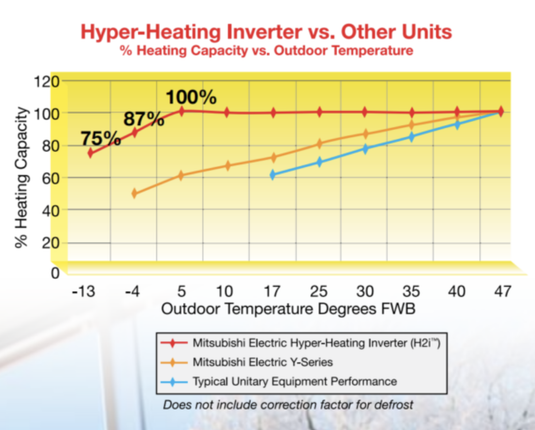
I'm talking about that Mitsubishi "Hyper heat" compressor unit.

@CelloMomOnCars That's 'heating capacity', but the efficiency still drops below fossils in low temps. If you inspect the data sheet, you'll see the COP drop to 2 at 17F and lower, while the wattage skyrockets. The Hyper-Heating units are awesome, and they will keep blowing hot air even when older/lesser heat pumps couldn't, but they cost more to run than fossils in deep cold. IIRC, resistive electric is COP 1.0, heat pumps are 2-4 depending on outdoor temps, and the break-even point on cost/greenhouse emissions for most natural gas systems is about 3.0.

https://metuspublicassets.s3.us-east-2.amazonaws.com/submittals/ME_SUBMITTAL_MXZ-SM36NLHZ.pdf

@DarcMoughty

Yeah.
The devil's flatulence is cheaper because it is mispriced.

@CelloMomOnCars agreed. And the reason I'm pointing out this thing about the low-temp COP is that depending on how your electricity is made and how cold it is, heat pumps can end up burning more of it than having a gas boiler.

@CelloMomOnCars

They're all over the place in eastern Canada (we have 4 on our house, which admittedly is excessive). They work great down to about -15C, after which the temperature indoors will drop a bit. If you get temps below that on a regular basis a backup (electric baseboard or whatever) is helpful.

Heat Pumps

Heat pumps are heating and cooling systems that operate by transferring heat from one location to another. They are designed to extract heat from indoor or outdoor air and provide cooling or heating to your home.There are a few factors to consider when purchasing a heat pump:The type of system availableYour existing systemLimitations due to Saskatchewan's climateHow to prepare your home for installationTypes of Heat Pump SystemsHybrid Heating

SaskEnergy
@CelloMomOnCars Worked for me. Yes, Finland counts as 'colder climate', even the south coast.