🪨THE RIDDLE OF RYŌAN-JI'S GARDEN🤔

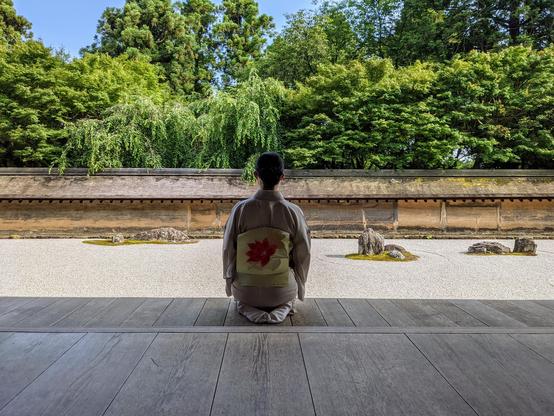
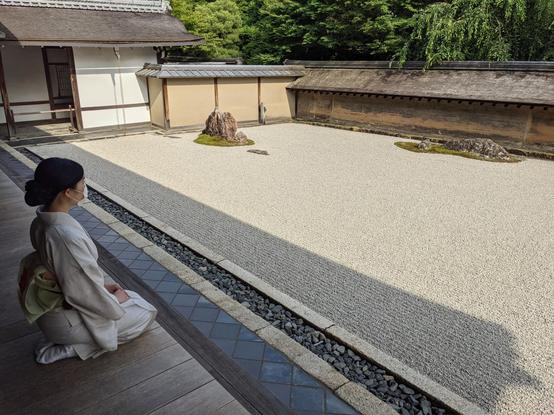
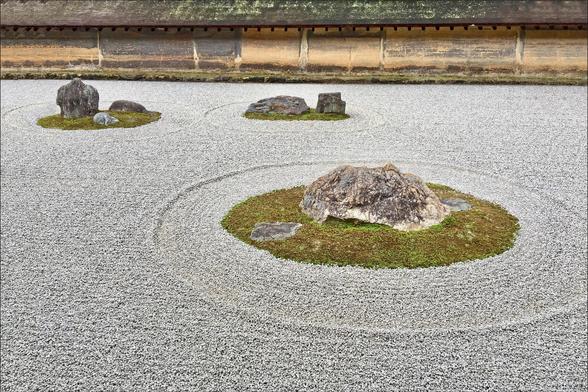
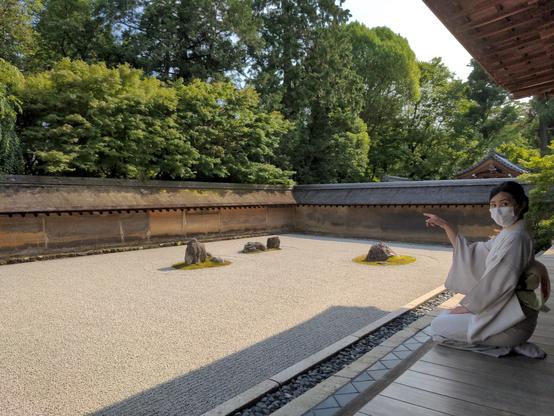
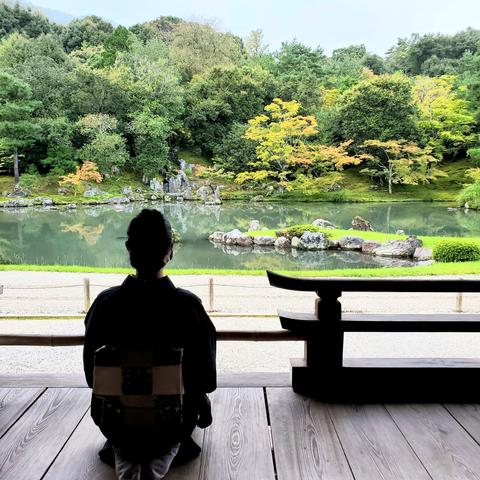
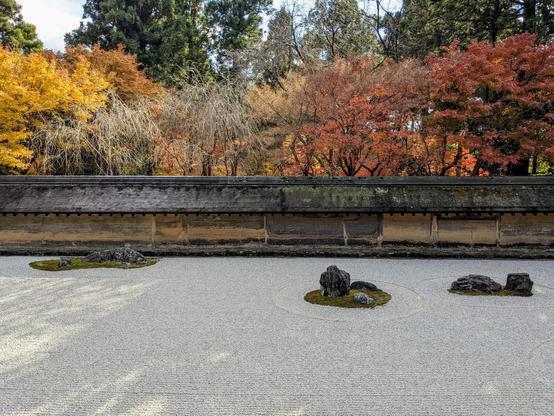
Ryōan-ji's (竜安寺) dry landscape garden (枯山水 'karesansui') is by far the most famous zen garden in the world.

It is a 'koan' (公案 a zen riddle without a solution, intended to focus & open the mind) written in gravel, rocks and moss.

#Japan #Kyoto #京都 #Ryoanji #龍安寺 #公案 #zen #善 #枯山水 #karesansui
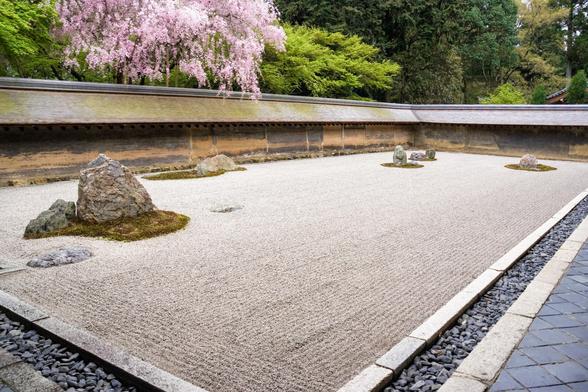
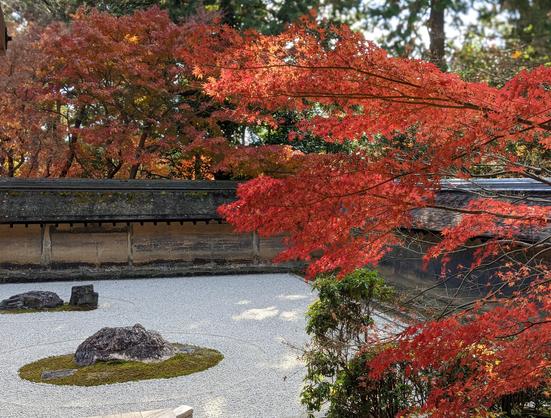
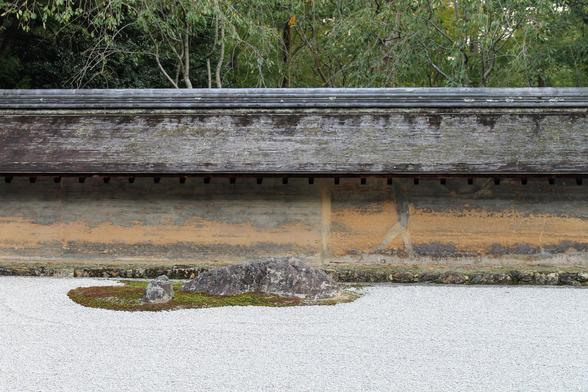
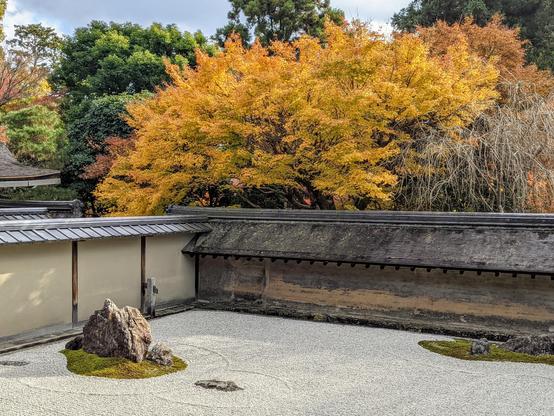
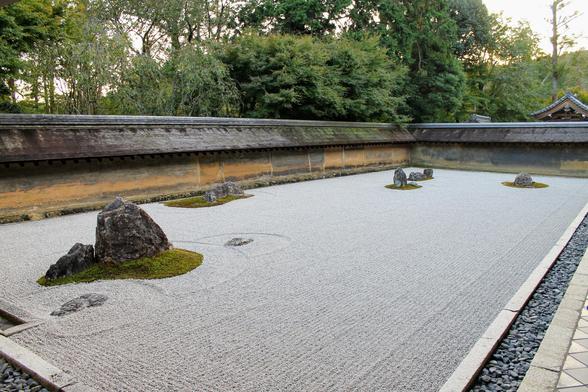
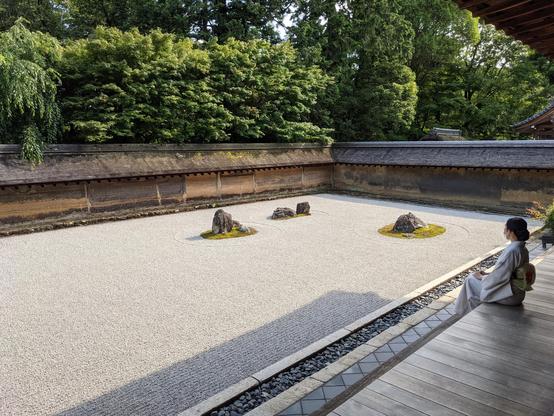
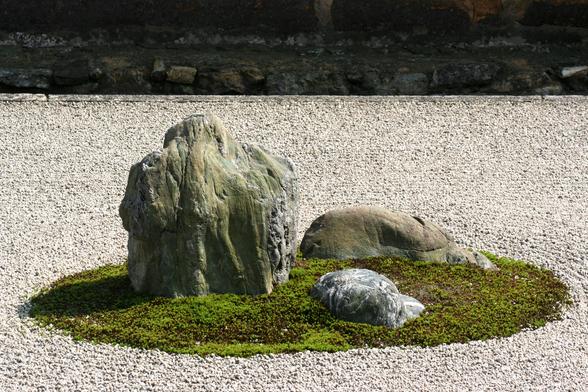
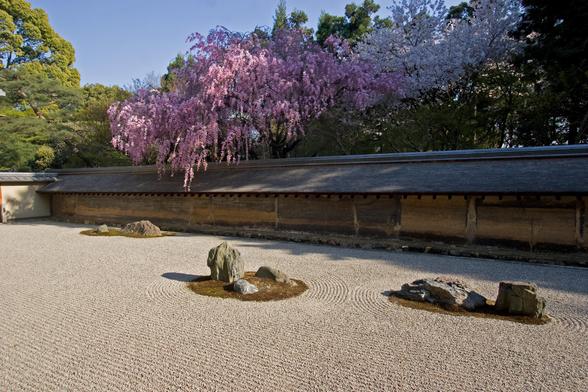
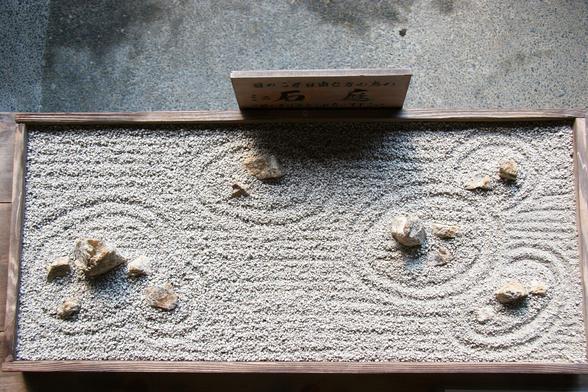
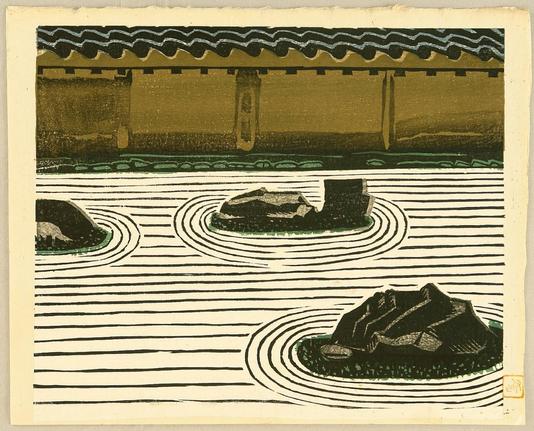
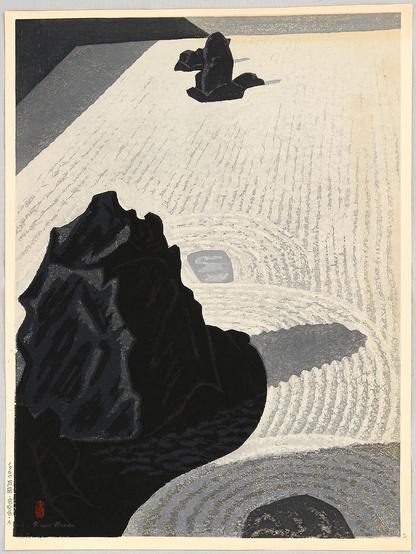
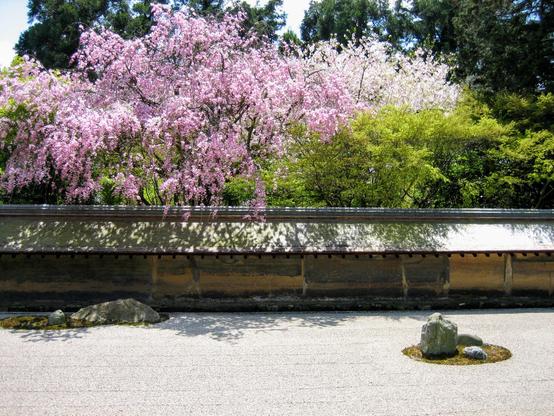
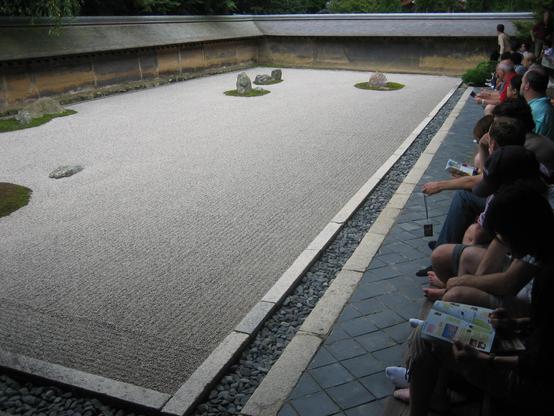
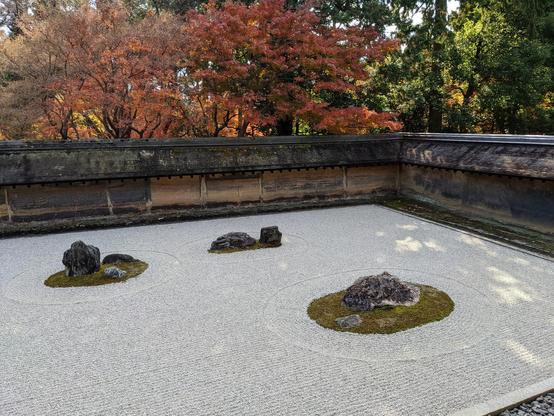
The 'karesansui' garden is a 248 square metre rectangle of carefully raked gravel and 15 rocks.
Some of the rocks sit on small islands of moss, the only greenery to be seen.

The rocks are gathered into 5 groupings (5 / 3 / 3 / 2 / 2)🪨

#Ryoanji #竜安寺 #Kyoto #京都 #Japan
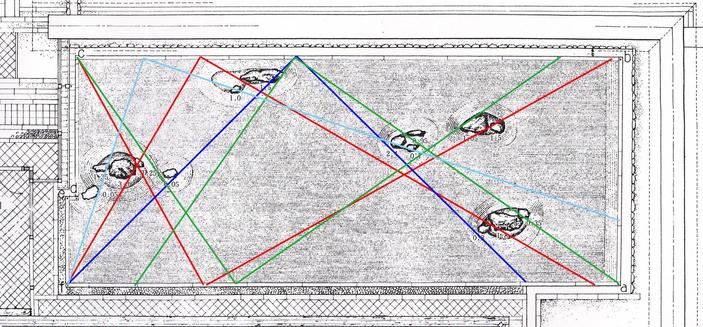
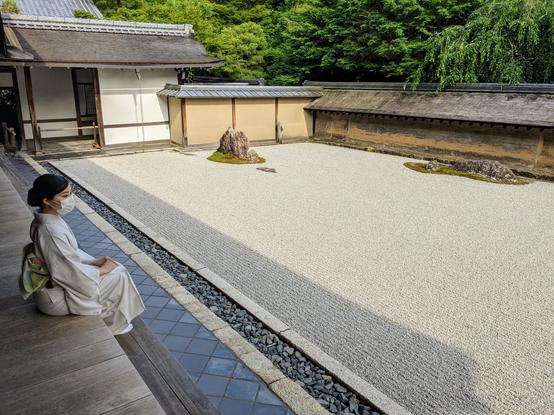
Forced perspective is cleverly used to give the garden depth and make it appear larger.

25m east-west and 10m north-south, the space is actually not level. The S.E. corner is 70cm lower than the highest point, the garden gently sloping down from the N.W. (this helps with drainage).

#Ryoanji #竜安寺 #Kyoto #京都 #Japan

Other tricks are used to bring depth...

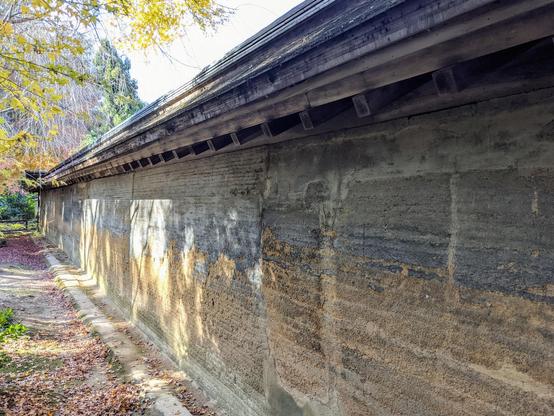
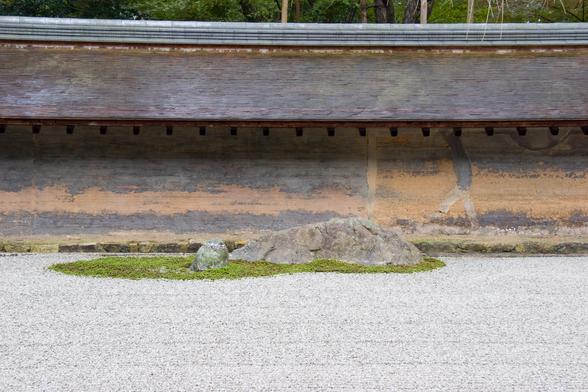
🔎the west wall is constructed 7 inches higher nearer the hōjō (方丈) to give the impression of distance

🔎the 2 rocks at the rear of the garden are shallower

🔎even colour is manipulated (closer rocks are reddish, farther rocks blueish)

#Ryoanji #竜安寺 #Kyoto #京都 #Japan

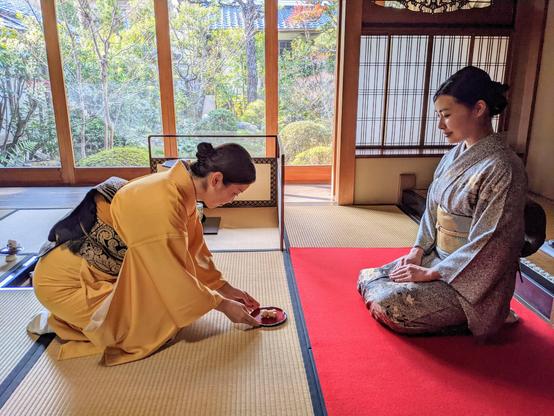
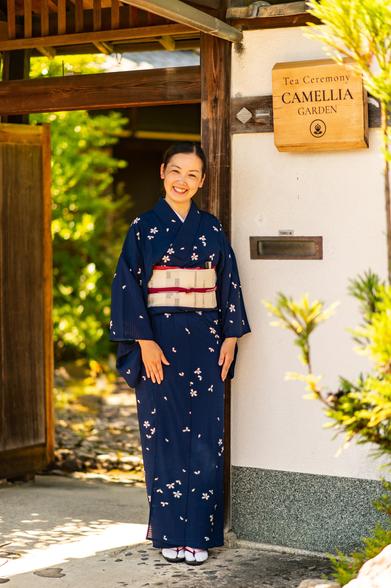
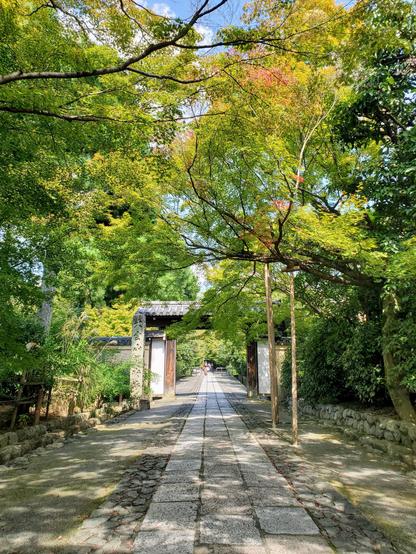
Ryōan-ji is actually our neighbour, just across the road from Garden Teahouse.
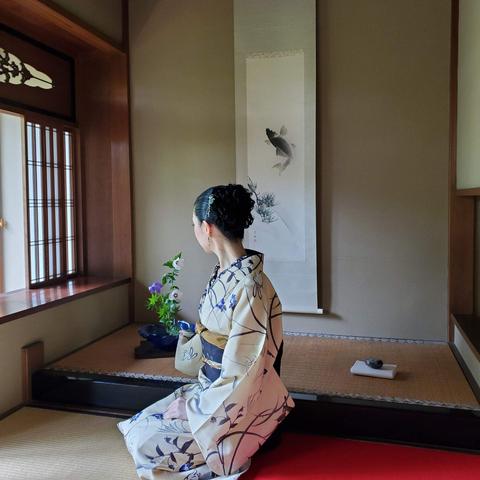
Why not come and have tea in-between all that temple hopping...

Nao-san's 'how to find us' videos👣
⬇️
https://x.com/camelliakyoto/status/1515877168316043264

Online reservation🙇‍♂️⬇️
https://tea-kyoto.com/garden-general-information

#Ryōanji #竜安寺 #Kyoto #CamelliaTeaCeremony #teaceremony #GardenTeahouse #茶道 #matcha #抹茶

Camellia Tea Ceremony (@camelliakyoto) on X

🤔🗺️HOW TO FIND US👣🍵 We've put together some short videos to help you find your way to our teahouses (and other nearby sites) when you come to visit. First of all Nao-san guides you to, from, and around Camellia Garden Teahouse. 1) Closest bus stop to the teahouse 🚏➡️🍵

X (formerly Twitter)

Thought to have been landscaped in the late 15thC, it is unclear who designed the garden.

The bigger mystery, however, is what the garden symbolises. If, that is, it symbolises anything at all. Quite possibly it was always intended to be an unsolvable riddle🤯

Interestingly the garden may have had many different incarnations. We know the garden was altered following a massive fire in 1797.
The historian Kurokawa Dōyū in 1681 mentions only 9 rocks, perhaps hinting that the garden was constantly.

INTERPRETATIONS🤔

1) ENLIGHTENMENT😇
The rocks are placed so the composition cannot be seen from any one point on the veranda. Only 14 are visible at one time.
It is said that only through attaining enlightenment will one be able to view the 15th (in the mind).

2) THE GOLDEN RATIO📐
The garden may follow the Golden Ratio, a design theory seen with the Pyramids & Parthenon. Construction of a structure at a ratio of 1:1618 is said to bring a unique sense of stability that is particularly beautiful.

3) A LANDSCAPE IN MINIATURE🌄
The simplest explanation is that the rocks represent mountains or islands, and the gravel the sea, rivers, or clouds.
This miniature landscape could well reimagine the universe, hinting at worlds within worlds.

4) LOOKING TO THE STARS💫
Quite possibly the rocks are placed to mirror the constellation Cassiopeia.
An alternative theory proposes that 3 groups of rocks form a horseshoe collection of stars, another group represents the moon, and the final group the sun.

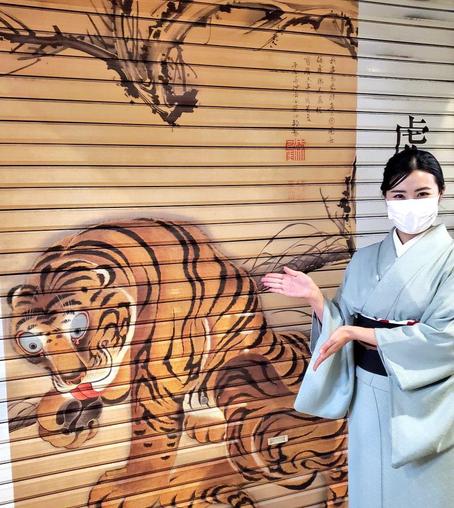
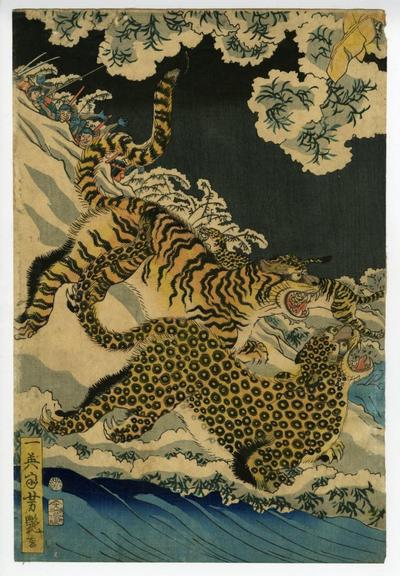
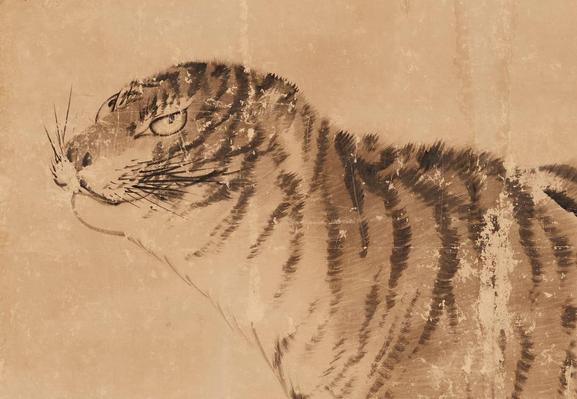
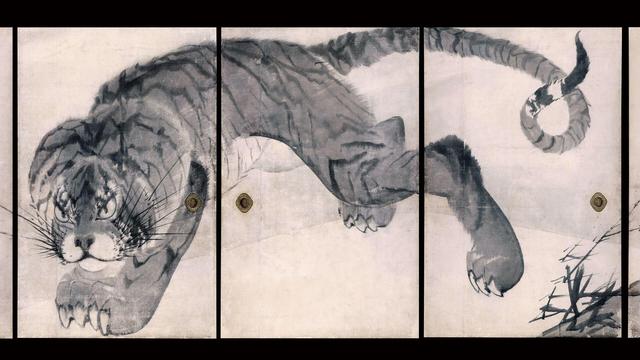
5) CROSSING OF THE TIGER CUBS (虎の子渡し 'Tora-no-ko-watashi')🐅

A mother tiger has to cross a river. She has 3 cubs, but can carry only one at a time.
One cub was born a leopard and if left alone will devour the other cubs.

The positioning of the rocks may answer the riddle.

The 'tora-no-ko-watashi' riddle is an odd one, based on the Chinese tale 'Guixin Zashi' (癸辛雑識).

#Ryoanji #龍安寺 #tiger #garden #drylandscapegarden #zen #虎の子渡し

It was believed that when a tiger gives birth to 3 cubs, one is always a leopard. In total, to bring all 3 cubs safely across the river, the tiger must cross 7 times.

She can only carry 1 cub at a time, so it takes 7 moves.

For example...
1 - carry leopard baby over the river🐆
2 - return🏊‍♂️
3 - carry first cub🐅
4 - return with leopard baby🐆
5 - carry second cub🐅
6 - return🏊‍♂️
7 - carry leopard baby🐆

#Japan #Kyoto #京都 #zen #虎の子渡し

6) 5 MAUSOLEUMS (五陵) or 5 HEAD TEMPLES (五山)🙏
Some have suggested the 5 rock groups represent either the 5 imperial mausoleums on Shu-zan (朱山五陵) or the 5 'Gozan', 5 former shōgunate-sponsored zen temples.
📿Tenryū-ji
📿Shōkoku-ji
📿Kennin-ji
📿Tōfuku-ji
📿Manju-ji

7) HEART or FAN🫶
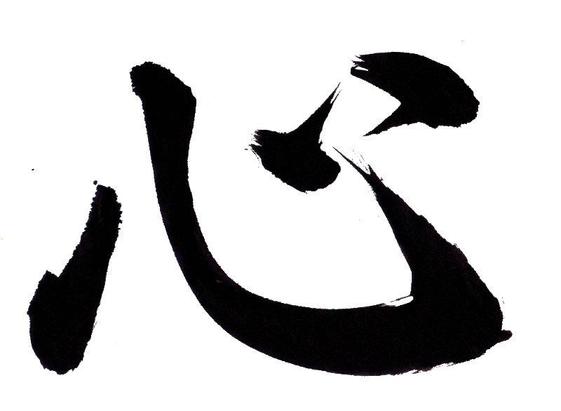
When viewed from above the rocks may well form the character '心' ('heart'), a common motif used in Japanese garden design.
In addition to this some believe the garden represents a giant fan, pivoted on one of the rocks.

8) BORROWED SCENERY🔭
It's almost certain the garden originally made use of borrowed scenery (借景), now hidden by a wall and foliage.

Possibly the rock groups mirrored the world beyond: Higashiyama (東山), Otokoyama (男山), Narabigaoka (双ヶ丘), Nishiyama (西山) and Kitayama (北山).

#Japan #Kyoto #京都

9) THE TSUKUBAI💦🪙
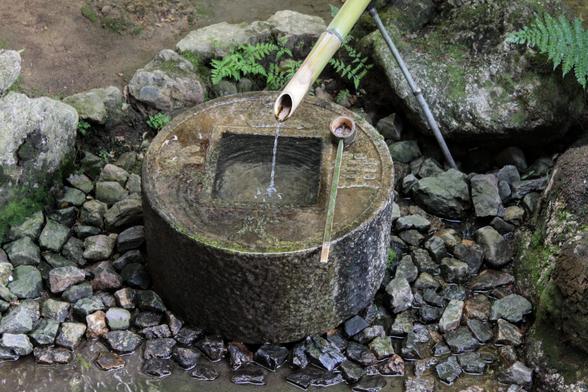
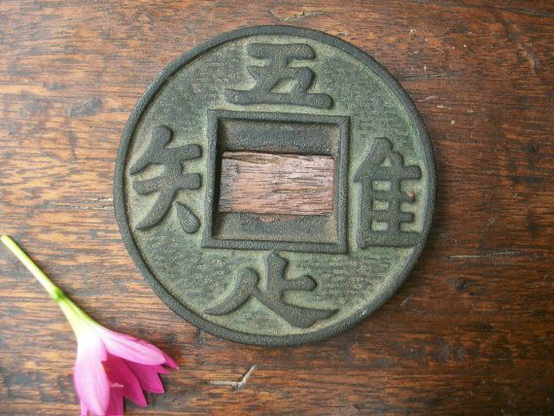
Some have hinted that the garden might in some way visualize the proverb featured on the temple's famed wash-basin (蹲踞 'tsukubai') beside Zōroku-an (蔵六庵)...
吾 唯 足 知 'what one has is all one needs' or 'I learn only to be contented'.

The wash-basin on display at Ryōan-ji is actually a replica. The original, out of sight, was donated by Tokugawa Mitsukuni (徳川光圀 1628-1701) in 1660 and belongs to 'Zōroku-an' teahouse.

#Japan #京都 #竜安寺 #蔵六庵 #Ryoanji #Kyoto

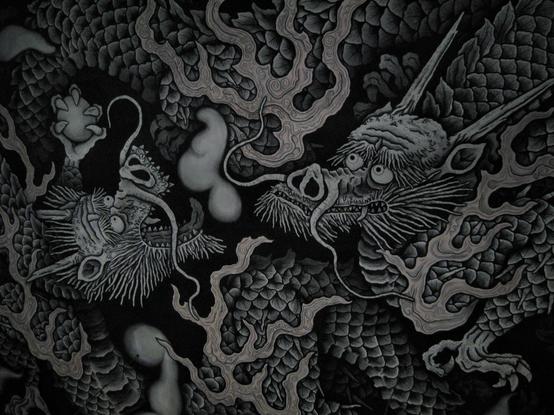
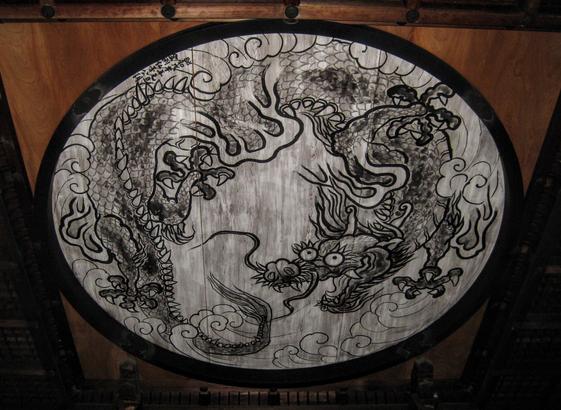
10) THE DRAGON (龍)🐲
Some say it's possible to trace the outline of a dragon, starting with the rock at the most easterly point.
Follow the curving body through the central garden to the NW group, then on to the SW group, finishing at the tail (the low rock from Shikoku 四国).

This may seem like a pretty far out there idea, but the temple's name 'Ryōan-ji' (竜安寺/龍安寺) translates as 'The Temple of the Dragon at Peace' so...

#竜安寺 #龍安寺 #Ryoanji #dragon #龍 #Kyoto #京都 #Japan

11) CRANE TORTOISE GARDEN (鶴亀の庭)🐢
Modern landscape-historian Shigemori Mirei (重森三玲) described it as the pinnacle of a Crane-Tortoise (鶴亀 'tsurukame') and Hōrai (蓬莱の庭 'Island of Perpetual Youth') style garden, which included a Sanzon-seki (三尊石 'Triad Stones').

#Kyoto #Japan #Ryoanji #garden #japanesegarden #drylandscapegarden

12) A BRANCHING TREE🌲
In 2002 a research team at Kyōto University claimed to have cracked the garden's riddle. Using a computer program they discovered that when viewed from the correct angle, the rock groups conjure the image of a branching tree.

13) THE LUCKY NUMBERS 7-5-3🍀
The group of numbers 7-5-3 (15) are considered to be very lucky, symbolising in their various forms the entirety of heaven & earth.
It is believed the garden's rocks are gathered in such a way to form -more or less- 7-5-3.

14) NOTHING💢
The garden historian Gunter Nitschke wrote: "The garden at Ryōan-ji does not symbolise anything...I consider it to be an abstract composition of 'natural' objects in space, a composition whose function is to incite meditation."

#Ryoanji #Zen #zen #竜安寺 #京都

Many believe the artist Sōami (相阿弥) constructed Ryōan-ji's garden around 1500.

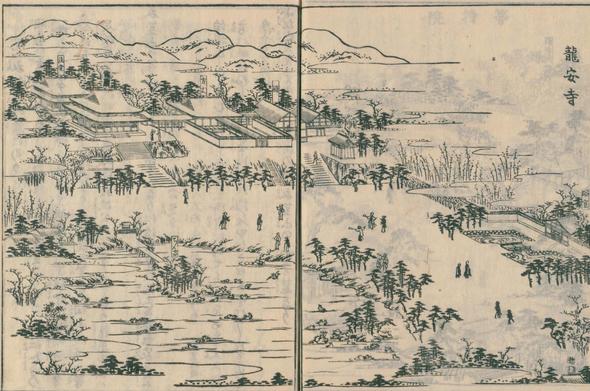
The original garden was without a wall and made use of borrowed scenery, looking across Kyōyōchi Pond.

14 of the garden's rocks are from Kyōto, the 15th (against the far wall) comes from Shikoku.

📸NOT ALWAYS FAMOUS🤨
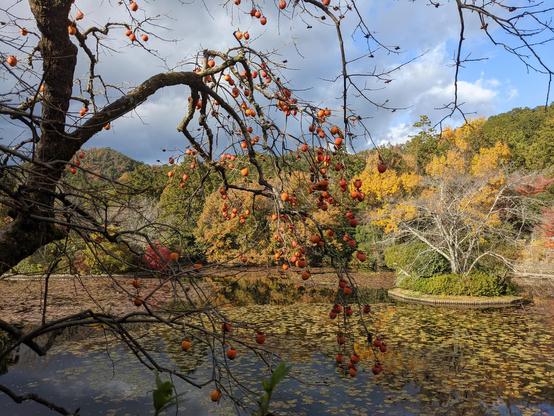
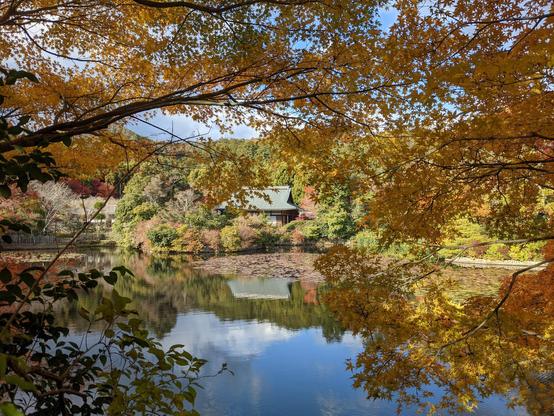
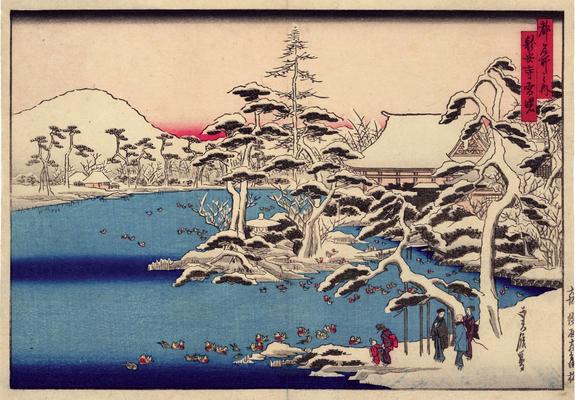
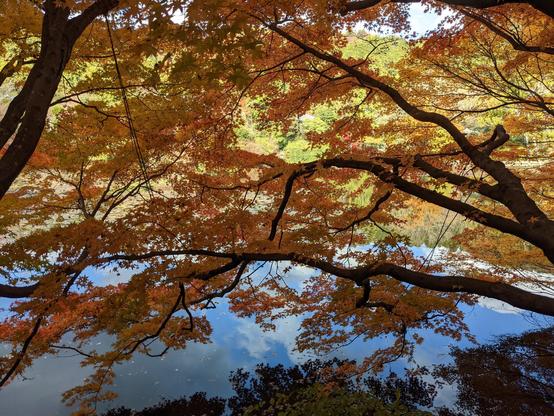
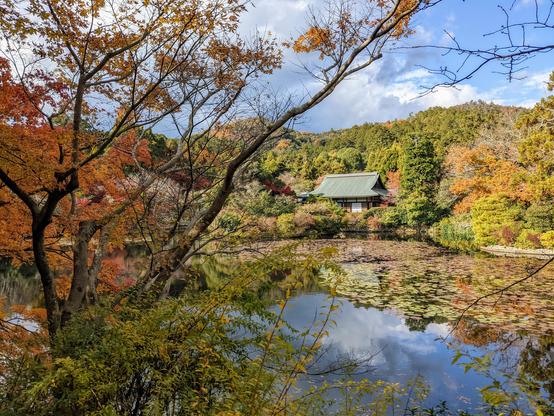
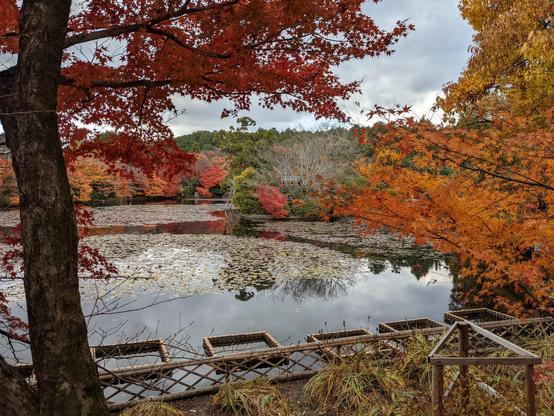
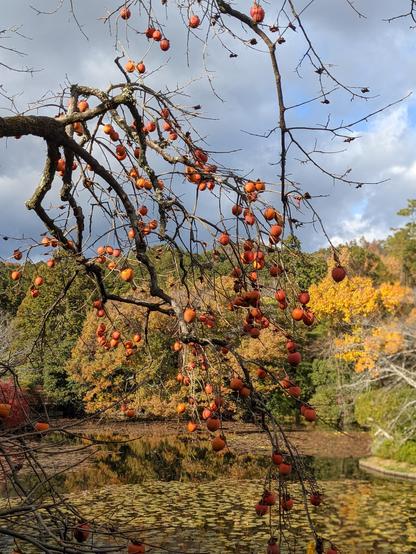
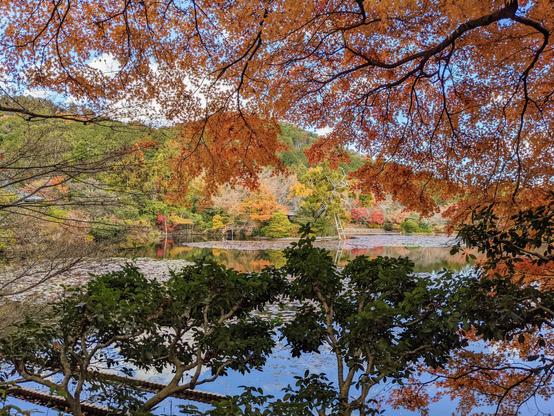
'Kyōyōchi Pond' is far older than the temple, created by Tokudaiji Saneyoshi (徳大寺実能 1096-1157) as a boating lake in the 12thC.
Even after the creation of the temple and the garden, for centuries it was the pond that attracted sightseers.

The pond was once nicknamed 'Oshidori-ike' (鴛鴦池) after the many mandarin ducks that lived here (all now gone). Because they mate for life, it was considered a deeply romantic spot.

The pond has 2 small islands: Benten-jima & Fushitora-jima.

@camelliakyoto I have been to this garden and loved it, the house and setting are gorgeous. The well pictured in this post is used as the template for a bottle opener for sale in hte shop. I bought all three they had available and gave them away to friends. 1/3
@camelliakyoto Every time I meet the friends and use the bottle opener they have, I remember the garden, the tranquility and the friends and link them all together in my memory. The text (using the hole in the middle) roughly translates as “I only know contentment”, however I wish I had got one for myself and hope to go back some day and get some more. But I’ll probably give them away again and have more friends and memories to link back to Ryoanji.
2/3
@camelliakyoto If and when I do, I will cross the road and visit the tea shop and if I have enough, I may leave a bottle opener with you, to expand the memories and to spread the contentment
3/3
@redundantbloke What a lovely story! I have never noticed a bottle opener at the temple shop, so now I'm intrigued. If ever we do find a bottle opener outside the gate we'll know you've been (like an out of season Santa). But if you do ever pass by be sure to say hello!
@camelliakyoto I will try. A picture I found of the bottle opener online…

@camelliakyoto my dream one day is both to go to Japan, see Ryoan-ji and go to a proper tea ceremony and now I follow you with all your knowledge, I’d so want to go to yours. I’ve studied it a bit and am enamoured by it.

The Tsukubai from Ryoan-ji has a lot of meaning for me as well. It’s become a recurring symbol in my art.