 Spaceflight 🚀
"How #NASA will protect #astronauts from #SpaceRadiation". Spoiler alert : #luggage 🧳 https://www.youtube.com/watch?v=vpNa4u997xA
#HumanSpaceflightHealth #RadiationProtection #Artemis #LunarGateway

"How #NASA will protect #astronauts from #SpaceRadiation". Spoiler alert : #luggage 🧳 https://www.youtube.com/watch?v=vpNa4u997xA
#HumanSpaceflightHealth #RadiationProtection #Artemis #LunarGateway
#ESA 📆 18/06/2024 #SolarOrbiter shows the Sun ☀️ raging on https://www.esa.int/Science_Exploration/Space_Science/Solar_Orbiter/Can_t_stop_won_t_stop_Solar_Orbiter_shows_the_Sun_raging_on
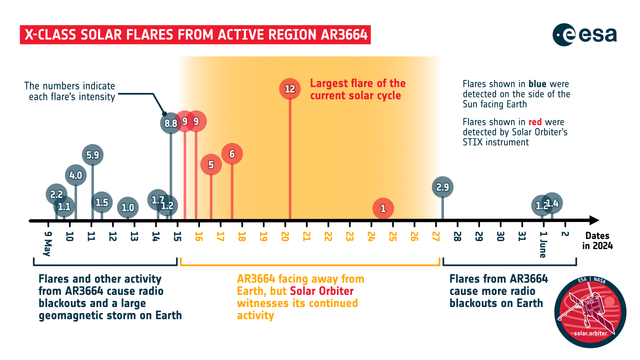
The hyperactive sunspot region responsible for the beautiful auroras earlier in May was still alive and kicking when it rotated away from Earth’s view. Watching from the other side of the Sun, the ESA-led Solar Orbiter mission detected this same region producing the largest solar flare of this solar cycle. By observing the Sun from all sides, ESA missions reveal how active sunspot regions evolve and persist, which will help improve space weather forecasting.
#NASA #Orion #radiation protection plan 🗒️ "astronauts will position themselves in the central part of the crew module and #create a #shelter using the stowage bags 🛍️ on board. The crew would in some cases need to stay inside for as long as 24 hours ⌛ https://www.nasa.gov/missions/artemis/orion/scientists-and-engineers-evaluate-orion-radiation-protection-plan/
#HumanSpaceflightHealth #RadiationProtection #Artemis #LunarGateway
Despite guidelines and the past 30 years of research, there has been little progress on fully defining or mitigating the space radiation ☢️ risk to human crew. Schwadron et al. project that Galactic Cosmic Ray fluences will be substantially higher 📈 during the next solar cycles leading to increased background #radiation exposure and, subsequently, as much as a 20% decrease in the allowable safe days in space (outside of #LEO) https://www.nature.com/articles/s41526-018-0043-2

Despite years of research, understanding of the space radiation environment and the risk it poses to long-duration astronauts remains limited. There is a disparity between research results and observed empirical effects seen in human astronaut crews, likely due to the numerous factors that limit terrestrial simulation of the complex space environment and extrapolation of human clinical consequences from varied animal models. Given the intended future of human spaceflight, with efforts now to rapidly expand capabilities for human missions to the moon and Mars, there is a pressing need to improve upon the understanding of the space radiation risk, predict likely clinical outcomes of interplanetary radiation exposure, and develop appropriate and effective mitigation strategies for future missions. To achieve this goal, the space radiation and aerospace community must recognize the historical limitations of radiation research and how such limitations could be addressed in future research endeavors. We have sought to highlight the numerous factors that limit understanding of the risk of space radiation for human crews and to identify ways in which these limitations could be addressed for improved understanding and appropriate risk posture regarding future human spaceflight.
#Radiation ☢️ shielding is a mandatory element in the design of an integrated solution to mitigate the effects of radiation during long #DeepSpace voyages for human exploration. #Kevlar has radiation shielding 🛡️ performances comparable to Polyethylene, reaching a dose rate reduction of 32 ± 2% and a dose equivalent rate reduction of 55 ± 4% (for a shield of 10 g/cm2). https://www.nature.com/articles/s41598-017-01707-2

Passive radiation shielding is a mandatory element in the design of an integrated solution to mitigate the effects of radiation during long deep space voyages for human exploration. Understanding and exploiting the characteristics of materials suitable for radiation shielding in space flights is, therefore, of primary importance. We present here the results of the first space-test on Kevlar and Polyethylene radiation shielding capabilities including direct measurements of the background baseline (no shield). Measurements are performed on-board of the International Space Station (Columbus modulus) during the ALTEA-shield ESA sponsored program. For the first time the shielding capability of such materials has been tested in a radiation environment similar to the deep-space one, thanks to the feature of the ALTEA system, which allows to select only high latitude orbital tracts of the International Space Station. Polyethylene is widely used for radiation shielding in space and therefore it is an excellent benchmark material to be used in comparative investigations. In this work we show that Kevlar has radiation shielding performances comparable to the Polyethylene ones, reaching a dose rate reduction of 32 ± 2% and a dose equivalent rate reduction of 55 ± 4% (for a shield of 10 g/cm2).
Traditional shielding strategies aim to reduce #astronaut radiation ☢️ exposure by increasing vehicle mass, but this is ineffective for the extremely penetrating #galactic cosmic rays. #Astronauts will face radiation hazards resulting from solar ☀️ activity that can create solar energetic particles. Active shielding 🛡️ approaches are likely a required component of any realistic solution (#electrostatic shielding) https://www.sciencedirect.com/science/article/abs/pii/S0969806X22000494
#Galactic cosmic rays consist of high energy protons (85%), alpha particles (14%) and other high energy nuclei. #Solar ☀️ energetic particles consist primarily of protons accelerated by the Sun to high energies via proximity to solar flares and coronal mass ejections. The quantitative biological effects of cosmic rays are poorly known.
• Human health effects 👨🚀
• #Spacecraft shielding 🛡️
• Wearable 🦺 radiation shielding
• Drugs 💊 to repair damage caused by radiation ☢️
https://en.m.wikipedia.org/wiki/Health_threat_from_cosmic_rays
📆 1989 Had you been flying around the #Moon 🌙 at that time, you would have absorbed well over 6 Sieverts of radiation ☢️ - a dose that would most likely kill 💀 you within a month or so.
📆 2024 “It wasn’t possible 10 years ago. Using grid-like, porous structures we not only brought the weight down, but we also brought the needed power down from megawatts to 100 watts. Such shields 🛡️ are not #ScienceFiction anymore” https://arstechnica.com/science/2024/03/shields-up-new-ideas-might-make-active-shielding-viable
The #StormShelter concept has been changed for #Artemis II since the smaller shelter aboard Artemis I might not be big enough for the crew to carry out normal operations if they had to remain there for an extended period during a #SolarStorm https://edition.cnn.com/2024/09/19/science/artemis-i-orion-capsule-radiation/index.html
@spaceflight
And also @DLR is contributing to the research in #radiationprotection for future manned space flights to Moon and beyond! 🌍👩🚀🚀🌒

During long-term astronaut missions, space radiation poses health risks to the human body. Such radiation can lead to cancer and several degenerative organ diseases, so suitable protective measures need to be found to ensure that astronauts are protected to the greatest extent possible during ever longer space missions in the future.


 Jan
Jan