 Reed Mideke
In today's #AIIsGoingGreat, we learn that "This technology is proven to have some of the most comprehensive capabilities in the industry, fast and accurate in some of the most demanding conditions" is IBM marketing-speak for "not able to hold down a job at McDonalds" https://www.bbc.com/news/articles/c722gne7qngo

Another great example how #LMM #AI produces extremely confident BS when presented with something (in this case, a rare name) not represented in the training data https://kansasreflector.com/2024/06/22/artificial-intelligence-has-spread-lies-about-my-good-name-and-im-here-to-settle-the-score/

In today's #AIIsGoingGreat: Adobe apparently adds the AI mark of shame to images that have been touched by its "AI" based tools, no matter how minor the effect. And then Meta uses that mark to (sometimes?) flag the image as "Made with AI"
Arguably correct, but also almost entirely useless… it's not like an image is more or less fake if you generative fill to cover up a spot rather than the regular old clone tool or airbrush
https://www.theverge.com/2024/6/24/24184795/meta-instagram-incorrect-made-by-ai-photo-labels

But where do you draw the line, and how to capture that in metadata?
Today's #AIIsGoingGreat features @MozillaAI "To avoid confirmation bias and subjective interpretation, we decided to leverage language models for a more objective analysis of the data"
Aside from the obvious [citation f-ing needed] on LLMs providing "more objective analysis" what exactly was the input? Oh … "After each conversation, we wrote up summary notes" … definitely no room for bias and subjective interpretation to be introduced there

They go on provide the output of three models, which seem fairly generic and bland with the occasional grammatical oddity, but without the input, we have no way to judge how accurate or insightful they were. We just get @MozillaAI's subjective "They identified the majority of trends and patterns among the 35 organizations we studied… This exercise showcased how well local language models can extract valuable insights from large text datasets"
They also give us this, which, I dunno, all seem pretty obvious and not at all surprising?
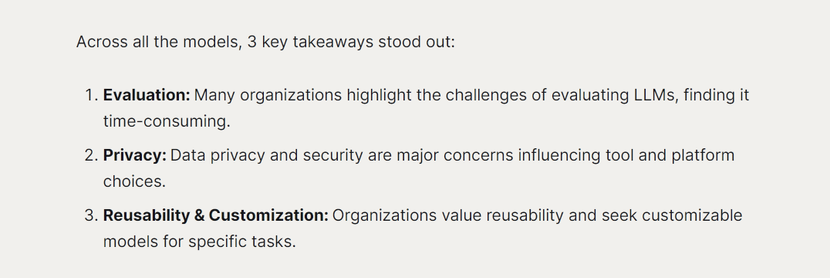
Could have been a much more interesting post if @MozillaAI had tried to rigorously test their assertion that LLMs provide "a more objective analysis of the data"
Today's #AIIsGoingGreat is a system which, for a mere hundred million dollars in training costs, forecasts future events about as well as a coin toss: "Focusing on binary forecasts, we show that GPT-4's probabilistic forecasts are significantly less accurate than the median human-crowd forecasts. We find that GPT-4's forecasts did not significantly differ from the no-information forecasting strategy of assigning a 50% probability to every question" https://arxiv.org/abs/2310.13014

Large Language Model Prediction Capabilities: Evidence from a Real-World Forecasting Tournament
Accurately predicting the future would be an important milestone in the capabilities of artificial intelligence. However, research on the ability of large language models to provide probabilistic predictions about future events remains nascent. To empirically test this ability, we enrolled OpenAI's state-of-the-art large language model, GPT-4, in a three-month forecasting tournament hosted on the Metaculus platform. The tournament, running from July to October 2023, attracted 843 participants and covered diverse topics including Big Tech, U.S. politics, viral outbreaks, and the Ukraine conflict. Focusing on binary forecasts, we show that GPT-4's probabilistic forecasts are significantly less accurate than the median human-crowd forecasts. We find that GPT-4's forecasts did not significantly differ from the no-information forecasting strategy of assigning a 50% probability to every question. We explore a potential explanation, that GPT-4 might be predisposed to predict probabilities close to the midpoint of the scale, but our data do not support this hypothesis. Overall, we find that GPT-4 significantly underperforms in real-world predictive tasks compared to median human-crowd forecasts. A potential explanation for this underperformance is that in real-world forecasting tournaments, the true answers are genuinely unknown at the time of prediction; unlike in other benchmark tasks like professional exams or time series forecasting, where strong performance may at least partly be due to the answers being memorized from the training data. This makes real-world forecasting tournaments an ideal environment for testing the generalized reasoning and prediction capabilities of artificial intelligence going forward.
#AIIsGoingGreat "Companies are acting like generative AI is going to change the world and are acting as such, while the reality is that this is a technology that is currently deeply unreliable and may not change much of anything at all" https://www.404media.co/goldman-sachs-ai-is-overhyped-wildly-expensive-and-unreliable/

#OpenAI "made staff sign employee agreements that required them to waive their federal rights to whistleblower compensation … threatened employees with criminal prosecutions if they reported violations of law to federal authorities under trade secret laws" -
"No reporting crimes" clause in contract has people asking a lot of question already answered by the contract

Also, did they use ChatGPT to write that shit? Because I'm pretty sure a competent attorney would advise you that a "no reporting crimes" clause is unlikely to work in your favor if crimes are, in fact, reported
"The summary by ChatGPT is pretty often empty waffle. It almost feels like a psychic con (I think I read this analogy somewhere) with its always-true generalisations that do not make an actual point" - Yep, Barnum effect satisfies a goal of "words that sound like they go together in this context" just as well as meaningful statements https://ea.rna.nl/2024/05/27/when-chatgpt-summarises-it-actually-does-nothing-of-the-kind/

I'm not sure I entirely buy the author's identification of "shortening" as a distinct behavior, but the point is well made, once again, that LLMs lack actual understanding "To truly summarise, you need to be able to detect that from 40 sentences, 35 are leading up to the 36th, 4 follow it with some additional remarks, but it is that 36th that is essential for the summary and that without that 36th, the content is lost" https://ea.rna.nl/2024/05/27/when-chatgpt-summarises-it-actually-does-nothing-of-the-kind/
And again, even if it *sometimes* gives you a decent summary, the *only way to be sure it did* is to actually read the original material yourself, in full ¯\_(ツ)_/¯
"big Wall Street investment banks including Goldman Sachs and Barclays, as well as VCs such as Sequoia Capital, have issued reports raising concerns about the sustainability of the AI gold rush, arguing that the technology might not be able to make the kind of money to justify the billions being invested into it" 🥳
https://wapo.st/3zVS5hR

#AIIsGoingGreat, featuring the old Silicon Valley "sell at a loss until everyone is hooked" strategy "[OpenAI] Total revenue has been $283 million per month, or $3.5 to $4.5 billion a year. This would leave a $5 billion shortfall"
Also "OpenAI gets a heavily discounted rate of $1.30 per A100 server per hour. OpenAI has 350,000 such servers, with 290,000 of those used just for ChatGPT" 🤯 https://pivot-to-ai.com/2024/07/24/openai-could-lose-5-billion-in-2024/

I can't help but think we could do something useful or at least fun with that kind of compute power
"The Dynamics 365 Field Service management system has also integrated Microsoft’s Copilot AI to help generate work orders based on customer requests. Copilot can also summarize ongoing work orders and update existing requests" - I for one cannot think of anything which could possibly go wrong using spicy autocomplete to write work orders for "services like machine maintenance, repair, cleaning, or home healthcare"
https://www.404media.co/how-a-microsoft-app-is-powering-employee-surveillance/
#AIIsGoingGreat

#AIIsGoingGreat Operators of bullshit generating machine *shocked* to find bullshit going on in their establishment https://www.theverge.com/2024/7/30/24210108/meta-trump-shooting-ai-hallucinations

#AIIsGoingGreat … so great the term is becoming toxic to consumers. Who could have predicted that transparent hype chasing and adding dumb chatbots where no one asked for them would end this way? https://futurism.com/the-byte/study-consumers-turned-off-products-ai

"[Leopold Aschenbrenner] emphasizes this as a critical moment, claiming “the free world’s very survival” is “at stake.” That reaching “superintelligence” first will give the U.S. or China “a decisive economic and military advantage” that determines global hegemony. He is also raising millions of dollars for an investment fund behind this thesis"

#AIIsGoingGreat "Do not hallucinate. Do not make up factual information" - Welp, problem solved! https://www.theverge.com/2024/8/5/24213861/apple-intelligence-instructions-macos-15-1-sequoia-beta

Today's #AIIsGoingGreat is brought to you by @jasonkoebler who followed the money all the way to the bottom of Facebook's AI slop pit https://www.404media.co/where-facebooks-ai-slop-comes-from/

Courtesy of @ct_bergstrom*, Today's #AIIsGoingGreat features people who have somehow convinced themselves it's a good use of time to investigate whether an ouroboros of BS generators can do scientific research https://arxiv.org/abs/2408.06292
* https://mastodon.social/@ct_bergstrom@fediscience.org/112957271701969972
The AI Scientist: Towards Fully Automated Open-Ended Scientific Discovery
One of the grand challenges of artificial general intelligence is developing agents capable of conducting scientific research and discovering new knowledge. While frontier models have already been used as aides to human scientists, e.g. for brainstorming ideas, writing code, or prediction tasks, they still conduct only a small part of the scientific process. This paper presents the first comprehensive framework for fully automatic scientific discovery, enabling frontier large language models to perform research independently and communicate their findings. We introduce The AI Scientist, which generates novel research ideas, writes code, executes experiments, visualizes results, describes its findings by writing a full scientific paper, and then runs a simulated review process for evaluation. In principle, this process can be repeated to iteratively develop ideas in an open-ended fashion, acting like the human scientific community. We demonstrate its versatility by applying it to three distinct subfields of machine learning: diffusion modeling, transformer-based language modeling, and learning dynamics. Each idea is implemented and developed into a full paper at a cost of less than $15 per paper. To evaluate the generated papers, we design and validate an automated reviewer, which we show achieves near-human performance in evaluating paper scores. The AI Scientist can produce papers that exceed the acceptance threshold at a top machine learning conference as judged by our automated reviewer. This approach signifies the beginning of a new era in scientific discovery in machine learning: bringing the transformative benefits of AI agents to the entire research process of AI itself, and taking us closer to a world where endless affordable creativity and innovation can be unleashed on the world's most challenging problems. Our code is open-sourced at https://github.com/SakanaAI/AI-Scientist
"To evaluate the generated papers, we design and validate an automated reviewer, which we show achieves near-human performance in evaluating paper scores"
To do this, they "compared the artificially generated decisions with ground truth data for 500 ICLR 2022 papers extracted from the publicly available OpenReview dataset"
Which seems like serious logical error…
They wrote a system which (according to them) scores real, honestly written human papers similarly to how humans would score them. They then use that to evaluate probabilistically generated imitations of human written papers, implicitly assuming an imitation scored by this method is "as good" as a similarly scored human written paper. But IMO this does not follow…
Their system confirms the imitation *looks like* a similarly scored human written paper, but all that says is it's a good imitation, not that it actually has characteristics we value, like accuracy and logical consistency
Notably, they do not appear to have confirmed the "near-human performance" for imitation papers. This could have been done by having real humans critically evaluate the imitations (knowing it was an LLM output and focusing on the actual logic and accuracy of the content), and then comparing the scores with the "automated reviewer", but that would be a lot of work ¯\_(ツ)_/¯
Think your spicy autocomplete can actually do research? OK, tell your chatbot to go to https://www.stsci.edu/ftp/presto/ops/program-lists/HST-TAC.html, find a random completed observation, download the proposal and the FITS files and write the paper
How to run Doom badly using only a billion or so times the compute resources required by the original
(snark aside, this is pretty cool)

You know #AIIsGoingGreat when convicted fraudsters Jacob Wohl and Jack Burkman jump on the bandwagon using fake names to found an AI lobbying startup https://www.politico.com/news/2024/09/02/jacob-wohl-jack-burkman-ai-lobbying-pseudonyms-00176917
#AIIsGoingGreat "Reviewers told the report’s authors that AI summaries often missed emphasis, nuance and context; included incorrect information or missed relevant information; and sometimes focused on auxiliary points or introduced irrelevant information. Three of the five reviewers said they guessed that they were reviewing AI content" - Pretty much what you'd expect from using autocomplete to generate a summary-shaped thing without actual understanding
https://www.crikey.com.au/2024/09/03/ai-worse-summarising-information-humans-government-trial/

#AIIsGoingGreat "The reviewers’ overall feedback was that they felt AI summaries may be counterproductive and create further work because of the need to fact-check and refer to original submissions which communicated the message better and more concisely" - 💯 my perennial #LLM gripe: Even if it's *mostly* good, you always need a subject matter expert to be sure it hasn't drifted off into total BS. In which case, why not just have the SME to do the job? 🤔 https://www.crikey.com.au/2024/09/03/ai-worse-summarising-information-humans-government-trial/
Incidentally that ASIC report does pretty much what I flamed* @[email protected] for not doing when they hyped using AI to summarize: Compare the results of humans doing the same task, as evaluated by humans https://www.aph.gov.au/DocumentStore.ashx?id=b4fd6043-6626-4cbe-b8ee-a5c7319e94a0
Recurring phenomena I've noticed with gee-whiz AI results is that they frequently use some automated metric to score the result, rather than having humans critically evaluating the final product. Presumably, because
1) Humans are expensive
2) The product is often obviously crap to humans, but not by whatever metric they chose
1) Humans are expensive
2) The product is often obviously crap to humans, but not by whatever metric they chose
Supplemental #AIIsGoingGreat: Yet another instance of AI-generated crap being used to game monetization systems https://arstechnica.com/information-technology/2024/09/fbi-busts-musicians-elaborate-ai-powered-10m-streaming-royalty-heist/?utm_brand=arstechnica&utm_social-type=owned&utm_source=mastodon&utm_medium=social

Double plus supplemental #AIIsGoingGreat: Hobo standing in the middle of the street yelling about how spicy autocomplete sent them to a non-existent shelter it hallucinated, again https://www.gov.ca.gov/2024/09/05/governor-newsom-seeks-to-harness-the-power-of-genai-to-address-homelessness-other-challenges/


Today's #AIIsGoingGreat (courtesy of @davidgerard) features former Kubient CEO Paul Roberts. Specifically, it features him pleading guilty to accounting fraud in relation to a scheme to falsely portray the startup's "AI click fraud detection" technology as something that actually worked and generated revenue https://pivot-to-ai.com/2024/09/18/kubients-adtech-use-case-for-ai-an-excuse-for-a-fraud/

My big takeaway from Altman's "OMG SUPERINTELLIGENCE IS RIGHT AROUND THE CORNER" blog is that his company is losing money hand over fist while trying to close a $6.5 billion funding round in an environment where the likes of Goldman Sachs are saying "hey guys, this AI thing isn't really paying off and looks like an overhyped bubble"
https://arstechnica.com/information-technology/2024/09/ai-superintelligence-looms-in-sam-altmans-new-essay-on-the-intelligence-age/
https://arstechnica.com/information-technology/2024/09/ai-superintelligence-looms-in-sam-altmans-new-essay-on-the-intelligence-age/

 simonbp
@reedmideke They're blowing through cash AND all the free Azure credits M$ gave them in exchange for 75% of the (nonexistent) profit. Once they're out of cloud credits, they're toast.