If done right: "A study published late last year found that insect abundance had tripled over five years on test plots at two other Minnesota solar sites. The abundance of native bees grew twentyfold."
https://www.nytimes.com/2024/09/05/climate/solar-power-pollinators-wildlife.html
Solar Farms Look to Produce Something Apart From Power: Pollinator Friendly Habitat

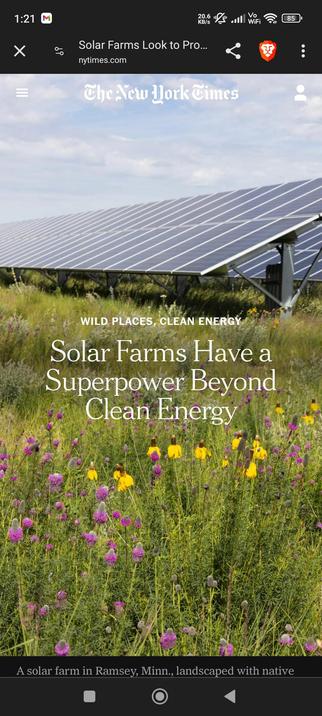
The sites fight climate change and can help with another global crisis: the collapse of nature. But so far, efforts to nurture wildlife habitat have been spotty.

The New York Times
@akshatrathi you can do this on roofs too. biosolar roofs, as they're called, also produce cooler temperatures for the panels which makes them work better

@fluffykittycat

#PostOfTheWeek (season 1):
It’s not your average solar farm.

The glassy panels stand in a meadow. Wildflowers sway in the breeze, bursts of purple, pink, yellow, orange and white among native grasses. A monarch butterfly flits from one blossom to the next. Dragonflies zip, bees hum and goldfinches trill.

@akshatrathi I look forward to buying local honey from my local solar farm
@akshatrathi However, there does seem to be a drift towards maximising panel area, effectively completely covering large areas which will obvs render the underlying surface desolate https://www.kentwildlifetrust.org.uk/campaigns/planning-and-development/cleve-hill-solar-park
Cleve Hill Solar Park | Kent Wildlife Trust

Cleve Hill Solar Park is a proposed development of solar panels covering an area of approximately 360 hectares (890 acres) of farmland (former grazing marsh) at Graveney, to the north-east of Faversham.

@gavin @akshatrathi I know there is research going on trying to find the optimum panel placement that will give good electricity generation without causing the ground to be left 'desolate' as you put it.
@ariaflame @akshatrathi I'm beginning to think that optimum panel placement is a financial consideration rather than ecological tbh
@gavin @akshatrathi Depends on who is doing the placing and why and what the optimum financial outcome is. It isn't always just from the electricity.
@akshatrathi it’s especially good to see solar farms tended by sheep who are protected by donkeys.
@akshatrathi This is the kind of article I love to read but unfortunately I don't want to create an account, giving my info away, just to do it.
Ah, well. I'll carry on and assume it's all good.
@akshatrathi I can’t see the article but could you share a link to the scientific study? Looks really interesting.
@domino_joyce @akshatrathi I'm not sure if this is the one, since it didn't say tripled, but you know newspapers, but you could see if https://iopscience.iop.org/article/10.1088/1748-9326/ad0f72?link_id=23&can_id=a466f2359c1ebedb16e29b50194060af has the info. (open access)
Radware Bot Manager Captcha

@akshatrathi

related: https://iopscience.iop.org/article/10.1088/1748-9326/ad0f72

"Solar-pollinator habitat is unlikely to completely offset the residual ecological impacts of solar developments poorly sited in areas with high ecological value. In this context, solar-pollinator habitat may have the greatest potential for ecological benefit for solar energy facilities sited in areas that have been previously ecologically compromised, such as marginal farmland, former industrial or mine lands, and other disturbed sites."

Radware Bot Manager Captcha

@akshatrathi Solar panels don't require to poison the land.