In The Verge, I explained why self-driving cars could be a disaster for climate change and road safety -- even if they work perfectly.

The answer lies in the Jevons paradox, a classic 19th century economic theory.

https://www.theverge.com/2024/9/2/24232386/self-driving-car-jevons-paradox-robotaxi-waymo-cruise
#climate #climatechange #cars

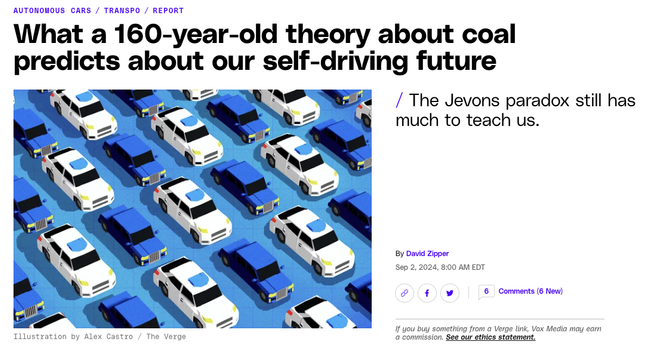
What a 160-year-old theory about coal predicts about our self-driving future

The Jevons paradox originated in the coal era, but it has a lot to teach us about the future of self-driving cars.

The Verge
@davidzipper we saw it with Uber as well. It created trips that didn’t exist before. It was cheaper than taxi (at first) and more convenient, so for some part of the middle class this became better than transit.
@davidzipper this reminds me of self licensing in social psychology. People will think "well I don't own a car" then feel entitled to use self driving cars liberally.
@davidzipper The paradox assumes increased usage but wouldn't autonomous driving eliminate the joyride or the scenic route? Wouldn't the point be to eliminate inefficient driving with a more efficient on demand option?
@mike @davidzipper it seems like those uses would still exist though?
@freeheelin @davidzipper I'm thinking more like if an autonomous car service replaced car ownership.
@mike @freeheelin @davidzipper
My sense is that the trips that drive congestion are not "joyrides" or trips for pleasure, but rather, trips during peak hours like commuting, school drop-off or pick-up, lunch rush, etc. I could be wrong, but even if autonomous vehicles eliminated all the scenic drives, it would still make traffic and congestion worse, while still undermining transit.
@mike @davidzipper I would enjoy the scenic route a whole lot more if I wasn’t driving. And if the car was like an office, and I could work while traveling, I might travel more. (I’d rather do that with trains, but AFAIK that’s not an option around any U.S. city, and not affordable on Amtrak)
@mike @davidzipper The vast vast majority of trips are not for joyriding or taking the scenic route. They’re for getting from somewhere to somewhere else you need to be, or from somewhere else to back home.
@MisuseCase @mike @davidzipper the vast majority of the trip is to avoid paying parking, they just go round and around and around
@davidzipper nicely written, thanks for sharing!
@davidzipper Energy demand will continue to increase & the only true way forward is clean sources of energy. It's an equation; number of people times number of energy-consuming machines per person times energy units per machine times pollution per unit. The only way to bring the result of that equation to zero is for one of the factors to be zero - so unless we want to either eliminate people or machines, the only factor we can even imagine getting to zero is the last one...

@davidzipper @lisamelton The article defines the problem, and yet provides no solution. No self-driving at all? The elderly and disabled would like a word.

The overall theme seems to head towards fewer personal transportation options in general. A laudable goal, but this leads to other issues in the short term where population density doesn’t support mass transit.

With no solutions it’s an easy way out. I blame the editor, not the author.

@bubbajet @davidzipper @lisamelton
I don't think the main problem is elderly/disabled not having access to motorised chauffeurs, of one kind or another
The same goes for rural areas, if that's what you mean by '[low] population density'

@bubbajet @davidzipper @lisamelton

When it comes to (sub)urban settings with low density, which are the main problem (current and potentially in the future, as the article says), the solution to provide as many as possible with mobility independence is clear and has been scientifically proven for a long time:
a simultaneous combination of 1. densification, 2. access to sustainable transport and 3. traffic restriction is the only way forward

@nissetingsvall @davidzipper @lisamelton Sure! Agree! Number 1 is the hardest and most pie-in-the-sky. Current US infrastructure is based on tens (hundreds?) of millions of single family homes on small-medium lots. I’ve seen (and can’t imagine) zero serious proposals to *actually* “densify” these areas where people *own* their homes.

It will take *decades* to get this done. Meantime, why not help the elderly and disabled?

@bubbajet @davidzipper @lisamelton
i mean, i agree that it will take many years and it could be hard, but considering it's a reform that has been made~in most other rich countries i don't see it as unrealistic
Also, there have been serious proposals locally🇺🇸 for legalizing building~as dense as you want in your own property, some of which have recently~been approved
(still don't get why you think most elderly/disabled need to be driven more, tho; again,most need more active/sust.transp.,not less)