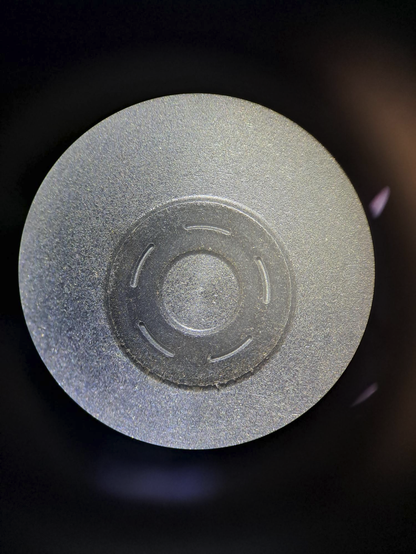
Not sure if enough #massspec people are here but I need some help for #hplc #troubleshooting: Have you ever found brownish dirt in your LC valves? We see this now accumulating since several months but have changed neither protocols nor solvents. Doing #proteomics with MS-grade solvents using mostly C18 stage tipping sample prep and an Ultimate3000 LC. Any ideas welcome!
@aretaon My question would be: when was the rotor seal exchanged and was this exchange done by a "professional"? Besides the dirt, is there any scratch on the surface? (Difficult to see on that shiny surface, I know...)
@kabalak Seals are regularly exchanged by us and we have been doing this for years (last exchange was 5-6 months ago). There are abrasions on the rotor seal (picture of the corresponding seal below) which we assume to result from the dirt accumulating and mechanically damaging the seal. We have seen this now multiple times on two LCs, so I assume this is rather a global problem than a faultily installed seal.
@aretaon Ok, and the solvents are the same, same LOT all the time? And what about your samples running on the LCs, proteomics samples (plasma, urine or other weird things?) - C18 cleaned and/or what is the installed sample loop. Injector things look still fine?
Very weird things can happen in that autosampler; especially if you use µL-pickup combined with the big vials to get the µL-pickup solutions into the system. Deteriorated metal caps' contamination can be seen - but there must be a leak.
@aretaon And in addition: is the rotor mounted absolutely tight? And what is the maximum flow on the system?

@kabalak And yes the rotor sits tight as we stably get 600 bar column pressure on a Waters C18 col at 300 nl/min.

Another idea: Vici changed the material of the rotors in 2020 (https://www.vici.com/support/tn/tn829.pdf) and possibly this material deteriorates faster during valve switching. Does anyone else use Vici Cheminert valves with the new E5 material over longer time periods (>5 months) with frequent switching?