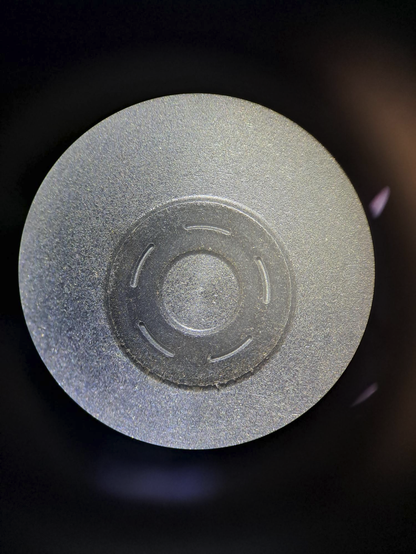
Not sure if enough #massspec people are here but I need some help for #hplc #troubleshooting: Have you ever found brownish dirt in your LC valves? We see this now accumulating since several months but have changed neither protocols nor solvents. Doing #proteomics with MS-grade solvents using mostly C18 stage tipping sample prep and an Ultimate3000 LC. Any ideas welcome!
@aretaon My question would be: when was the rotor seal exchanged and was this exchange done by a "professional"? Besides the dirt, is there any scratch on the surface? (Difficult to see on that shiny surface, I know...)
@kabalak Seals are regularly exchanged by us and we have been doing this for years (last exchange was 5-6 months ago). There are abrasions on the rotor seal (picture of the corresponding seal below) which we assume to result from the dirt accumulating and mechanically damaging the seal. We have seen this now multiple times on two LCs, so I assume this is rather a global problem than a faultily installed seal.
@aretaon Ok, and the solvents are the same, same LOT all the time? And what about your samples running on the LCs, proteomics samples (plasma, urine or other weird things?) - C18 cleaned and/or what is the installed sample loop. Injector things look still fine?
Very weird things can happen in that autosampler; especially if you use µL-pickup combined with the big vials to get the µL-pickup solutions into the system. Deteriorated metal caps' contamination can be seen - but there must be a leak.
@aretaon And in addition: is the rotor mounted absolutely tight? And what is the maximum flow on the system?

@kabalak And yes the rotor sits tight as we stably get 600 bar column pressure on a Waters C18 col at 300 nl/min.

Another idea: Vici changed the material of the rotors in 2020 (https://www.vici.com/support/tn/tn829.pdf) and possibly this material deteriorates faster during valve switching. Does anyone else use Vici Cheminert valves with the new E5 material over longer time periods (>5 months) with frequent switching?

@kabalak Yes solvents are the same, we didn’t record the LOTs so I cannot comment on that but the same manufacturer and product for sure. No strange samples only proteins.
Sample loop is a normal 20uL nanoViper loop. We use 100uL glass inserts in vials with PTFE seals in the autosampler but we didn’t check the needle yet.

@aretaon @kabalak

Have you found a solution to your problem?

Proteins in HPLC is always a red flag for me, since it's really hard to keep them from interacting with non-inert surfaces or from precipitating. Iron leaching from pump heads or capillaries is always a problem for phosphate groups. And lastly, certain solvent manufacturers tend to change things without telling you, so that's also always an option.

Have you tried collecting the material on the valve, dissolving, and analyzing it?

@Ramses_X @kabalak Troubleshooting is still work in progress but our current suspect is the ultra pure water system. We changed to bottled water and have now a dedicated HPLC just running mock samples on the type of column that made most problems. We regularly check the valves for debris and hope for the best. Funnily, the conductivity readbacks for the water system are great, we have 0.055 uS/cm which is pretty much the physical limit at 25C. So what ever is potentially in the water would have to non-contributing to conductivity. Silica for example has this property but we will have to test for that to be sure. [1/2]
@Ramses_X @kabalak Peptides as such are not the issue we have been measuring proteomics samples with the identical setup for years without ever having precipitates in the valves. As you said it’s likely something in the solvents that we don’t know about.
We have been collecting the debris but it’s minute amounts and I don’t know yet how to analyse it. We’re even not sure yet how to dissolve it for analysis because it’s such a low amount (that is stuck to a cotton swab). [2/2]

@aretaon @kabalak

Hmm, water systems are a special case. They are way too often neglected. Do you use a 0.2 micrometer outlet filter? Those are usual for purified water in microbiology but isn't a bad choice for HPLC either, as long as you change them frequently. Also the inlet filters (metal or ceramic frits) in the bottles should be changed or at least cleaned frequently.
Did you check the inline filters of the pump? If they are ok, you might have something precipitating from the water.