
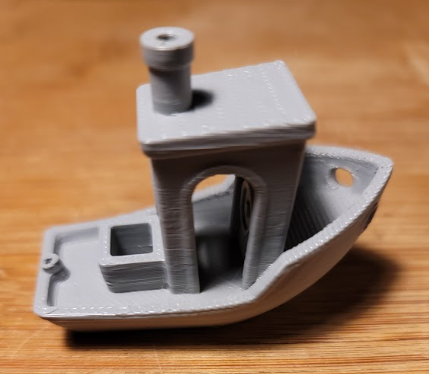
Damn. Just did my first print on the Bambu Lab A1. Given my experiences with other 3D printers over the last almost 10 years or so, this thing comes across like genuine alien technology. Printed the traditional 3DBenchy calibration test boat. Essentially all I did was push the filament into one of the four AMS Lite entry funnels, clicked print ... and ... that was it. Crazy fast -- about 20 minutes. Looks and feels essentially flawless. If I didn't know better, my first impression would be that it was injection molded. It takes a number of minutes before that print started since the machine was doing a variety of automated cleanup/purge/calibration steps, and then it launched and was almost a blur.

Very cool. Or hot. Or sick. Or groovy. Or whatever current euphemism you prefer. We're definitely in the 21st century with this one.

@lauren Nice!

I haven't tried Bambu Labs but I have noticed an uptick in usability across the board since about 2 years ago now that just about all manufacturers offer auto calibrating Z height, no-springs buildplate designs. These things Just Work compared to the old Ender 3 standard. And don't get me started on my first 3D printer - a Sunhokey Prusa-i3-based design with a perspex chassis. Never heard of Sunhokey? Yeah, well, that says it all.

#3dprinting

@marcusjenkins @lauren wow, I am using An ender 3 V 2 and I am lucky if I can get any print at all to not just end up a solid blob, this sounds cool in comparison.

@LeonianUniverse @lauren That's a real shame because 3D printing can be good fun. I'm definitely not an expert, but I've wrangled about a dozen printers in the last 8 years.

Solid blob sounds like whatever you're printing isn't sticking.

* Try normal PLA first, not PETG, PLA plus, ABS
* Print at ~ 190°C nozzle with 50°C bed
* Bed levelling - easy after the first few times
* Clean build surface with alcohol & kitchen towel between prints
* Use a little glue stick on the bed

@marcusjenkins @lauren as for bed leveling, I use the leveling paper method, easy method for sure to use and especially nice because I am completely blind and its all tactile.

@LeonianUniverse @lauren I also use the paper method on my non-automatic levelling machines. I may be telling you things you already know, but:

* You should do the bed levelling with the nozzle and bed at printing temperatures because of thermal expansion.

* Having the nozzle hot enough to melt the filament while levelling also ensures that there’s no solid filament hanging from the nozzle which would screw up the levelling.

@marcusjenkins @lauren wait... level while the printer is heated? Should I pre-heat the printer in advance before printing in order to give the filament sufficient time to heat up pre-print?
@marcusjenkins @lauren sorry if I am asking so many questions, its just... I want to at least make one successful print that doesn't come out like plastic shit.
@LeonianUniverse @lauren No worries at all. It's a real shame that you have a printer and it's not working for you. Everybody has problems to start with, especially with manual bed levelling designs. Once you get the knack of the paper trick and work out how to make a few good prints you're set. You may need to redo the bed levelling every few prints. If you start getting success I recommend a magnetic spring steel bed plate - they're an awesome upgrade.
@LeonianUniverse @lauren Another tip: between prints, if you remove the magnetic build surface (assuming you're printing on that, not the textured glass thingumy), you need to make sure there's no whisps of filament or other crud on on the build plate nor underside of the magnetic flexi mat otherwise your build surface isn't flat any more. Remember, even the thickness of a piece of paper is important here.
@marcusjenkins @LeonianUniverse The A1s come with a textured coated (gold color) magnetic plate. It's pretty magical at least with PLA (which is all I use). No tape, no glue. Prints just stick and then pop off when done.

@lauren @LeonianUniverse Yup. So did the Anycubic printers I bought.

To be honest, I don't really know why Creality continues to sell the manual bed levelling machines with the floppy plastic print surface or, worse, the glass surface (boy that REALLY tries my patience). I guess there's some money to be made in the *slightly* simpler design, but, sheesh, as we see here, these designs can put newbies off of 3D printing forever.

@marcusjenkins @lauren I'm not put off yet, I just want to print something successful. By the printing surface, do you mean that plastic surface that has to be held down by those 4 clips? I flipped it so that the smooth side was facing the nozzle, because originally, I was printing on the rough side of it, but that didn't seem to' make a difference and I didn't want to remove it and print directly on the metal surface because I was worried it would damage the bed. Just trying to clarify if that was my problem?
@LeonianUniverse @lauren Ah, 4 clips? Is that a *bit* flexible like spring steel or rigid like glass? You absolutely don't want to print on the metal surface that your plate is clipped to.
@marcusjenkins @lauren It feels like metal but I can't be certain, definitely feels like metal though and not like glass. I could be wrong though as I'm just feeling it though and not seeing it because I have no sight, but from what I can tell, it feels like metal, probably steel if I remove the plastic printing surface that is being held down by the 4 clips.
@LeonianUniverse @lauren OK. So I'm assuming that it's a plastic coated steel plate about 1mm thick. If you unclip it and you can bend it a little (gently!) and it springs back then that's confirmed. Which is OK. You might want to do a bed level with the smooth side and then flip it over, re-do the bed level to be sure and try a print. The rough side is good for PLA printing. Good luck!
@LeonianUniverse @lauren I'm pretty sure that everyone says you should bring the printer up to temperature before levelling, yes. Because the hot end, the nozzle and, to a much lesser extent, the bed will all expand when hot. Hence my warning about not burning your fingers. You can probably get away with only heated bed to, say, 40° and that would be close enough. The nozzle should be hot, though, when bed levelling for the 2 reasons I mentioned. But be careful! Perhaps wear gloves?
@marcusjenkins @LeonianUniverse Seriously, the Bambu A1 does all this automatically, and much more. Period. It just doesn't make sense to use anything else unless you WANT to be doing all the manual calibration and fighting the hardware all the time, especially at the A1 and A1 Mini price points.

@lauren @LeonianUniverse Quite so. But if you've already just bought an Ender 3 V2 you might want to at least try to get it working.

I have a couple of Anycubic printers that have a fixed print bed, auto bed levelling and auto Z calibration. They were inexpensive and worked out of the box and I've printed a LOT of stuff with them in PETG and PLA. I believe Creality and others also offer basically the same these days. All around $/€ 200.