 R. J. Sweet
John Unterecker's biography of #HartCrane, Voyager, captures the essence of a poet whose life was defined by relentless movement & sense of displacement; viz., driven by a desire to escape the turmoil of his Ohio upbringing. Akin to #Rimbaud -- his French counterpart & usually point of comparison -- emerges as a quintessentially nomadic figure. His nomadism ended in the 30s when he leapt into the Gulf -- a tragic and defining moment that mythologized his existence for over 70 years.
When reading #HartCrane, his rootlessness is emblematic of his broader instability, a condition #PhilippeSoupault characterized as that of a "man torn apart" -- a victim of familial rupture, plagued by alcoholism, and driven to suicide. #HartCrane's [Passage] can be read as this textual embodiment of his perpetual state of errancy. The poem's final voyage -- ending in death by drowning -- mirrors the trajectory of a man who existed on the margins (in life & art), detached from home & identity.
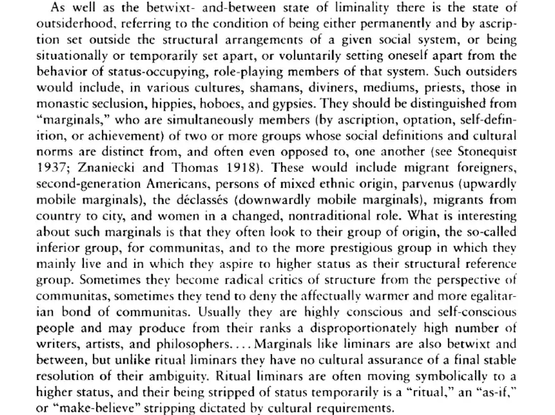
In this way, #HartCrane is the consummate passenger on a voyage: an individual whose transitory existence challenges conventional notions of belonging & rootedness (see Victor Turner's Dramas, Fields, and Metaphors, Ch. 6). Per Turner, Crane's efforts to evade social structure & occupy a liminal space is evident where he embeds his own sense of marginality. He constructs Passage as a text that deliberately disrupts the syntactic and semantic framework dictated by conventional grammar/logic.
Passage then is intentionally elusive, defying any attempt at a fixed, stable interpretation. Can see why #TSEliot & #MarianneMoore rejected to publish the poem, the latter critiquing its excessive density & lack of simplicity. The poem's difficulty is no accident: it reflects Crane's project to crafting an "elusive idiom" (see his letters). Passenger then suggests a transient discourse that resists being anchored to any singular meaning, w/ verses that perpetually shift interpretations.
The opening line's image presents a cedar leaf carving a gap in the sky —an interstitial space that, through the phenomenon of synesthesia, enables the poet to perceive the sea's voice & the promise of a return to a childlike state. The stanzas introduce a rite of passage, but one that is markedly reversed: rather than the usual transition from childhood to adulthood, this passage represents a regression.
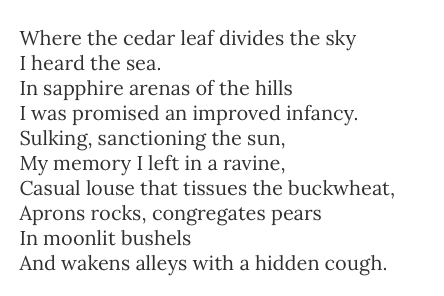
Etymologically, the term suggests a backward movement—re: (return)—indicating a step back towards early childhood or even a return to a pre-linguistic state, to that of the silent, pre-verbal infant. Thus, the passage alluded to is twofold: it is both temporal, involving a movement from the realm of time to a timeless state, & textual, signifying a shift from language to silence.
The dual theme introduced in the first line through the phrase "cedar leaf" serves a metaphorical function; the cedar, by carrying this leaf, shifts the verse towards a temporal dimension, which is further developed in the following stanza with the noun "memory." In Crane’s work, the tree often functions symbolically as a family tree or a repository of memory & past experiences.
This symbolic role is echoed in another poem, "Forgetfulness," where Crane writes, "Forgetfulness is white,— white as a blasted tree," suggesting that felling the tree equates to bleaching memory & succumbing to oblivion. Thus, the cedar leaf symbolizes the pre-written page, the prior inscription that binds the poetic self to a memory & history it seeks to escape.
Initial readings:
1. verbs tissues and aprons endow memory w/ a function of concealment, as in the view of black wheat has been cast over the text (more obscurities);
2. the bushel furthers the theme of concealment via the proverb "to hide one's light under a bushel" (where memory is a closed vessel obscuring the light -- message -- of poetic talent);
3. not really sure how to think of "congregates pears:" fruit of creation? condemned or confined? how to connect it to darkness of the bushel?
1. verbs tissues and aprons endow memory w/ a function of concealment, as in the view of black wheat has been cast over the text (more obscurities);
2. the bushel furthers the theme of concealment via the proverb "to hide one's light under a bushel" (where memory is a closed vessel obscuring the light -- message -- of poetic talent);
3. not really sure how to think of "congregates pears:" fruit of creation? condemned or confined? how to connect it to darkness of the bushel?
Could Crane's dense weaving of obscure phrases in the verse represent memory as a black screen that obstructs/obscures light? What about the musicality of these lines? The rhythm, accents in the prepositions and indefinite articles, the rise of the iamb: these phonetic movements culminate in a sought, a stifled poetic breath, trapped in the congested throat of memory, a violent expulsion that clears the "alleys", creating a moment of awakening.
This 3d stanza serves the pivotal juncture in the poem: delineating the boundary between the ravine & the horizon of valleys that unfold in the poem. Whereas the previous stanza is rich in space (minerals, veggies, animals), this stanza represents the void, the anti-place epitomized by the "without". From a world of richness to one of dissolution & shadows: immaterial, abstractions, such as movement, air, vibrations and scent.
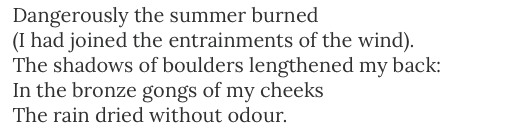
The living poetic body transforms into a metamorphosis of obscure sensory boundaries -- further into the immaterial realm. Liminality. The "I" is now connected to the ideas (conceptual abstractions): summer, shadows, rain; all swept away or destroyed by the powerful breath or consuming flames. Through dislocated and fragmentation, this stanza is the threshold of leading things into the void, and as a moment of intense illumination (rapture).
Lacking both space and shelter, similar to the "great winds" depicted by Saint-John Perse, these verses embody pure motion within the poem—a powerful gust that sweeps everything away, dismantling the previous reassembly achieved by memory. As an empty structure & a moment of forgetfulness, the text reflects the process of shedding and fading away of the subject, which is no longer anchored or stabilized within the structured, architectural framework of its memory.
Now, this stanza's abruptness halts this dual movement operative in the previous stanza. The undifferentiated space of the last stanza is restructured within the valley, reflecting the poet's reconstitution, comforting the impossibility of his own destruction. "Heart" invokes Crane's name (often times signing his letters with a <3 drawing), as a man rooted in history and his own narrative. No long the poetic I, rather the "you" -- a split in identity.
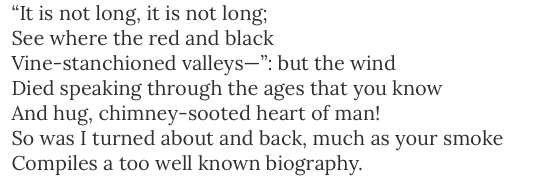
the interrogative phrase “And had I walked the dozen particular decimals of time?” introduces an element of irony into the narrative voice, casting doubt on the poetic "I"'s return to the ravine of memory, its immersion in time, & its personal history. This irony is further underscored by the interaction between the "I" & the thief, emphasizing a fundamental division in the discourse: rather than a singular unified subject as at the poem’s outset, there are now two distinct figures.
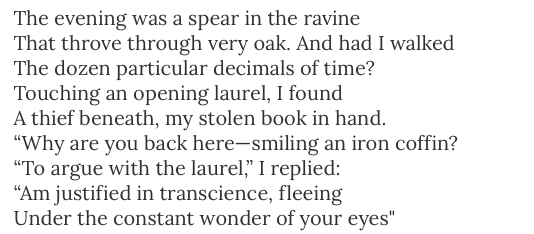
One represents the custodian of the biographical text (my book), memory,, while the other seeks poetic glory (laurel) & finds salvation in the transient & transience, ironically reflecting on the past enshrined in a tomb (smiling an iron coffin). The martial imagery of the spear piercing the oak, coupled with the omission of the article in the phrase “very oak,” indicates that the tree—once a symbol of genealogy—is no longer as robust, now appearing mutilated and split.
The pentameter, associated with the promise of a silence preceding language (I was promised an improved infancy), the initial ascent (My memory I left in a ravine), and the subversive wind of poetic inspiration (I had joined the entrainments of the wind), underscores this shift. As a terrain of conflict between self and other, the open (opening) and the closed (coffin), the continuous (constant) and the fleeting (fleeing) pave the way for the poem’s ultimate resolution in the final stanza.
The conclusion of the poem, marked by the disintegration of the page and memory, ultimately realizes the initial promise of the primal utterance introduced at the poem's outset. The sibilant sounds (sea, sapphire, promised, infancy) from the first stanza gain prominence in this final section, intensifying within the auditory space through words like sand, us, abyss, serpent, swam, sun, and unpaced.
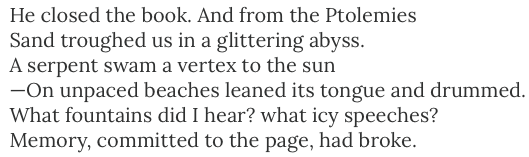
The sibilant consonant, reminiscent of a serpent's hiss, is symbolically linked to the reptile’s shedding of its skin, representing the perpetual release of the past or the concept of eternal recurrence. This imagery resonates with Emerson’s portrayal in his essay on nature: “the lover of nature […] has retained the spirit of infancy […] In the woods too, a man casts off his year, as the snake his slough, and at whatever period of life, is always a child. In the woods is perpetual youth.”
Crane extends this idea of perpetual youth to encompass the continuous renewal of language, achieved in this stanza through various neologisms. By subverting their traditional meanings, the poet promises a reinvention of words: "trough," normally a noun, is here given a new verbal dimension; "swim," typically intransitive, is transformed into a transitive verb...
The imagery of unpaced beaches and icy speeches metaphorically suggests the erosion of language preceding its revitalization into the rhythmic and crystalline expressions of poetry. This transition from emptiness to fullness is underscored by the chiasmic structure of the verses and further emphasized in the depiction of the luminous abyss.
The poem thus realizes Crane's aspiration to present his readers with a new word, never before uttered and impossible to articulate, a verb that is perpetually novel, fleeting, and transient, embodying a "Protean" quality that resists the fixed constraints of meaning imposed by grammar. Additionally, it serves as a prologue to the more expansive and exploratory sequences found in the concluding section of White Buildings, titled Voyages.