
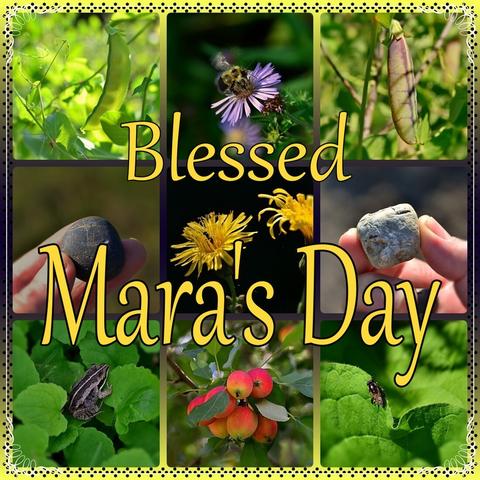
#Māras /Mara's Day or Great Mother Day in the #Latvian tradtion- is now mostly celebrated Aug 15, conflated with the Virgin Mary; really it should be around Aug 6, for the cross-quarter day between Summer Solstice/Autumn Equinox. Māra is the #prechristian Great/Earth Mother celebrated several times a year. This one marks final flowering, harvest, final days of summer. Digital altar this year, +more in this #blog post from 2021 with an #altar #offering
https://cohanmagazine.blogspot.com/2021/08/blog-post.html #animist #pagan
Māras/Great Mother Day: Late Summer and an Earth Goddess

Mara or Māra, Great Mother, is the highest goddess in Latvian mythology. Her sphere of power and influence is wide and varied. Numerous othe...

@cohanf I’ve seen rather plausible calculation variations for the cross-quarters (based on the height of the sun and the golden ratio) that let it fall around the 13th of August, so this fits. (There are also calendar movements to account for.) (Beltane and Samhain are roughly around the 1st as common, and Imbolc is a bit later in February, again matching various folk fests better. https://evolvis.org/~tg/calendars/ if you want the details.)
Index of /~tg/calendars

@mirabilos That's interesting! most of the dates seem to have been rationalised around the first of the month at least in the British tradition, for all of the days. and the Christianisation of many of the celebrations has altered dates too.
In the end it probably doesn't matter too much, the important part for me being that we are noting the seasonal rhythms and the changing seasons- 4 seasons is not really enough if you are really connected to them!
@cohanf yeah, you’re totally supposed to adjust them to local tradition, the dates I get are just a baseline when you don’t have anything else, and they’re fully based on the sun, which wfm
@mirabilos No relevant local traditions here..lol so I go by my interest in the Latvian traditons (pre-Christian as much as possible) and try to peg more or less to the actual astronomical dates. What those dates mean of course is very much affected by local climate- when they are celebrating first flowers in Britain, we are still very much in winter...lol

@cohanf right… the astronomical dates are also my starting point, but that gives you only four out of eight.

I actually learnt how to get them out of the JPL Horizon API from NASA down to half-second precision… (and scripted that so I don’t have to keep remembering.)

That’s why I used the “golden ratio on sun inclination” method for the other four days, it’s a good starting point for me. Sure, there’s also power in doing things at the same time, most most people I know online are in the americas and so not the same time anyway, and I don’t do big things anyway either.

See https://web.archive.org/web/20170628090744/http%3A%2F%2Fwww.astrothek.de%2Fartikel%2Fjahreskreis%2Fjahreskreis_inhalt.html if you’re interested (use a translator for the german or just look at the pretty graphs where they explain how they approximated the current common dates and found golden ratio to mostly work).

Astrothek - Astrologie zu Themen aus aller Welt - www.astrothek.de

@mirabilos I tend to forget exactly and have to look them up every time, but there are lots of online references for the cross-quarter days- many just give the British rationalisations of the firsts of the relevant months, but I usually find some other references, typically around the 6th. Works well enough for me, if I start remembering around the 1st when the Celtic pagans are posting things, then manybe i can get organised by the 6th...lol

@cohanf yeah, but those references often don’t say how they got them.

I figured out how to ask the NASA’s public data system for the sun positions on specific times, scripted that, and so I can now obtain the dates for, in theory, any year (although the dates in the future are estimated, not based on exact measurements, so the times can be a few seconds off, sometimes even half a second or one second within the next 12 months). So I have my own and can just favourite+boost those of others. (I’ve had that my date was before the “usual” cargo-culted date, too.)

@mirabilos The Latvian tradition, interestingly- especially if you can separate the Christian alterations- has preserved to a good degree the celebrations of the cross-quarter days and not just gone with the first of the month or saints' days.
BTW Brave browser offered a decent translation of the whole page, above.
@cohanf I’ll have to look into the Latvian traditions some time, for extra inspiration, I guess.
@mirabilos Of course the soviet period messed things up, and reconstructions can also confuse the issues, but idea is that Latvia was rather late to convert to Chrisitanity and so retained more of the pagan culture than some other places.
My deepest interest goes even farther back than the Indo-European pantheon to what we may be able to surmise about the most ancient deities from so called 'Old Europe'!---
@mirabilos It seems some of that may have persisted in the Baltics, passed down perhaps by the women who quietly retained their culture while men carried on with fighting, politics etc..lol
Many things we can never know, of course, but as with any spiritual or cultural path, we can choose what feels right to us :)
@cohanf yeah, though Europe wasn’t homogenous even in pagan times… romans, celts, germans, norse, slavs, and I have no idea where the baltics and livonians would even come from (perhaps an estland-finland connection, so north-north-east of slavic influence and somewhat free of it?). I live in a region that has Germani and Belgæ, Celtic settlements and over 2000 years of Romans, so lots to see, but lots of time for certain institutions to assimilate and cover up, too.
@mirabilos There are relatively new ideas on the Indo-European migrations, based on DNA analysis- interesting and complex. Some of the Baltic populations it seems stayed where they were when the Indo-Europeans took over, especially the female lines.
@mirabilos Interestingly, though we think of those peoples you mention as very different- and of course they were in some ways- they all were Indo-European with very similar pantheons (Balts too).