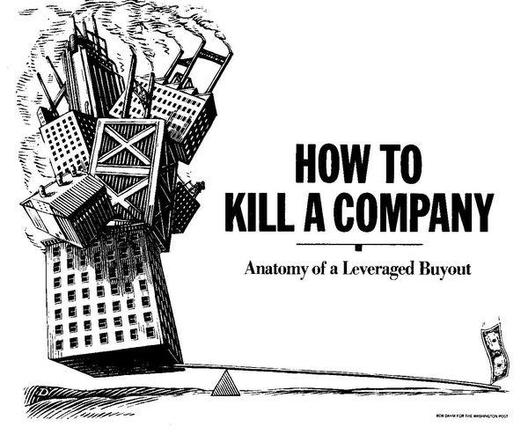
Here's an open secret: the confusing jargon of finance is not the product of some inherent complexity that requires a whole new vocabulary. Rather, finance-talk is all obfuscation, because if we called finance tactics by their plain-language names, it would be obvious that the sector exists to defraud the public and loot the real economy.

1/

If you'd like an essay-formatted version of this thread to read or share, here's a link to it on pluralistic.net, my surveillance-free, ad-free, tracker-free blog:

https://pluralistic.net/2024/08/05/rugged-individuals/#misleading-by-analogy

2/

Pluralistic: Leveraged buyouts are not like mortgages (05 Aug 2024) – Pluralistic: Daily links from Cory Doctorow

Take "leveraged buyout," a polite name for *stealing a whole goddamned company*:

I. Identify a company that owns valuable assets that are required for its continued operation, such as the real-estate occupied by its outlets, or even its lines of credit with suppliers;

II. Approach lenders (usually banks) and ask for money to buy the company, offering the company itself (which you don't own!) as collateral on the loan;

3/

III. Offer some of those loaned funds to shareholders of the company and convince a key block of those shareholders (for example, executives with large stock grants, or speculators who've acquired large positions in the company, or people who've inherited shares from early investors but are disengaged from the operation of the firm) to demand that the company be sold to the looters;

4/

IV. Call a vote on selling the company,, counting on the fact that many investors will not participate in that vote (for example, the big index funds like Vanguard almost *never* vote on motions like this), which means that a minority of shareholders can force the sale;

V. Once you own the company, start to strip-mine its assets: sell its real-estate, start stiffing suppliers, fire masses of workers, all in the name of "repaying the debts" that you took on to buy the company.

5/

This process has its own euphemistic jargon, for example, "rightsizing" for layoffs, or "introducing efficiencies" for stiffing suppliers or selling key assets and leasing them back. The looters - usually organized as private equity funds or hedge funds - will extract all the liquid capital - and give it to themselves as a "special dividend."

6/

Increasingly, there's also a "divi recap," which is a euphemism for borrowing even more money backed by the company's assets and then handing it to the private equity fund:

https://pluralistic.net/2020/09/17/divi-recaps/#graebers-ghost

If you're a *Sopranos* fan, this will all sound familiar, because when the (comparatively honest) mafia does this to a business, it's called a "bust-out":

https://en.wikipedia.org/wiki/Bust_Out

7/

Pluralistic: 17 Sep 2020 – Pluralistic: Daily links from Cory Doctorow

The mafia destroys businesses on a onesy-twosey, retail scale; but private equity and hedge funds do their plunder wholesale.

It's how they killed Red Lobster:

https://pluralistic.net/2024/05/23/spineless/#invertebrates

And it's what they did to hospitals:

https://pluralistic.net/2024/02/28/5000-bats/#charnel-house

It's what happened to nursing homes, Armark, private prisons, funeral homes, pet groomers, nursing homes, Toys R Us, The Olive Garden and Pet Smart:

https://pluralistic.net/2023/06/02/plunderers/#farben

8/

Pluralistic: Red Lobster was killed by private equity, not Endless Shrimp (23 May 2024) – Pluralistic: Daily links from Cory Doctorow

It's what happened to the housing co-ops of Cooper Village, Texas energy giant TXU, Old Country Buffet, Harrah's and Caesar's:

https://pluralistic.net/2021/05/14/billionaire-class-solidarity/#club-deals

And it's what's slated to happen to 2.9m Boomer-owned US businesses employing 32m people, whose owners are nearing retirement:

https://pluralistic.net/2022/12/16/schumpeterian-terrorism/#deliberately-broken

9/

Pluralistic: 14 May 2021 – Pluralistic: Daily links from Cory Doctorow

Now, you can't demolish that much of the US productive economy without attracting some negative attention, so the looter spin-machine has perfected some talking points to hand-wave away the criticism that borrowing money using something you don't own as collateral in order to buy it and wreck it is obviously a dishonest (and potentially criminal) destructive practice.

10/

The most common one is that borrowing money against an asset you don't own is just like getting a mortgage. This is *such* a badly flawed analogy that it is really a testament to the efficacy of the baffle-em-with-bullshit gambit to convince us all that we're too stupid to understand how finance works.

11/

Sure: if I put an offer on your house, I will go to my credit union and ask the for a mortgage that uses your house as collateral. But the difference here is that you own your house, and the only way I can buy it - the only way I can actually *get* that mortgage - is if you agree to sell it to me.

Owner-occupied homes typically have uncomplicated ownership structures. Typically, they're owned by an individual or a couple.

12/

Sometimes they're part of an estate divided up among multiple heirs, whose relationship is mediated by a will and a probate court. Title can be contested through a divorce, where disputes are settled by a divorce court. At the outer edge of complexity, you get things like polycules or lifelong roommates who've formed an LLC s they can own a house among several parties, but the LLC will have bylaws, and typically all those co-owners will be fully engaged in any sale process.

13/

Leveraged buyouts don't target companies with simple ownership. They depend on firms with equity split among many parties, some of whom will be utterly disengaged from the firm's daily operations - say, the kids of an early employee who got a big stock grant but left before the company grew up. The looter needs to convince a few of these "owners" to force a vote on the acquisition, and then rely on the idea that many of the other shareholders will simply abstain from a vote.

14/

Asset managers are ubiquitous absentee owners who own large stakes in literally every major firm in the economy. The big funds - Vanguard, Blackrock, State Street - "buy the whole market" (a big share in every top-capitalized firm on a given stock exchange) and then seek to deliver returns equal to the overall performance of the market. If the market goes up by 5%, the index funds need to grow by 5%. If the market goes down by 5%, then so do those funds.

15/

The managers of those funds are trying to match the performance of the market, not *improve* on it (by voting on corporate governance decisions, say), or to beat it (by only buying stocks of companies they judge to be good bets):

https://pluralistic.net/2022/03/17/shareholder-socialism/#asset-manager-capitalism

Your family home is *nothing* like one of these companies. It doesn't have a bunch of minority shareholders who can force a vote, or a large block of disengaged "owners" who won't show up when that vote is called.

16/

Pluralistic: 17 Mar 2022 – Pluralistic: Daily links from Cory Doctorow

There isn't a class of senior execs - Chief Kitchen Officer! - who have been granted blocks of options giving them a say in whether you become homeless.

Now, there *are* homes that fit this description, and they're a fucking disaster. These are "heirs property" homes, generally owned by Black descendants of enslaved people who were given the proverbial 40 acres and a mule. Many prosperous majority Black settlements in the American South are composed of these kinds of lots.

17/

Given the historical context - illiterate ex-slaves getting property as reparations or as reward for fighting with the Union Army - the titles for these lands are often muddy, with informal transfers from parents to kids sorted out with handshakes and not memorialized by hiring lawyers to update the deeds.

18/

This has created an irresistible opportunity for a certain kind of scammer, who will pull the deeds, hire genealogists to map the family trees of the original owners, and locate distant descendants with homeopathically small claims on the property. These descendants don't even know they own these claims, don't even know about these ancestors, and when they're offered a few thousand bucks for their claim, they naturally take it.

19/

Now, armed with a claim on the property, the heirs property scammers force an auction of it, keeping the process under wraps until the last instant. If they're really lucky, they're the only bidder and they can buy the entire property for pennies on the dollar and then evict the family that has lived on it since Reconstruction.

20/

Sometimes, the family will get wind of the scam and show up to bid against the scammer, but the scammer has deep capital reserves and can easily win the auction, with the same result:

https://www.propublica.org/series/dispossessed

A similar outrage has been playing out for years in Hawai'i, where indigenous familial claims on ancestral lands have been diffused through descendants who don't even know they're co-owner of a place where their distant cousins have lived since pre-colonial times.

21/

Dispossessed

Black landowners are disproportionately vulnerable to laws and discriminatory practices that allow speculators and developers to acquire their property.

ProPublica

@pluralistic Kaybee Toys, too.

Also I don't know what the term is for this, but when Toys R Us "liquidated" they had toys that were, say, $89.99 the week before (I was shopping there before) and then they were 80% off at $99.99 because they updated all the list prices to 10% more than last week x 100

Douchebaggery?

@ketmorco @pluralistic

I have a friend who had a friend employed when Woolworth's had its "everything must go sale." Their job was to apply a new price tag 10% higher than the one the previous day, so that the new day's additional 10% off worked out to be the same price.

@pluralistic

You can also add most local newspapers in the US.

@pluralistic
When the Red Lobster thing happened, I read a breakdown of the process and instantly thought it was just a bust-out, though the Goodfellas "Fuck you, pay me!" scene was the reference I thought of.
@pluralistic How difficult would it be (in terms of loopholes / unintended consequences that would need to be cut off) for the law to be changed such that passive index funds have to allow their investors to participate in those votes somehow? At a minimum by holding a parallel vote to decide what the fund will vote for.
@kmeisthax I don't think that's the right approach, because it doesn't strike at the root of the problem, which is the entire structure of PE. They have billions to spend on subverting this kind of regulation, and stand to make hundreds of billions doing so. Far better to *ban* PE, e.g. through banning divi recaps, special dividends, etc. We could also force chartered banks to tighten lending criteria to make debt financing impossible.

@pluralistic @kmeisthax

Another issue is the role exotic financial instruments play in driving economy-destroying public policy.

Example 1.
In the 2008 global financial crash, a concatenation of greed, the corruption of the teaching of economics by private interests like #KochNetwork, regulatory capture, conflicts of interest like revolving door recruiting between agency & industry, complicit ratings agencies, and exotic financial instruments like credit default swaps, mortgage...

1/3

2/3
... based derivatives, etc - all drove the global economy off the cliff & destroyed a generation of wealth.
https://www.investopedia.com/terms/d/derivativestimebomb.asp
https://www.washingtonpost.com/news/answer-sheet/wp/2014/09/12/how-a-koch-foundation-influenced-a-university-economics-department/
https://scholarship.law.cornell.edu/facpub/720/
https://www.cambridge.org/core/books/abs/economics-of-derivatives/role-of-derivatives-in-the-global-financial-crisis-of-2008/BE8F5DB55F65CF0E7B50C4D4B8E8D3DB
Example 2.
Are inflation-indexed derivatives driving "inflation-fighting" high interest Fed rate policies?
High interest rates punish workers & mortgage holders, not the profiteering monopolies actually driving inflation.

Is it another scheme forcing an aging population to sell their...

Derivatives Time Bomb: Definition & Warren Buffett's Warnings

Derivatives time bomb refers to the severe damage to the financial markets and economy in general that could be caused by a sudden unwinding of massive derivatives positions. The term is attributed to Warren Buffett.

Investopedia
@Npars01 I hate that this makes sense to me, that they'd actually do this insanity

@Npars01 “Goldman Sachs’ team […] has profited by correctly predicting the direction of European prices.”

So you’re telling me that a massively powerful financial firm made money by correctly *predicting* that prices would go up? 🤔🧐

They must be oracles or something—who could’ve guessed? 😑

#greatandpowerfuloz
#circularjerks

@pluralistic Vulture capitalism. Great and accurate description, brother, thanks.

So true, @pluralistic

"the confusing jargon of finance is not the product of some inherent complexity that requires a whole new vocabulary. Rather, finance-talk is all obfuscation"

#Economics #PoliEcon

@tanyatussing @pluralistic Still seems like the message itself could be told a bit clearer. "Obfuscation"? Maybe "mean to hide the meaning of words" is better?

@tanyatussing @pluralistic I see economics as the social control mechanism which filled the void vacated by religion after the enlightenment, reusing and co-opting the existing social APIs.

Finance is its mythology, rules conjured by its clergy (economists), granted the appearance of legitimacy with selective application of mathematics, and protected from scrutiny through obfuscation.

GDP is its God.

@pluralistic LBOs still make me think of Michael Milken, Barbarians at the Gate, and Other People's Money. Of course, the last was a Hollywood movie with a happyish ending that doesn't exist in real life, but it explains how the scam works in an easy 103 minutes.

https://m.youtube.com/watch?v=oOTlqs_j4IE

And instead of being made illegal in the 30 years since LBOs tanked the Poppy Bush economy, they've been normalized at internet speed. #Enshittification

- YouTube

Enjoy the videos and music you love, upload original content, and share it all with friends, family, and the world on YouTube.

- YouTube

Enjoy the videos and music you love, upload original content, and share it all with friends, family, and the world on YouTube.

@pluralistic

Economics is basically astrology for the rich.

@_chris_real @pluralistic there's actually 2 kinds of economics, and just like with the astrology/astronomy divide they are completely different beasts.

Unfortunately there isn't a separate name for the woo-woo kind of economics, so it's *really* hard to separate them out for purposes of discussion

@RandomDamage @pluralistic

If you're trying to create a good/bad economics dichotomy, I would strongly disagree. 'Scientific economics' is merely statistical survey with pretentions.

@pluralistic I'd say the same is true of the majority of economics too, just more indirectly and on a larger scale.

@pluralistic

This is an old article, 2015, by an economist, calling out the whole field for its jaronistic bullshit.

https://www.themonthly.com.au/issue/2015/july/1435672800/richard-denniss/clowns-and-treasurers#mtr

Of clowns and treasurers

Joe Hockey and the myth of Coalition economic management

The Monthly
@pluralistic
More or less like the jargon of the pirates of the seven seas.
@pluralistic Are you seriously sharing an antisemitic caricature?

@project1enigma That is not an antisemetic caricature; it's an altered *Puck* cover from 2/2,/1910, commemorating J Pierpont Morgan- literally the most goyishe banker in history - and the world's first billion dollar bank merger. That's Morgan.

Making the finance sector out to be diabolical is not antisemitic. Assuming that all unflattering caricatures of bankers are secretly unflattering caricatures of Jews is a) historically unsupportable; b) unproductive; and c) nuts.

Signed,

A Jew