 jgeorge
LOL what the everloving heck is this, it's the weirdest thing I've ever seen an IBM logo on. Spoilers: it's legit. I have it, it works, it does precisely what it says on the tin, and I love it.
Takeapart thread coming soon.

LOL what the everloving heck is this, it's the weirdest thing I've ever seen an IBM logo on. Spoilers: it's legit. I have it, it works, it does precisely what it says on the tin, and I love it.
Takeapart thread coming soon.
IBM Audible Random Timer lolwtfbbq thread, part 1 of however many.
This is a legitimate IBM product. Not for sale, clearly an internal - probably Field Engineering - tool. Here's some exterior views of the device. It's a plastic hobbyist project box about 45x70x110mm in size. It was originally plain white plastic, but this one has been brush painted gold. My best guess is Testors gold model paint that used to come in the tiny glass bottles with impossible to remove caps (https://www.dickblick.com/items/testors-enamel-paint-gold-14-oz-bottle).
Tell #1 it's an actual IBM product: Anyone knowing IBM machines from this era (spoiler: mid 80s) knows that stamped serial number tag. Proper tag, proper stamping, proper typeface on the stamp.
IBM Audible Random Timer lolwtfbbq thread, part 2 of however many.
Boring pics of the inside of the plastic case, showing whoever painted it did actually (good for them) test the paint to make sure it wouldn't damage the plastic.
Juicier pics coming, I promise. :)
IBM Audible Random Timer lolwtfbbq thread, part 3 of however many.
GUTS
PCB front and back. Tell #2 it's IBM made are the yellow bodge wires on the back of the PCB to add a couple of diodes in (IBM has a specific bodge wire color scheme, yellow means it's a rework done in manufacturing). Tell #3 are the rectangular tantalum capacitors with IBM part numbers on them.
5615372 and I are old, old friends. That's a standard issue double capacitor part that's been in use since Ramses II was Pharaoh of Egypt. They'd be standard parts for an IBM PCB design.
IBM Audible Random Timer lolwtfbbq thread, part 4 of however many.
How it works - overview.
The slide switch selects off, low volume, or high volume. "Low" volume is quite low. In a quiet room it's noticeable but not jarring. High volume is quite a bit louder, bordering (to me) on annoyingly loud in a quiet room but probably acceptable with any other ambient noise.
When powered on, it beeps 4-5 times to let you know it's working. Then, randomly, it will beep again 4-5 times and stop. You can stop the beeping by pressing the slide switch (it's also a pushbutton). If you leave it alone it'll beep those same 4-5 times then stop.
So far, with only a few (6-8) datapoints, the "random interval" has been between 7 minutes and just over an hour.
Beeper is a little piezoelectric buzzer stickytaped to the inside of the front panel.
Also, IBM-made tell #4 is the front panel. It's the same thickness and material as IBM machine nameplates and is the same screen printed technique.
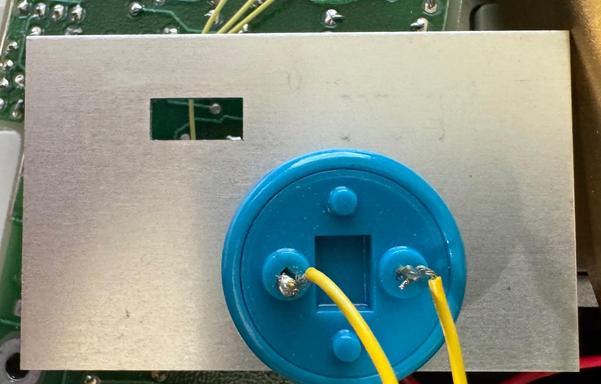
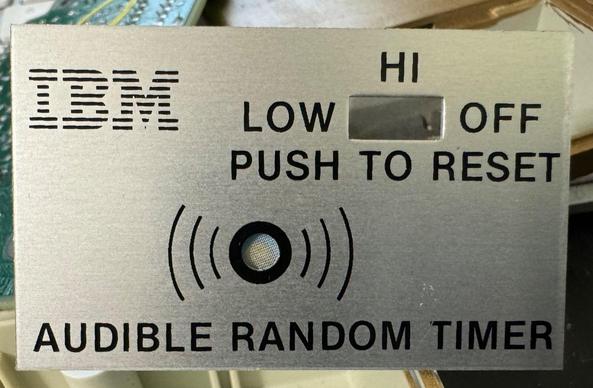
IBM Audible Random Timer lolwtfbbq thread, part 5 of however many.
How it works - detail.
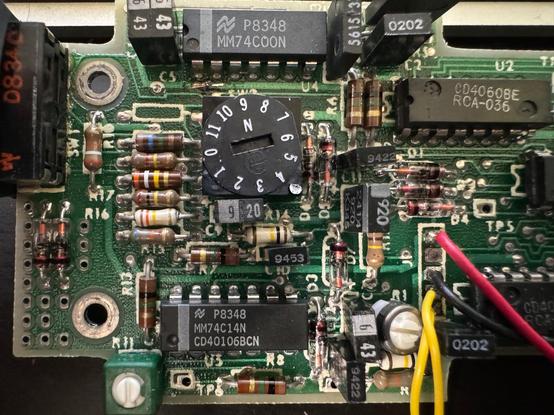
The right side of the PCB are two 4060 binary counter ships and a 74HC688 8 bit comparator. This is I think where the "randomness" is generated - assuming the two counters run at different rates, the comparator would trigger the alarm when the two counters hit the same number at the same time.
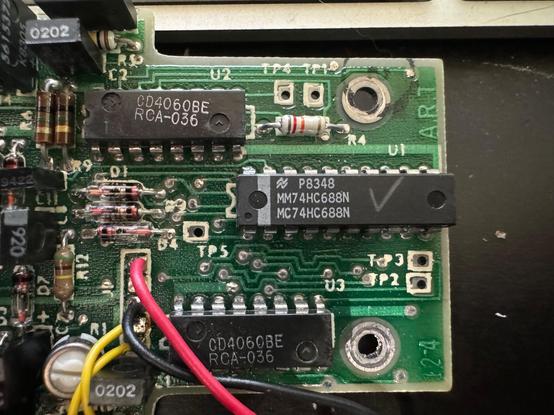
IBM Audible Random Timer lolwtfbbq thread, part 6 of however many.
R1 nearest the buzzer wires is a volume adjustment. I just realized that, and realized it's all the way down. Turned up this thing is SCREAMINGLY LOUD EVEN ON LOW.
R11 is a pitch adjustment for the alarm, and it's EXTREMELY touchy. Only about 5% of the range of the pot runs through audible frequencies, even just putting a finger on the pot will change the pitch significantly.
No idea what the 12-position rotary switch at SW2 does yet. Changing it doesn't seem to make any obvious difference so far. My theory is that switches between various resistor combinations to affect the time scale of the "random" events, but it's hard telling with so few data points so far.
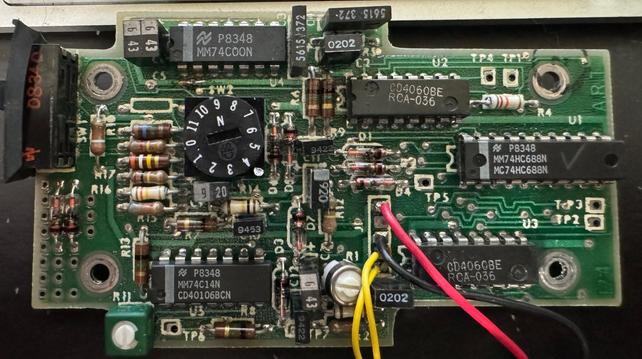
IBM Audible Random Timer lolwtfbbq thread, part 7 of however many.
Non-Audible Random Musings
All the chip dates are 48th week of 1983, meaning this device was probably manufactured early 1984 or so.
There's a belt clip, so this thing is designed to be worn or at least carried on your person. The best any of us have been able to come up with it that this was a way to keep someone from hyperfocusing on something - you get lost in your work, and are off in the weeds looking at something but maybe not realizing how much time has elapsed while you've been hyperfocusing, and this thing might have been around to remind you of the passage of time without being annoying.
IBM Audible Random Timer lolwtfbbq thread, part 8 of apparently 8.
Thats all for now until I can put a meter or logic probe on this thing to figure out more in detail how the counters operate or what that giant rotary switch does.
I'll answer any questions with my best guesses, or show more detail of the PCB for anyone that wants it.
I'm here all week. Tip your server. Try the Ceasar Salad!
IBM Audible Random Timer lolwtfbbq thread, part 9 of what is now 9.
I’ve left this thing on for almost 2 days solid. I haven’t been timing the “random” beeping, just kind of getting a feel for its scale. It will beep around 10 times in what I’d consider an “8 hour shift”.
Several people said it might have been used for task sampling, log what you are doing when it beeped, but those same people also said they’d be completely irritated if that was actually the use case, so I don’t think that’s it.
One of the most plausible explanations I’ve seen so far is that it might have been used as a “random sampler” for a manufacturing line - when it beeps, you pull the next thing off the line and send it off for validation testing. Given its wide range of randomness (minutes to hour+) and that the timing averages out to about 10-12 times a shift, that seems like it’d be a possible use.
Scope and logic analyzer (and sound samples) coming.
@philpem The ones I remember (I’m sure there were more) are:
Yellow: Factory EC (Engineering change). Applied to a board to indicate that the board was upgraded to a new EC level at the factory.
Black: Factory Configuration. Applied to a board for necessary modifications to support a specific combination of features. These were config specific, so you knew what wires to remove if you changed the machine configuration that required it).
Blue: Field EC. Engineering Change applied to a board in the field by an FE.
Pink: Pluggable jumper wires used in the field for temporary modifications or diagnostics. “Temporary” was a highly variable time span.
If you opened a failing machine and saw yellow and black wires, you didn’t really worry at all. Blue wires, you raised an eyebrow because you might be tracing out some other FE’s work. Pink wires everywhere? Call the spouse and tell ‘em you’re gonna be late.
@olireiv Those are called “heat set inserts” and are pretty popular for 3D printing You use a small soldering iron to heat them up enough to melt the plastic, stick ‘em in a hole, and let the plastic cool around them.
@jgeorge you were probably supposed to note down what you were doing it went off, preferably involving therbligs
my log would be a series of "screaming because this thing beeped at me" comments
@mekki ...you do know that the majority of my hobbies involve restoring and documenting old IBM midrange systems, right?
OH HELLO NEW BEST FRIEND
@jgeorge @mekki Oh for sure. 100% on board. I would love to just take a walk through that building (well, buildings), let alone get to do so regularly. I guess I just wonder how many of those IBMers were already IBM nerds, vs. how many became IBM nerds once they were hired and were suddenly surrounded by all of it.
I have to assume many of them. I'm sure AT&T has its share of Ma Bell geeks as well.
By the way... y'all hiring? :p
@jgeorge i have seen a claim that these were used in speed shooting competitions; the semi random timer was the starter alarm, so that the competitors could be gauged from an unpredictable start time.
Plausible(?) but unverified.
I came on to say the same thing, however in Single Action Shooting, once the timer goes off, it also senses the times between shots, for a performance indicator. I've got one floating around here, somewhere...not IBM.
This one may be to signify time to take measurements, in a study that requires a random time selection.
I’m sure that the printed manual for this thing will have several numbered pages with the only text being:
THIS PAGE INTENTIONALLY LEFT BLANK
🙂
@jgeorge So cool!
https://www.reddit.com/r/whatisthisthing/comments/1e960ti/ibm_audible_random_timer_vintage_electronic/ has some good ideas.
Have you tried running it? The length of the random intervals might give you an idea of its intended use.
I love the way they put some perfboard into the PCB design and used it with the bodge wires! Maybe it's a prototype, if they were so confident they'd need to bodge it? :)
Anyway, such a neat find, and some very cool archaeology by you.
@th I saw a restoration of one on YT, and I agree its up there in its weirdness. But I feel the ART still wins out because although both products tell you what they DO ("I calculate cheese slices" "I randomly make noise") at least you can tell WHY the Calculating Cheese Slicer does what it does. Nobody so far seems to have any idea why the ART exists or what problem it was made to solve. :)
Its less annoying with the pitch of the beep potted down like half an octave though. :)
Well for those times the recipe says "cook for a random amount of time", I guess ?
 Marsh Ray
 geekpower
 awight
 xxx
xxx leyrer
 tecleandor
 Eli the Bearded
 Pyxaron
 O! ver
 My name is Gordo
 Phil M0OFX
 Stewart Russell
 Mekki
Mekki Benjohn
 Jazz Rabbit 🐇🏳️⚧️
 Chris
Chris Maier Amsden
 Stu Duerson, machina exo deus
 Irenes (many)
 Rufus J. Cooter
 Tormod Halvorsen
 Simon Frankau
 Dan Neuman 🇨🇦
 Trammell Hudson
 arclight
 Badscrew
 SuperIlu
 Lysander il breve
 Fiona Ebner
 JamesB
 Richard W. Woodley ELBOWS UP 🇨🇦🌹🚴♂️📷 🗺️